
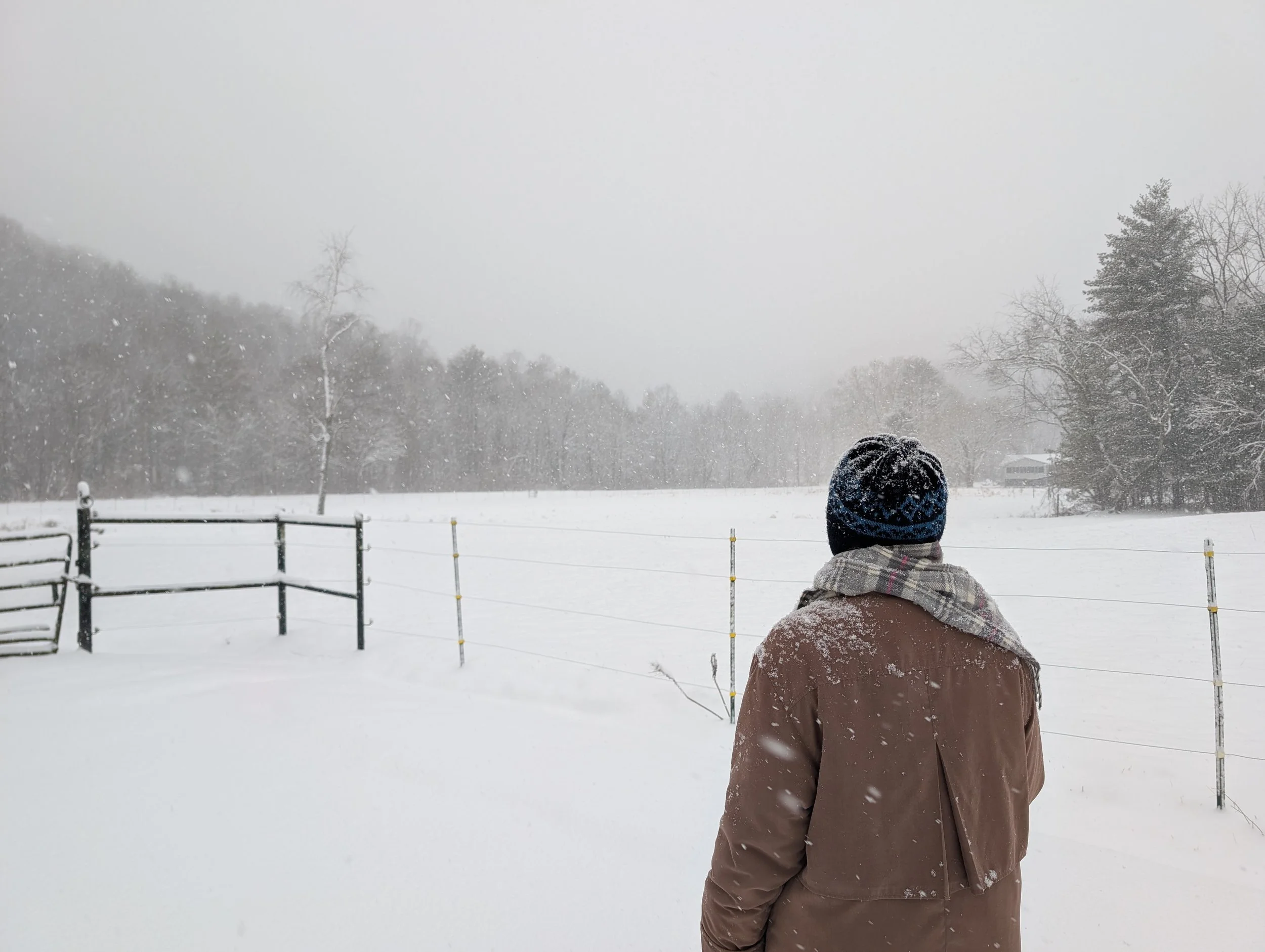
Walking in the snow with Sue yesterday, overlooking the field, and, beyond, Ecusta trail at the end of our street
Many of our neighbors would not agree with this statement, but we love snow. Growing up in Rhode Island, grad school in New Hampshire, living in the western Philadelphia suburbs - even a few surprise whoppers while we were in Raleigh - there is something magical about a snowstorm. With 6 inches of very light powder on the ground, a 10 degree morning with 20 mph winds, but snug and warm in the corner sunshine of our living room, this seems the perfect time to dig a little deeper into my 2026 garden plans.
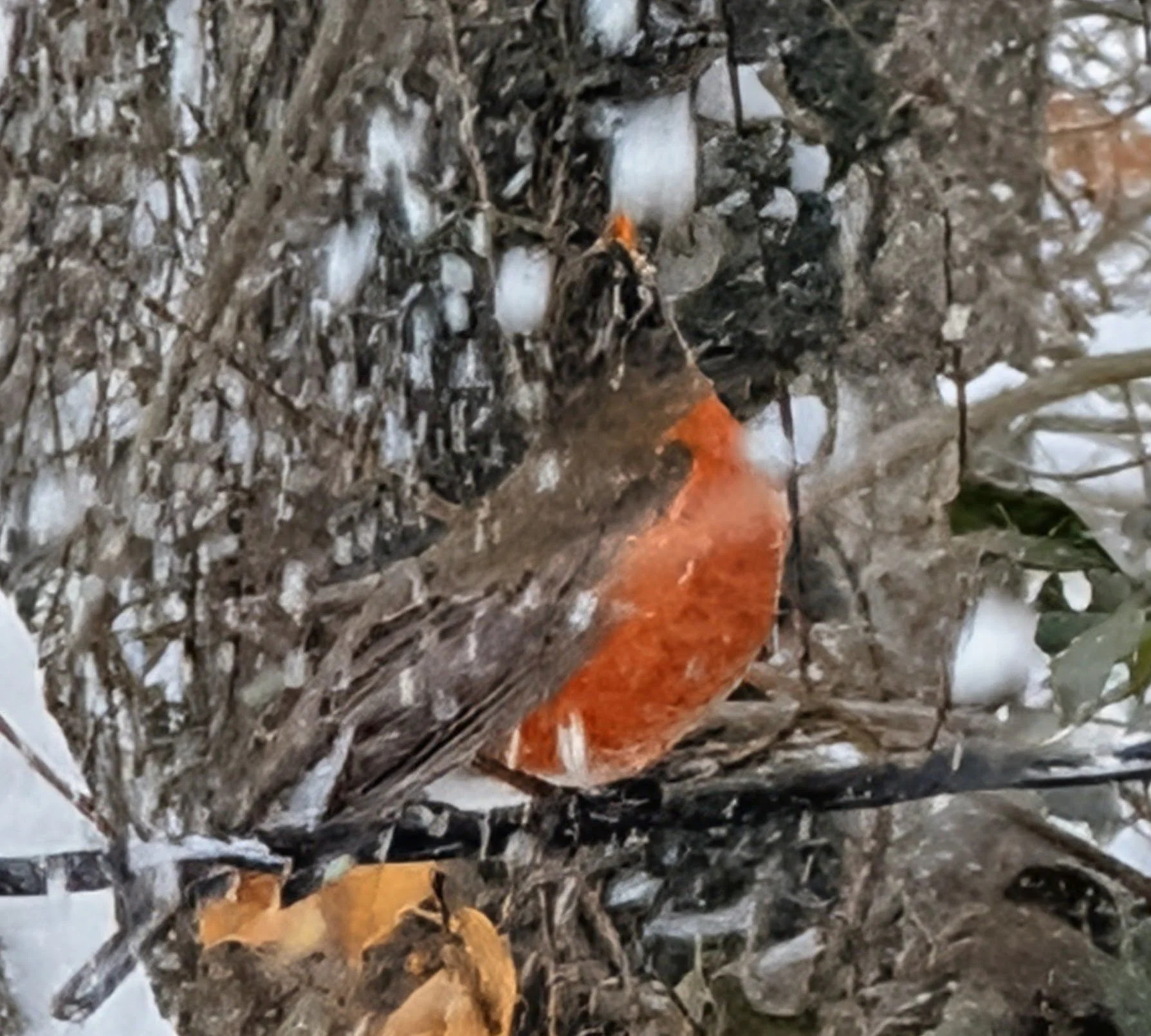
Robins were everywhere yesterday, focusing on the ripe Holly berries on a few of our trees.
Seed starting, for me, is as complicated as fulfilling seed requests - so many choices, so many seed lots spanning so many years. Some local folks have been in contact about my spring seedling supply possibility. I thought I would use this blog to go detailed on a few varieties I will be growing, talk about the progress on some breeding projects, and provide a high level overview of what I may be seed starting in early March.
First thoughts on seedlings that I will have in the spring. I always overplant, so some of these will be available as seedlings for those local to me who are interested. My goal is to start seed March 1, start to transplant late March, and have plants ready mid to late April through mid May - depending upon weather/temperatures.
Indeterminate varieties Cherokee Green, Brandywine, Lillian’s Yellow Heirloom, Sun Gold F1, Rosella Cherry, Aunt Ruby’s German Green, OTV Brandywine, Dester, Polish Bling, Mary’s Favorite, Rufus Rainbow, Cherokee Purple, Cherokee Chocolate, Captain Lucky, Lucky Cross, Potato Leaf Yellow, Lucky Bling, Ferris Wheel, World War 2, Green Giant, Earl, Giant Syrian, Cancelmo Family Heirloom, Egg Yolk, Mexico Midget, Sullivan Rose, Mullens Mortgage Lifter, Halladay’s Mortgage Lifter, and Earl.
Dwarf varieties still to be determined, but will include Dwarf Sweet Sue, Rosella Purple, Dwarf Gloria’s Treat, Uluru Ochre, and Dwarf Eli’s Surprise. What I have will depend upon my seed supply, but I will aim for a good color blend. Expect a few dozen varieties total of Dwarf Tomato Project offspring.
Digging a little deeper - which seeds to plant on a few selected varetiies
It is always fun to decide which seeds to plant for those favorite varieties that have been in my collection for many years. Here we go - I am just going to do Cherokee Purple in this blog. Future blogs will discuss my strategy for Cherokee Chocolate, Lucky Cross, Ferris Wheel, Green Giant and Cancelmo Family Heirloom.
Cherokee Purple - I have roughly 60 seed samples of saved Cherokee Purple since first growing it in 1990. There are three main branches of saved seeds, all from seed sent to me by J. D. Green. They are T90-10 (the 10th variety I saved in 1990 - my introduction to the still unnamed variety), T91-27, and T93-2. All of these were grown from seed #287 - now long gone (all that remains is the letter that came with the seeds).
The most recent grow out of the T90-10 line is T16-103 - now 10 years old. Of the T91-27 line, the most recent is T21-33. The T93-2 line is most recently represented in T25-5. But I want to ensure I have the oldest possibly germinating seeds from each of the 3 lines tested.
Therefore, my grow out strategy will likely be T25-5 for seedlings in number, and choose one of the following to grow in my garden - from the T90-10 line T16-103 (noted above), from the T91-27 line T6-104,and from the T93-2 line T16-102. I will wait to see germination before I decide which to grow myself.
Project work - the Captain Family (Sun Gold F1 X Captain Lucky)
Growout of the F1 seed of my cross provided me, and all others to whom I sent seed, a large orange cherry tomato - except for my friend Alex. I sent him an F1 seedling and he ended up with a large red cherry! That is sed #8169 in my collection, and I will grow out a few, hoping to choose a regular leaf and a potato leaf F2 for my garden. I won’t grow any more of my own F2 seed from the large orange, since I sent seed to many others to do so, and there are plenty of F2 selections to explore in 2026.
I hope to grow one each of the following F2 selections found by me, or sent to me by others. T25-13 was a potato leaf oval yellow/orange/pink cherry, T25-36 was a regular leaf mostly round green ripening to purplish cherry. 8092 was described as orange, no leaf shape specified. 8095 is a regular leaf orange. 8096 is a red cherry, leaf shape not specified. 8143 is a potato leaf purple cherry. 8148 is a potato leaf red cherry, 8149 is a regular leaf orange cherry. 8154 is a potato leaf bicolor mini beefsteak. 8155 is a larger, flat orange regular leaf cherry. What fun this will be - all will be grown in containers; it is not about yield so much as seeing what color, shape, size and flavor of tomatoes emerge.
In summary - I will have 2 F2 plants from Alex’s red fruited hybrid, and 10 F3 selections. There will be so much to learn from this project!
Project work from the Vary, Matey and Peppy families
Most of this work will be done by others this year, as it won’t be a focus. I did want to do a report on where we are, since it is quite interesting, and promising.. They are all crosses I made with Dwarf Walter’s Fancy, in effort to expand the tomato types with variegated and/or chartreuse (or both) leaves. Vary used Dwarf Blazing Beauty, Matey used Dwarf Choemato, and Peppy used Dwarf Zoe’s Sweet as breeding partners for Walter’s Fancy.
I will do a more extensive report on findings to date, but to summarize what I’ve been sent or saved -
Vary family - 12 different F3s, of which all are potato leaf (as expected) and 6 are variegated. There are fruit colors of ivory, red/yellow bicolor, yellow, red and light and dark shades of orange.
Matey family - 11 different F3s, of which all are potato leaf (as expected), and 4 are variegated. There are fruit colors of yellow, red, ivory, and red/yellow bicolor.
Peppy family - 10 different F3 selections, of which all are potato leaf (as expected). 3 are chartreuse leaf, 2 are chartreuse and variegated, 4 are variegated and 1 is normal green color. Fruit colors tend to be ivory or pink, with one yellow. Some of these have been named. Dwarf Eli’s Surprise, found and named by me, is chartreuse variegated potato leaf with medium to large ivory fruit.
There are also 5 F2 selections that are from any of the above 3 families - a labeling error by me caused the mix up. They are all potato leaf and variegated, with fruit colors of orange, pink, ivory or yellow/red bicolor.
We therefore have a project that has gotten large fast. I’ve sent out lots of seeds from the above - and some will still be exploring the F2 seeds I sent them to find more “good stuff”. But we already have 38 different F2 selections to work on!
Let’s leave it there; the above represents a lot to chew on. Clearly, the Dwarf Tomato Breeding Project is not finished. And I didn’t even touch upon other families of indeterminate heirlooms X indeterminate heirlooms, such as the Epic family (Cherokee Purple X Lillian’s Yellow Heirloom). We will cover that in a future blog.
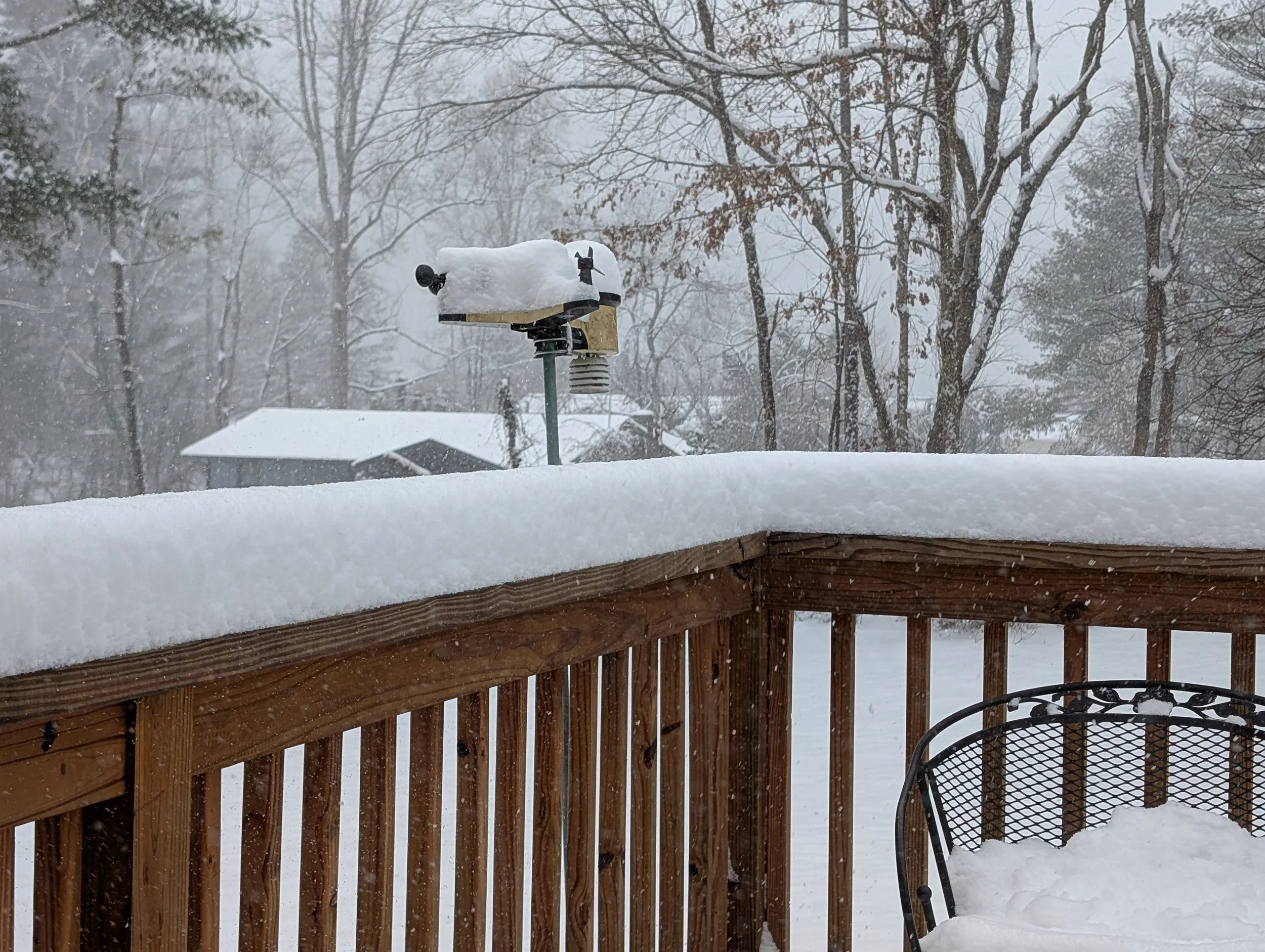
Our 6 inch snowfall, view from the deck last evening at the end of the significant precipitation.