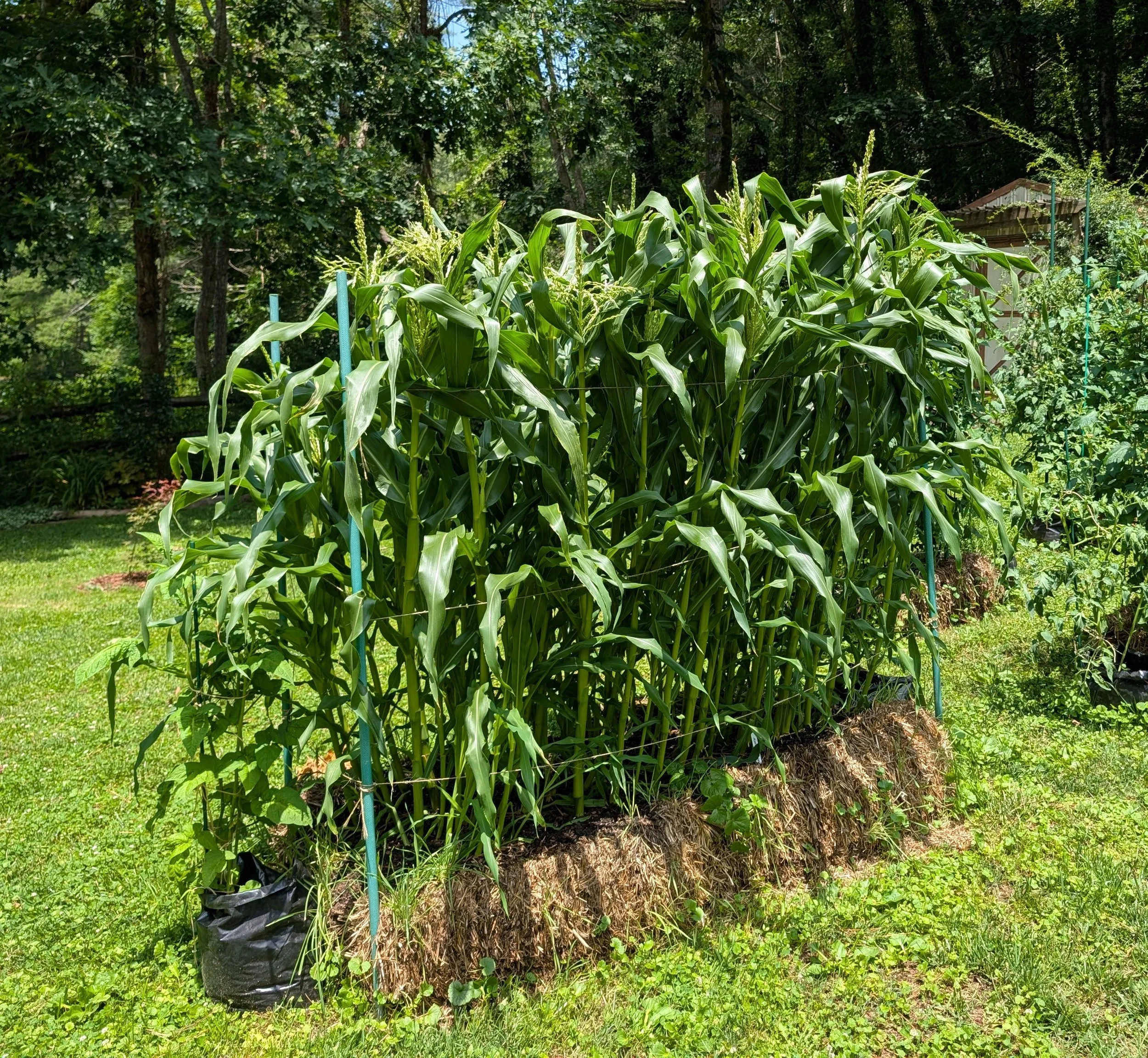
Garden Updates

...and now for the rest of the story! Review of all other tomatoes in the 2026 garden - as well as the other crops. Final 2026 Garden Review

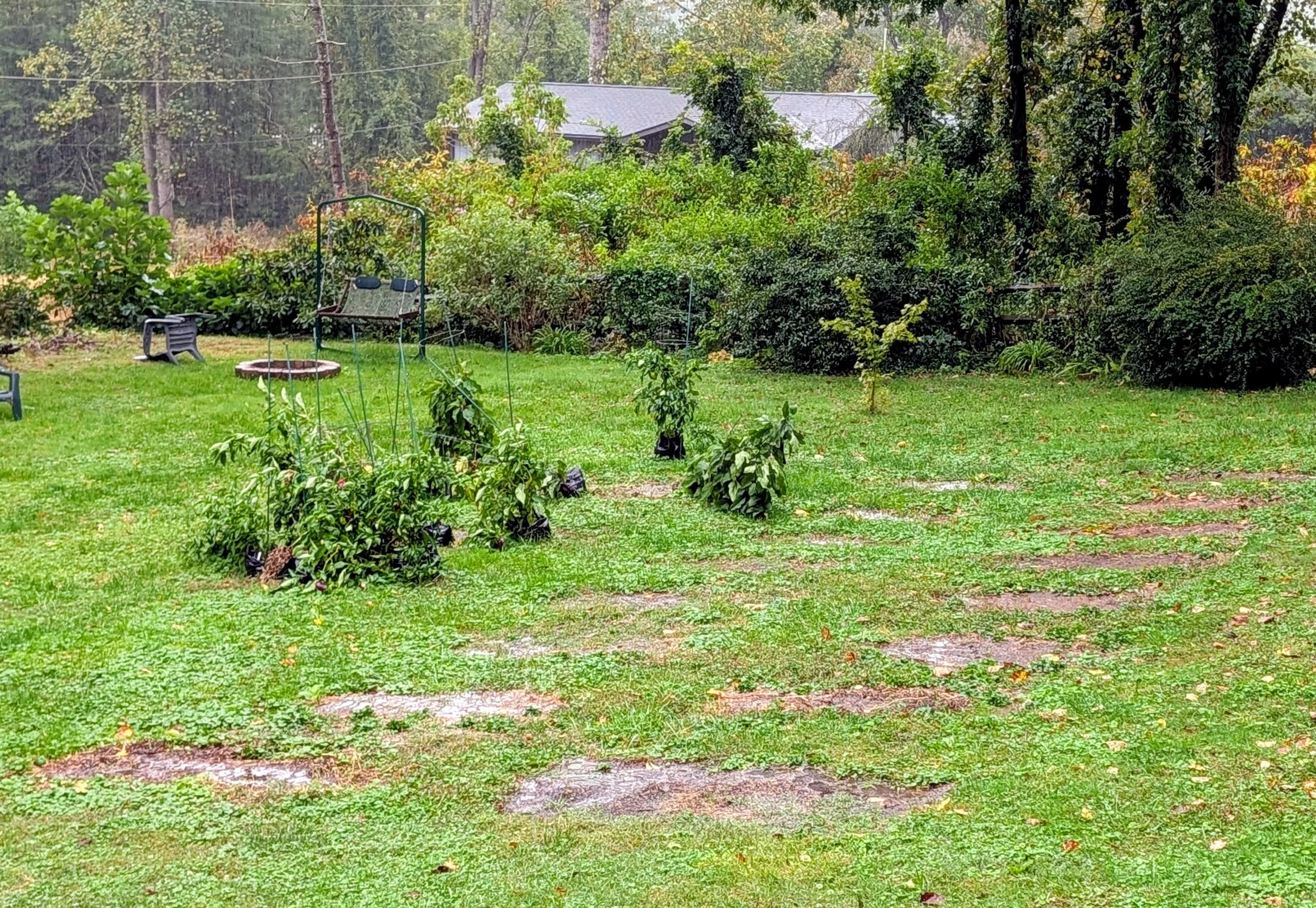
A few peppers and eggplants - the garden on a soggy October afternoon

This blog is now essentially finished - I spent a few hours just now filling in some missing information. If anyone finds errors or omissions, please let me know!

A few things remain in the garden, but most plants have been pulled and the strawbales and grow bags removed. We for the most part have our back yard again. I think Eli - and our dogs - miss the maze that sat out there spring and summer. It sure is easier to mow the lawn.

This is going to be one of those epic-sized blogs that captures my full 2026 garden experience (except for the Captain project, well covered in my last blog). Overall, the grade I would give my 2026 garden is a solid “A”. I harvested seeds from just about everything. Flavors were excellent, yields were sufficient, and surprises abundant. Rarely is one of my gardens so full of surprises, and seeds saved will lead to some exciting new tomato releases, given some selection work. I will need help going forward, for sure! My 2026 garden is likely the last of the really ambitious gardens in terms of number of varieties and plants. It will be a gentle, gradual slope downward after this.

I will to carry out my garden review crop by crop. As to pictures, that will be difficult for everything I grew, but I will do my best. Tomatoes are in the best shape for pictures to share. Let’s jump right in!

Garlic - The bulbs I planted were not as big as usual (they are all saved from my garden), and I put them into two of my raised beds in September. The squirrels created a bit of havoc with them, and it is clear that the weather created challenges. I harvested whatever scaped in June, and we are eating it now. I don’t expect to have any to plant for next year’s harvest. It may be time to take a year off from growing garlic.
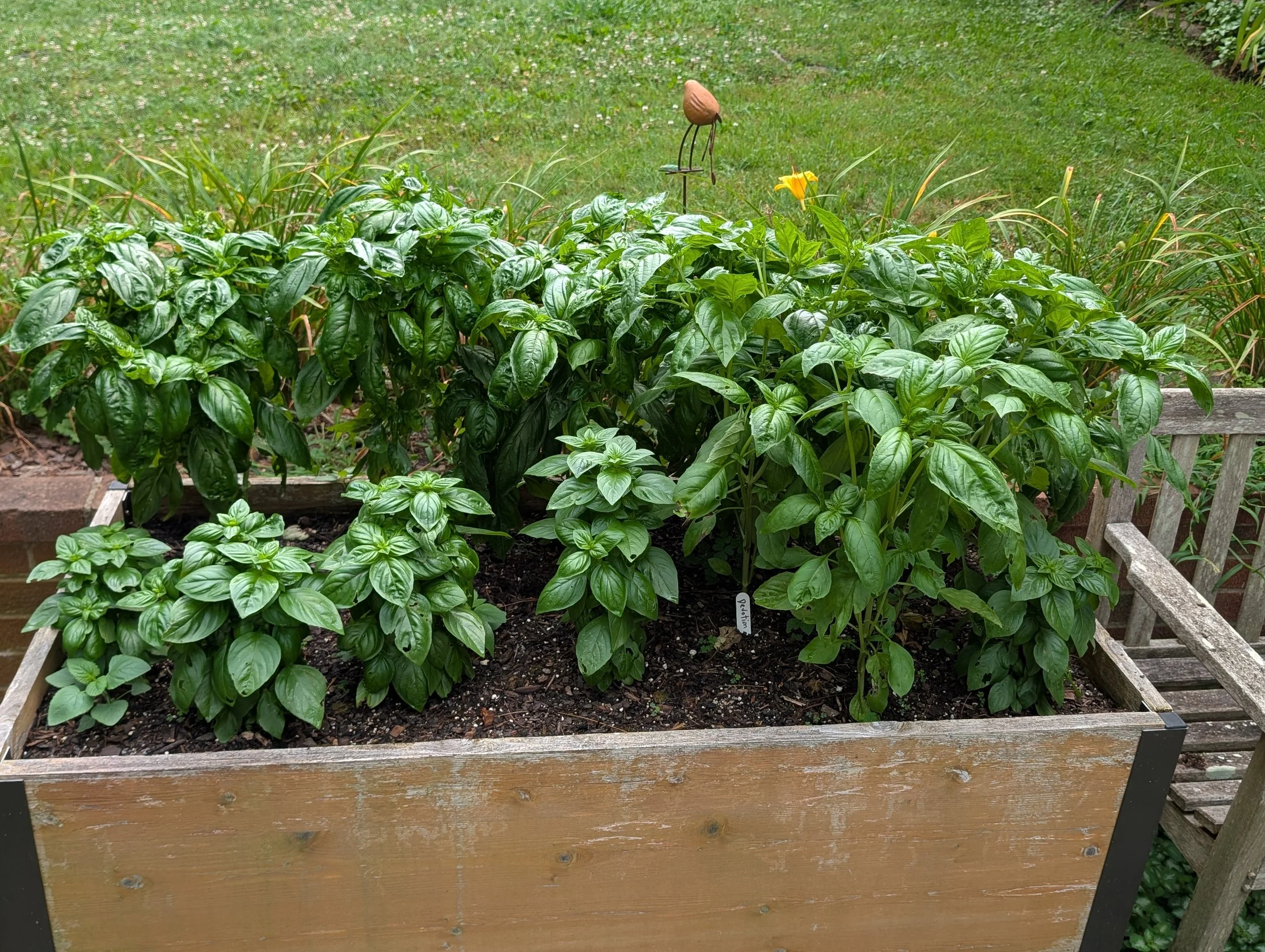
Three types of Genovese basil in our elevated raised bed

Basil - my basil this year, grown in a raised bed and some in terra cotta pots, was a bit of a mish mash. I planted seeds of Emerald Towers and the mildew resistant recently bred Devotion and Prospera, and had some plants from a pot we purchased at Trader Joe. My seeds were not the freshest so I had spotty germination. But, given all of the above, we had a very nice stand of basil that found lots of use in our cooking, as well as a big recipe of pesto that is now in our freezer. I just noted that there are newer mildew resistant varieties, such as Obsession, Passion and Piedmont, so I will switch up my basils next year.
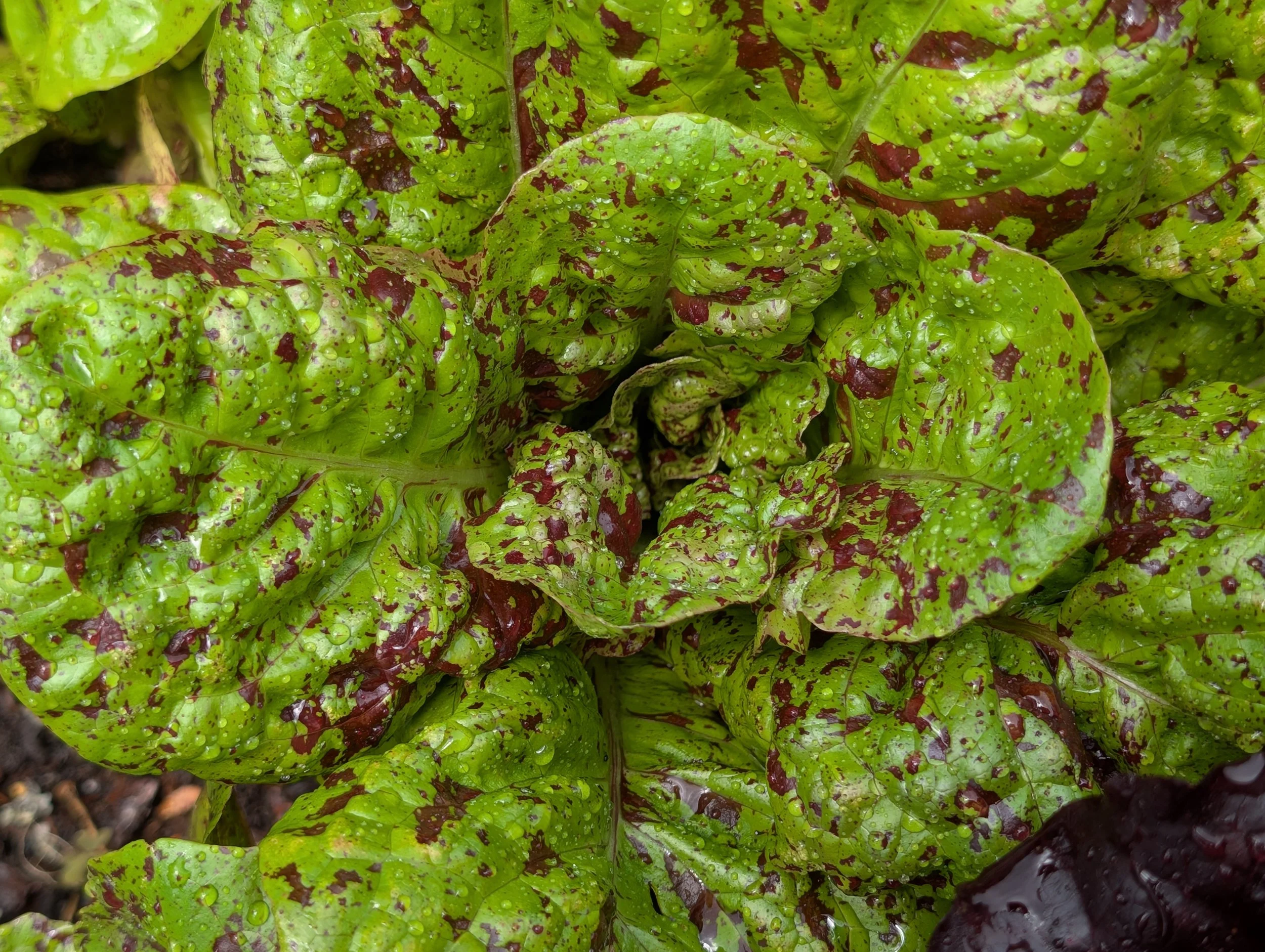
Perhaps our favorite of the various lettuces we grew

Lettuce - We had lots of lettuce and lots of salads, with two plantings. I used varieties sent to me by my friend Gail - Frank Morton bred varieties Zilla, Mix, Funky Purple and Wavy Green, as well as Tall Dark and Handsome. Germination remains great - we love the mix of colors. There is simply nothing like home grown lettuce.
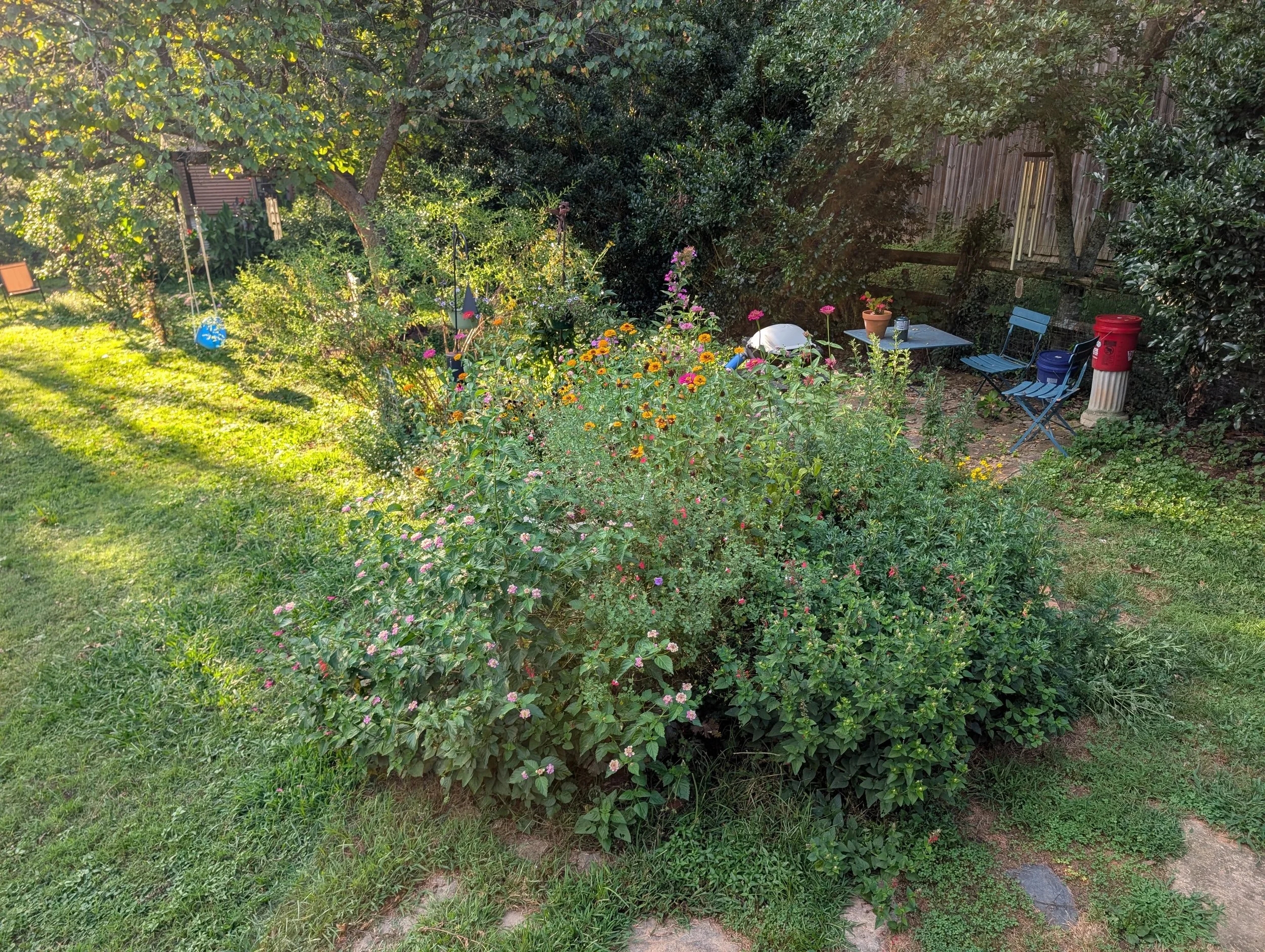
Our super-crowded perennial garden in late September

Flowers - aside from the various perennials in our gardens that we’ve had for years, the main annuals I started from seeds are a number of different Zinnias, and Hyacinth Bean for our trellis (aka lablab). I really like the Oklahoma mix of Zinnias. They are all still going strong, and attracting lots of bees and butterflies. My friend John sent some plants of a tall orange Marigold, an ornamental grass, and a red strawflower. They are doing just fine, and I appreciate John’s generosity.
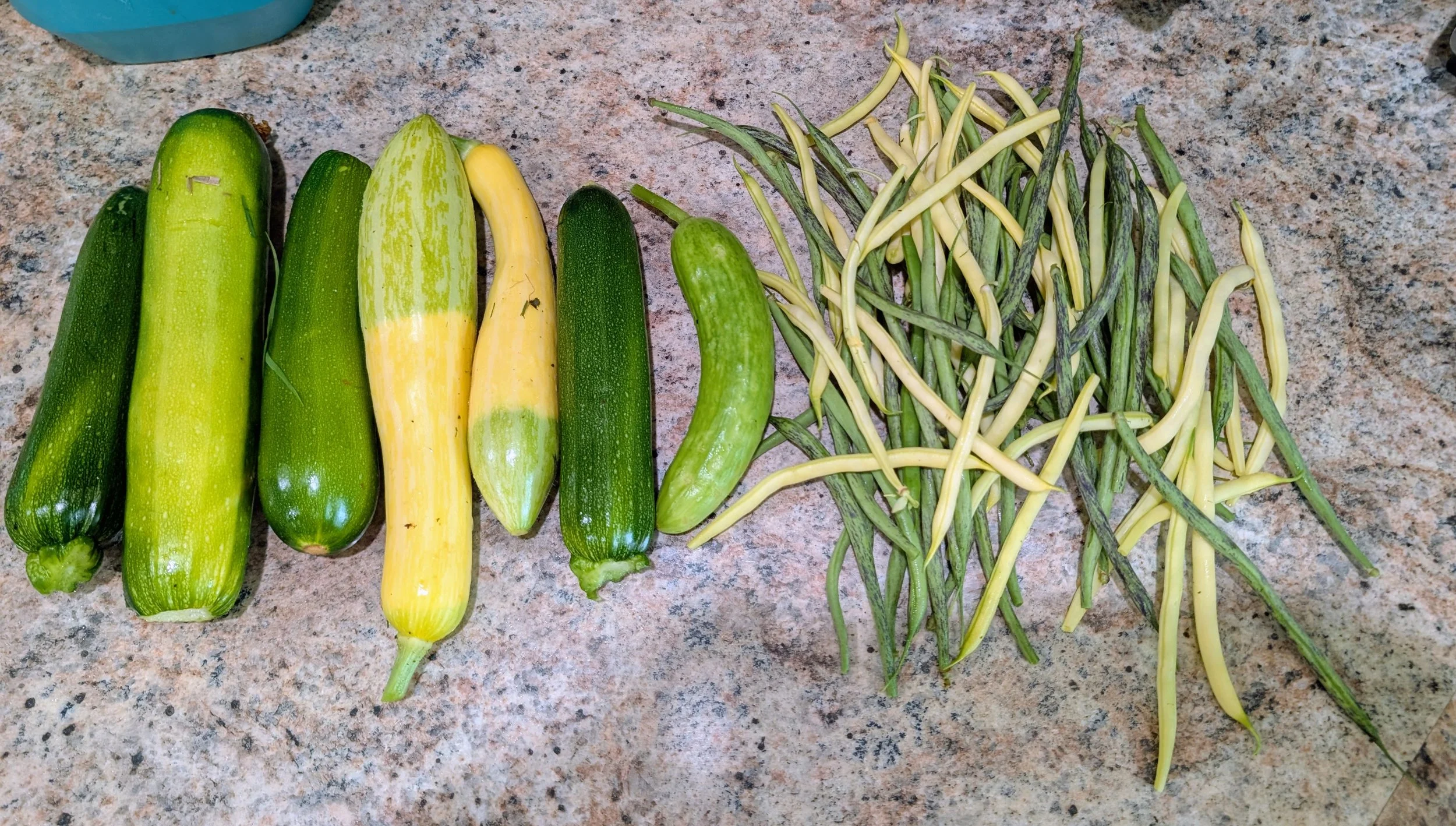
Squash, cuke, and bean harvest in June

Snap Beans - These were not as successful because the seeds were a few years old - low initial germination led to some replantings. The three varieties I chose to grow were Goldilocks yellow snap bush, Marbel striped filet bush snap, and Jade, a long green snap bean. I will change things up for next year for the green snaps, but Goldilocks is a must every year.

Cucumbers - Weather and disease (probably spread by cuke beetles) got the best of our cuke plants and crop. I grew the wonderful hybrid Deli Star, seeds coming from my UK garden friend Sam. The plants never looked particularly happy and yield was way off. I think we are going to give cukes a break next year.
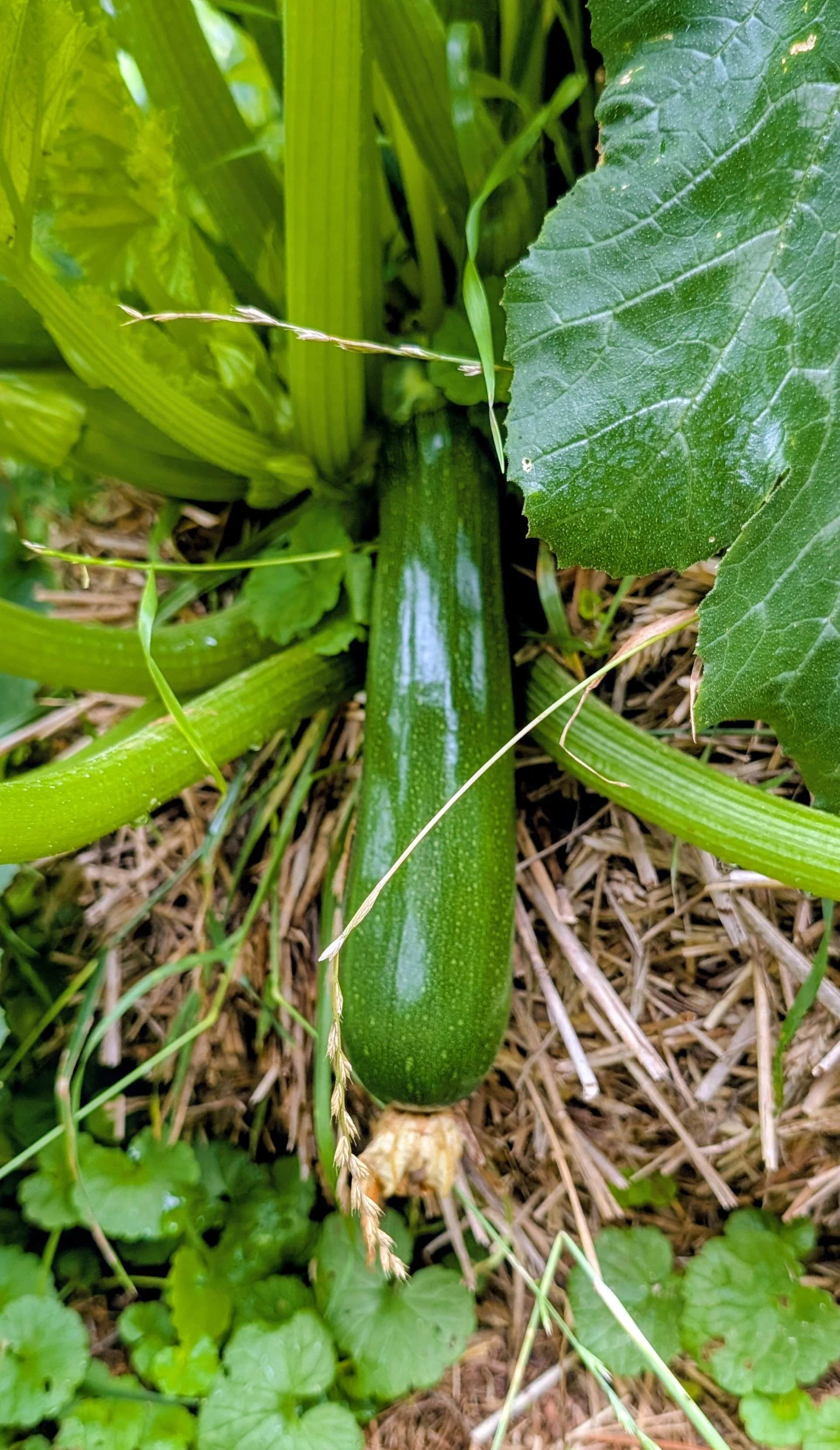
Green Machine hybrid Zucchini
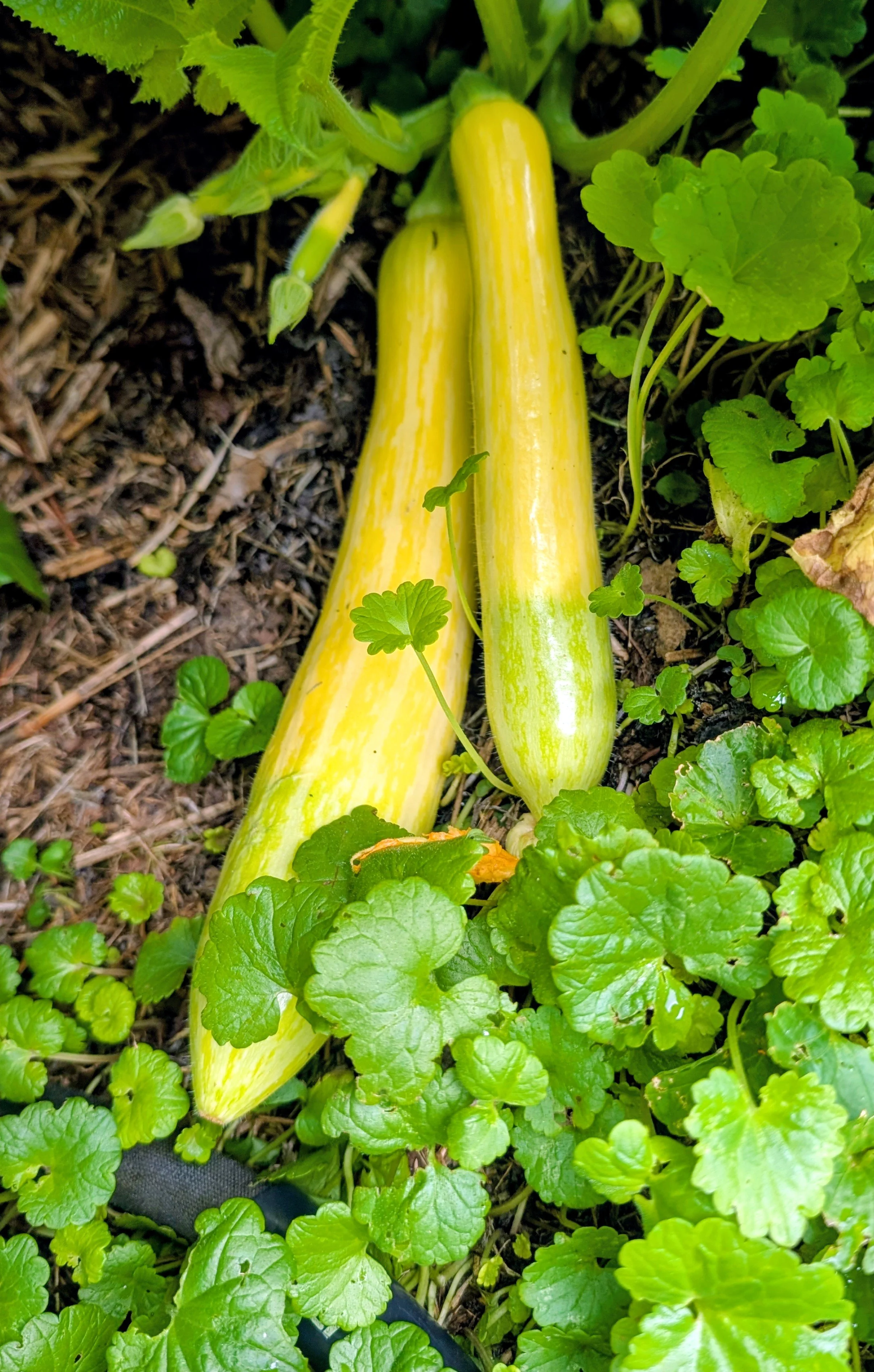
Zephyr hybrid yellow summer squash - our favorite

Summer Squash - I chose the yellow summer squash Zephyr, and green zucchini Green Machine. It is time for me to get some new Zephyr seeds. As usual, the yield of squash was more than adequate despite cutting way down on plant number (just two plants of each). I think Green Machine is now my zucchini of choice. Zephyr is a must in our gardens.
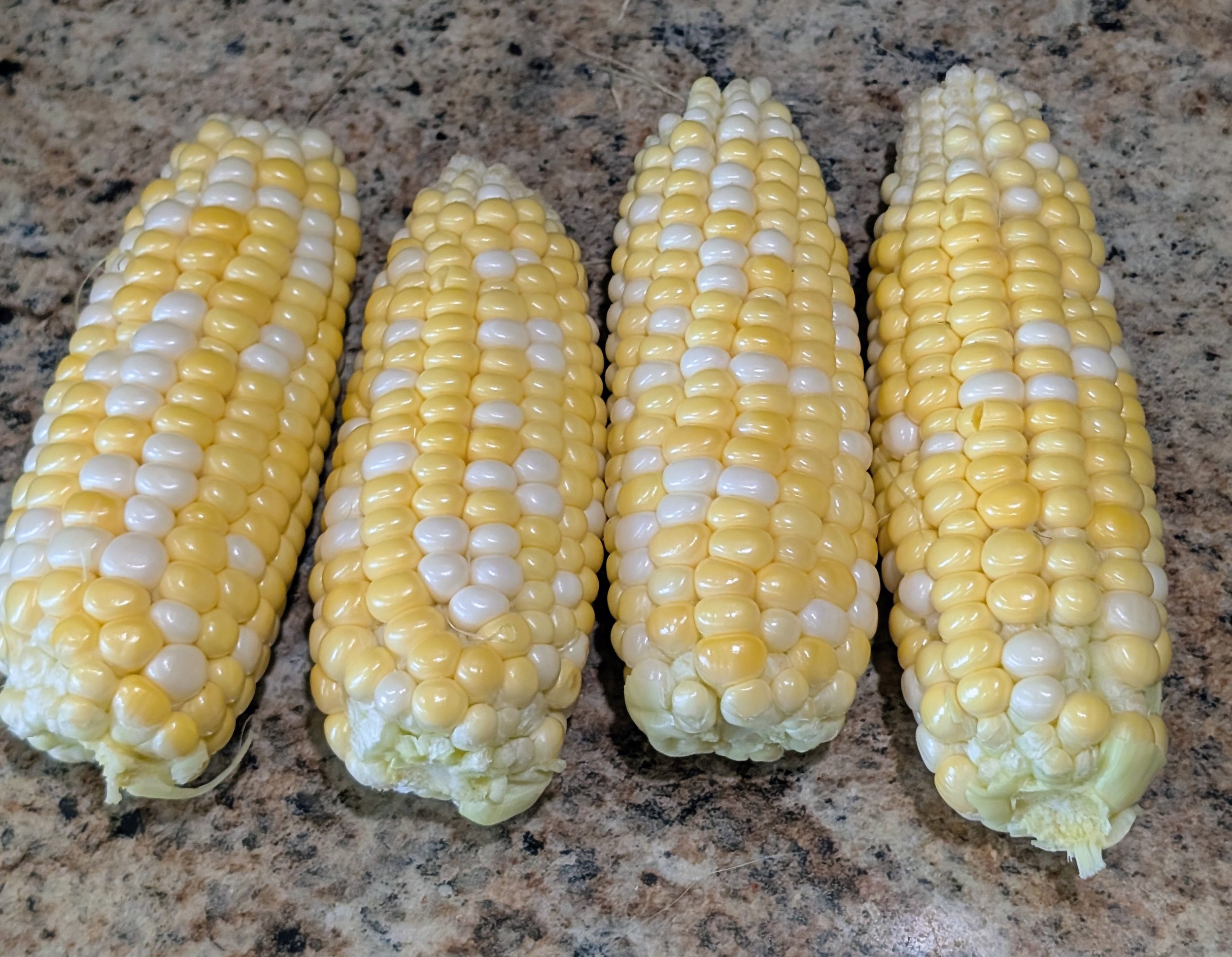
The smaller ears of Sweetness hybrid.

Corn - my new method of 2 pairs of 2 bales, rather than a block of 4, worked fine. The varieties grown were Jackpot and Sweetness, both enhanced sweetness bicolor hybrids. The yield of each was fine, but we preferred the longer ear of Jackpot. I think I will skip corn next year.
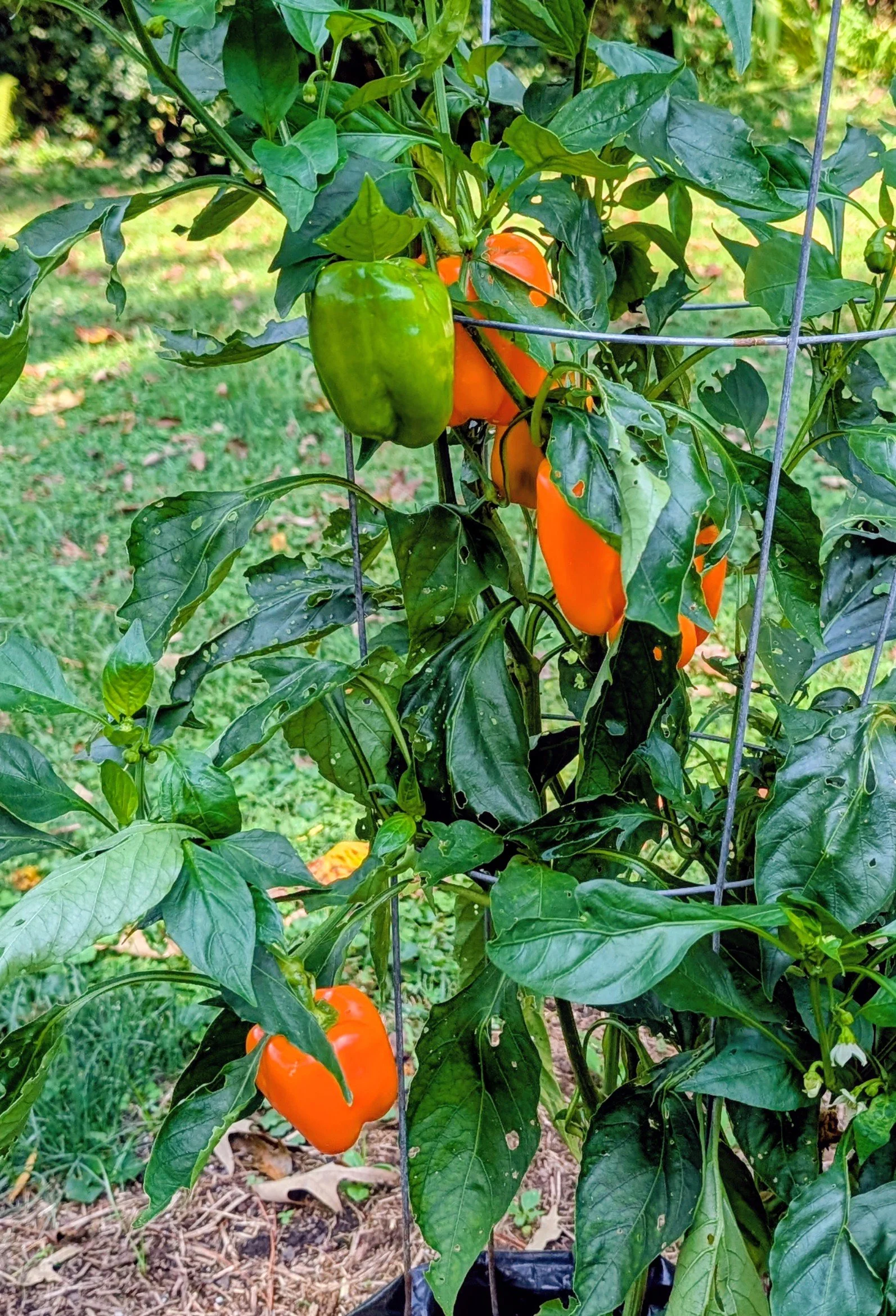
Orange Bell pepper
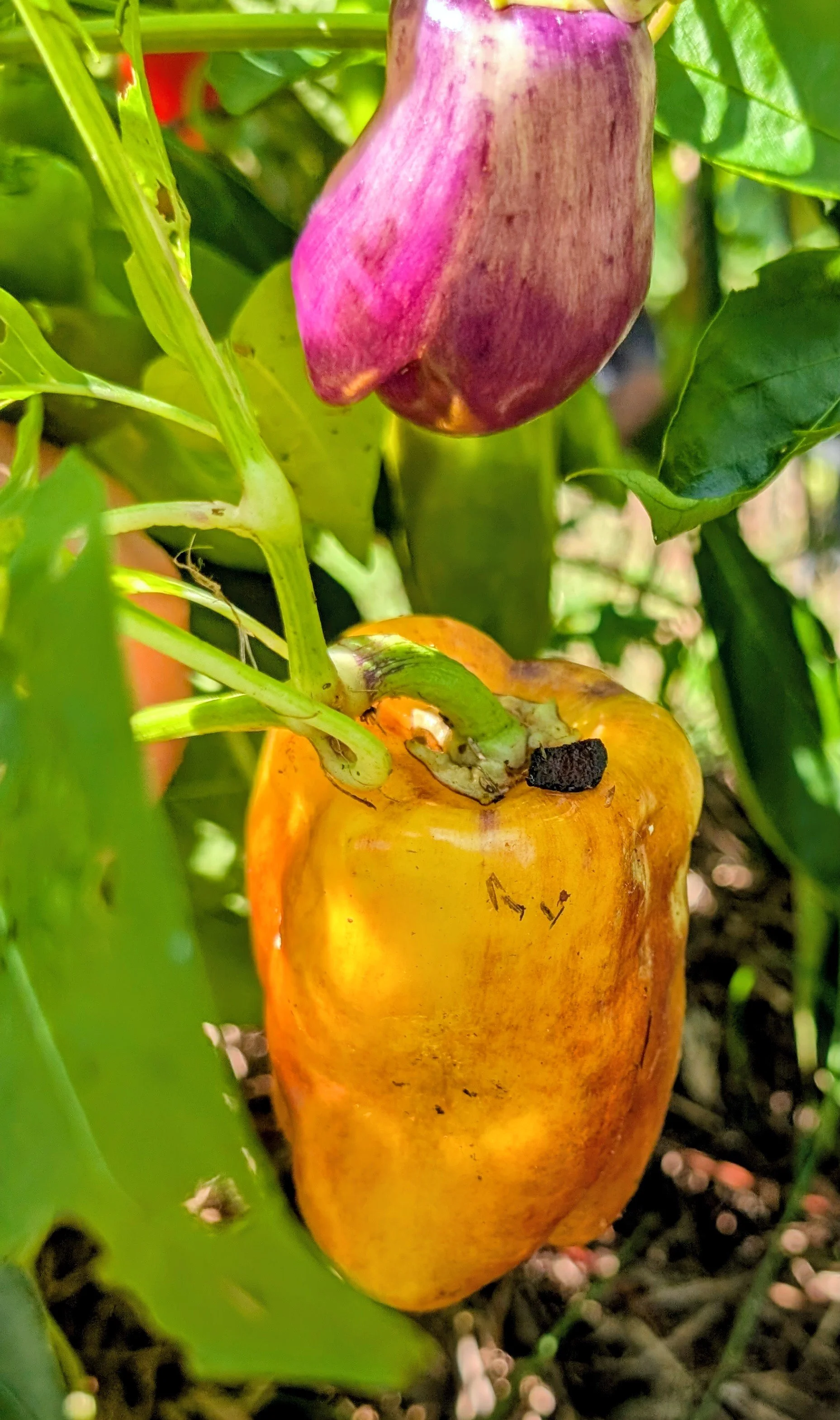
Fire Opal pepper
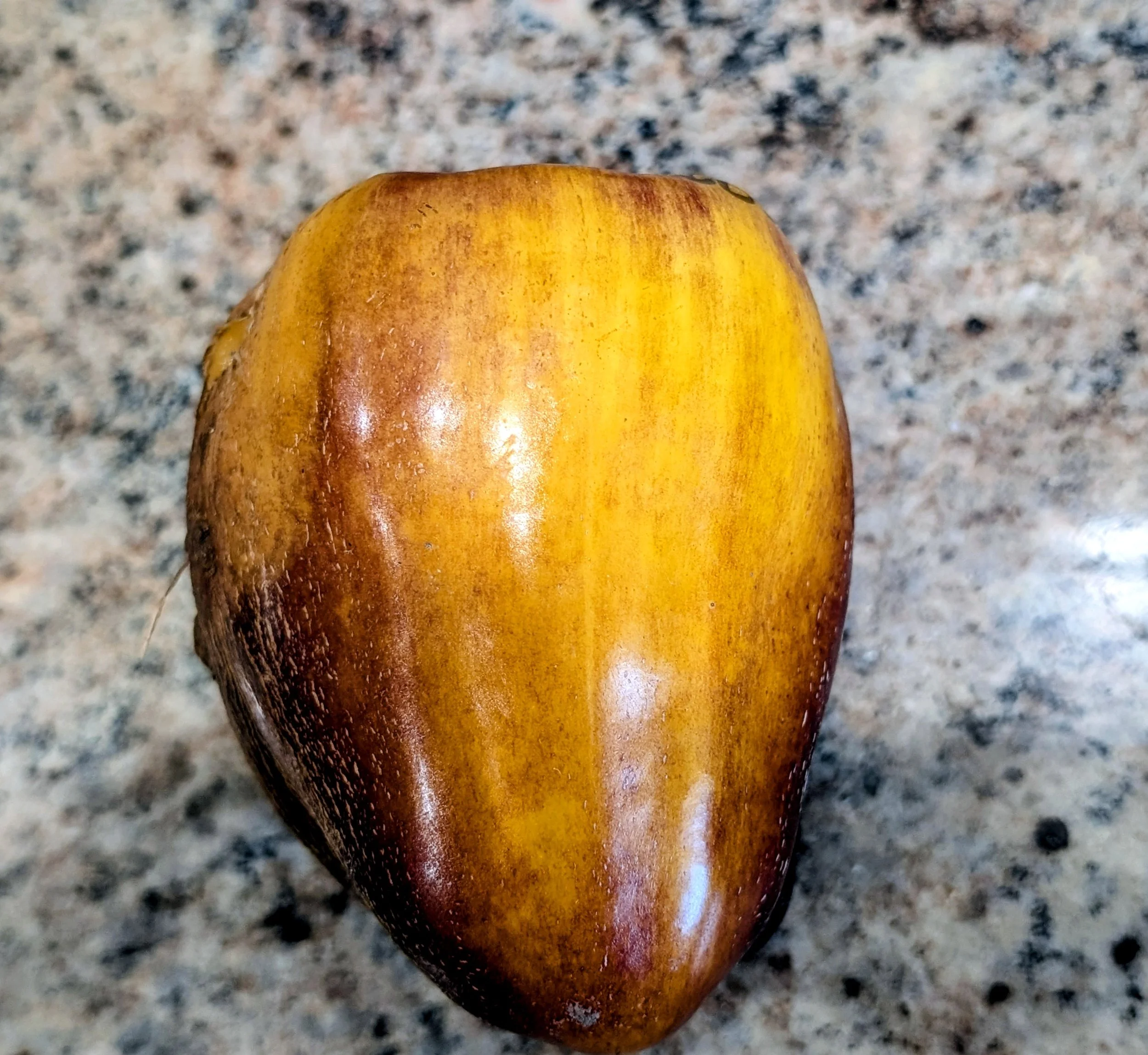
Later picked Fire Opal on its way to gold
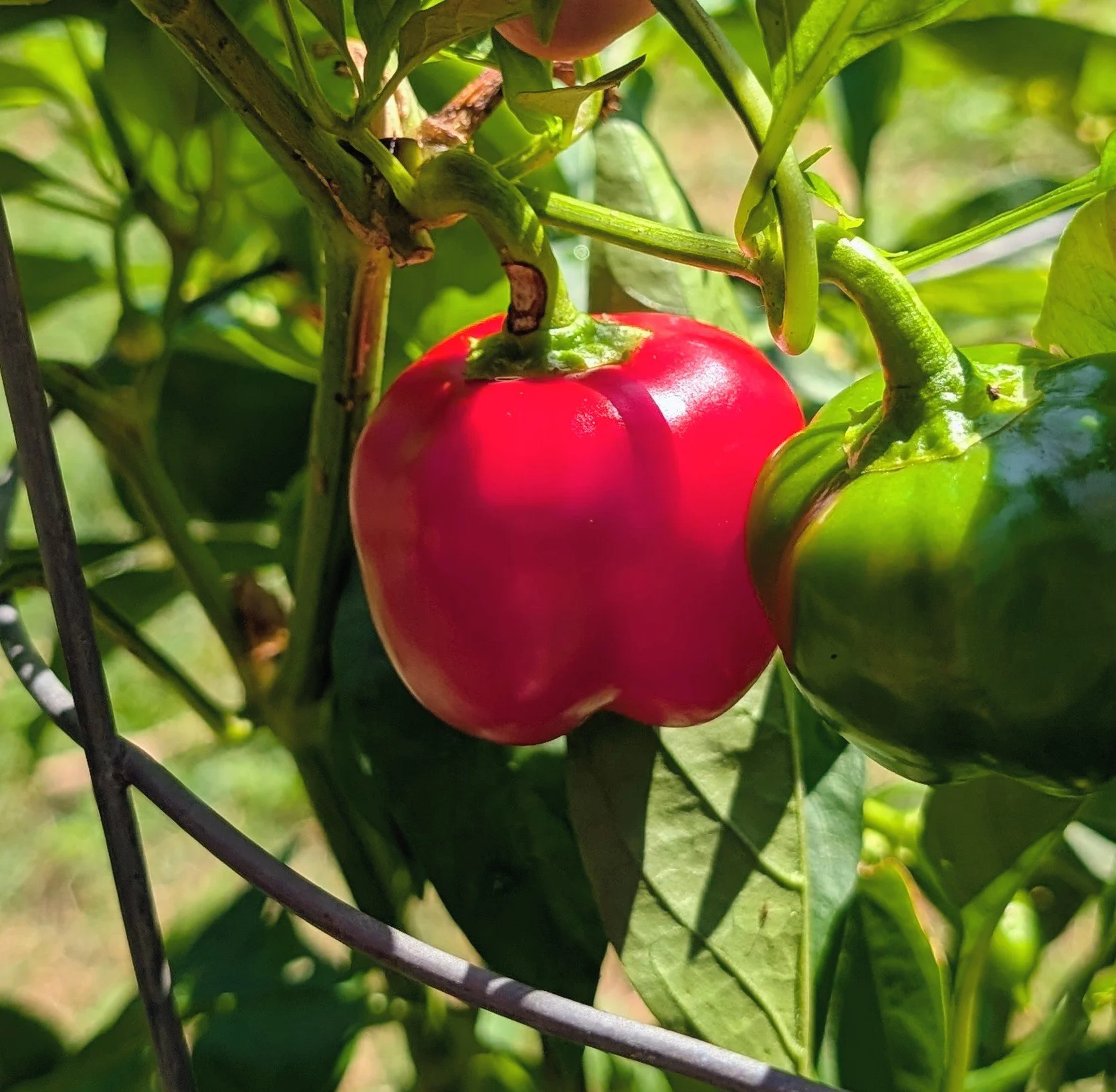
Snackabelle pepper
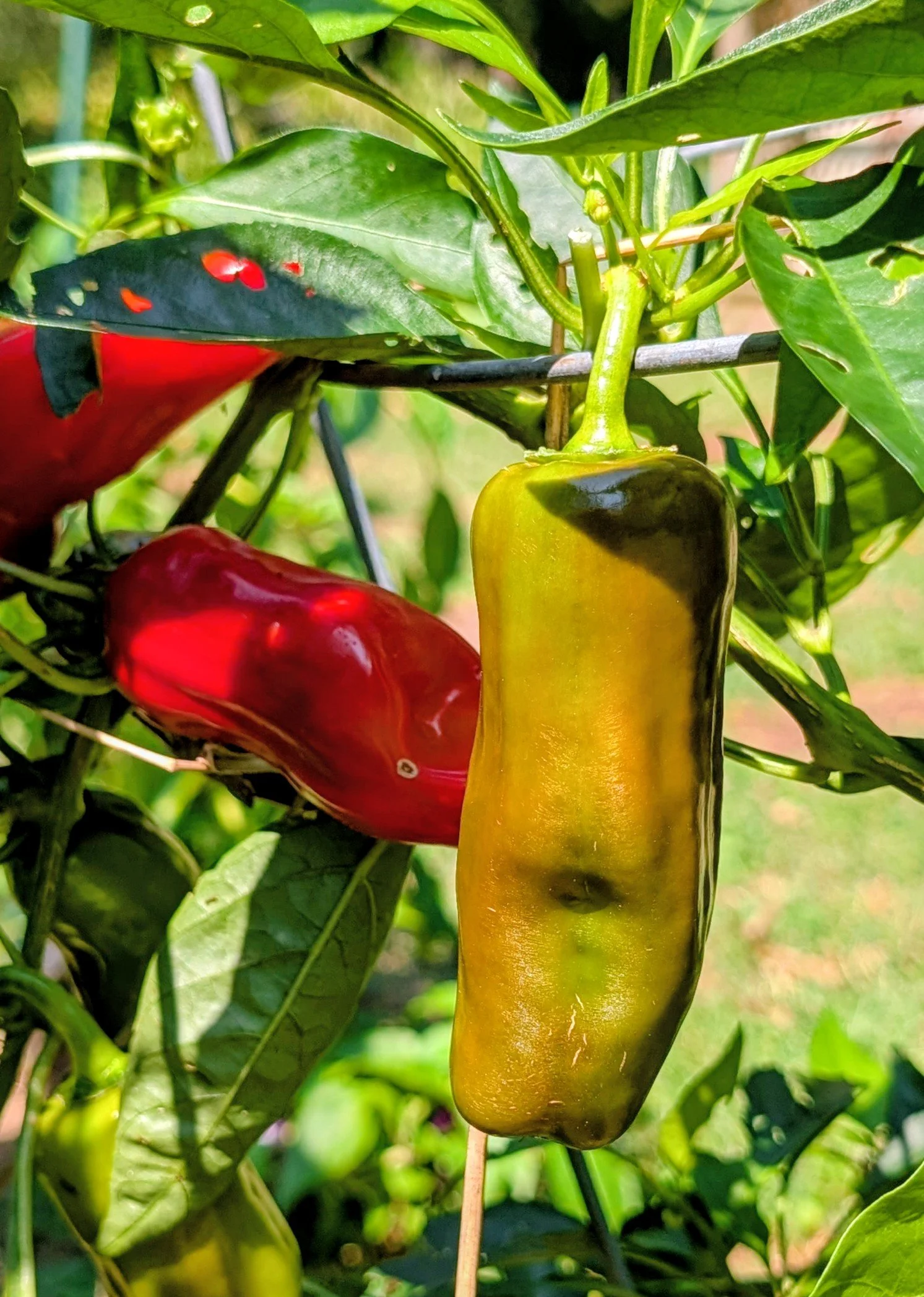
Shishito cross pepper
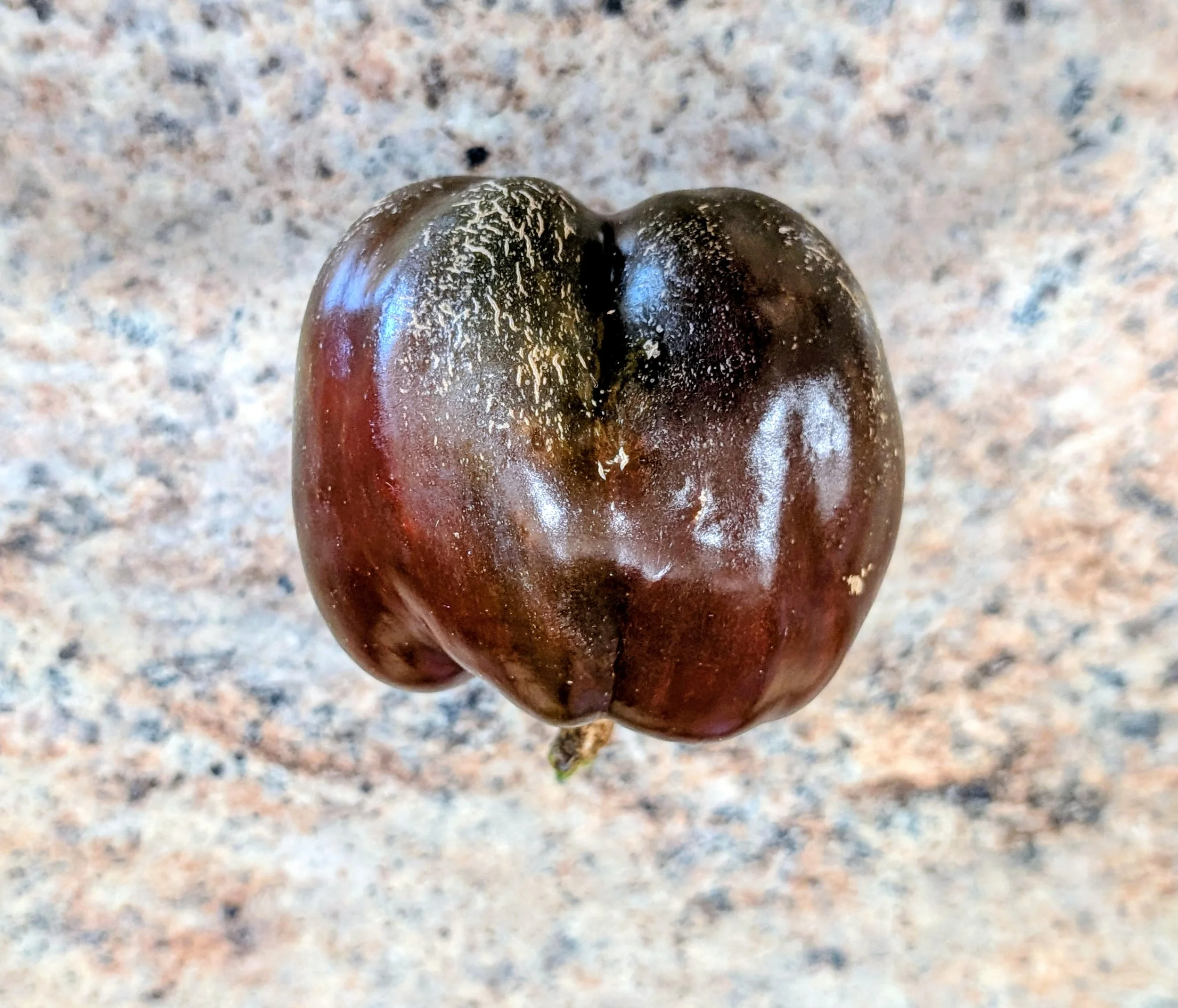
Unique Chocolate Bell ripe color. Starts out dark green.

Peppers - I grew far less peppers this year, and none of them were hot. My attempt at Shishito ended up in a cross. More on that later. The peppers I chose were mostly from breeding projects - Chocolate Bell, two different lots of Fire Opal, Orange Bell, two new hybrids to me, Snackabelle and Minibelle, and plants from saved seeds for Corno di Toro and Shishito. The best yields are coming on now, in September. All of the bells are of the hoped for color. The one odd one is a Shishito that is long, elongated and sweet. I assume it is Shishito X Corno Di Toro! Seeds from everything are saved, and I am going to think long and hard about what next year will look like for peppers. Fire Opal - planted P22-4 (saved as P26-1) and P22-5 (saved as P26-2). Both plants gave bells whose color transitioned from cream to lavender to gold, as hoped for; Orange Bell - planted P25-8 (saved as P26-3). This very productive bell started medium light green and ended glowing orange - very sweet! Chocolate Bell planted P25-5 (saved as P26-4) - the large blocky green fruit ripened a rich chocolate brown, as hoped for. Shishito planted P25-4 (saved as P26-6) - as noted above, this seemed to be a cross between Shishito and Corno di Toro - the long medium green thin walled peppers were sweet, and ripened red. Corno di Toro planted P25-11 (saved as P26-5) grew as expected - long dark green peppers that ripened red.
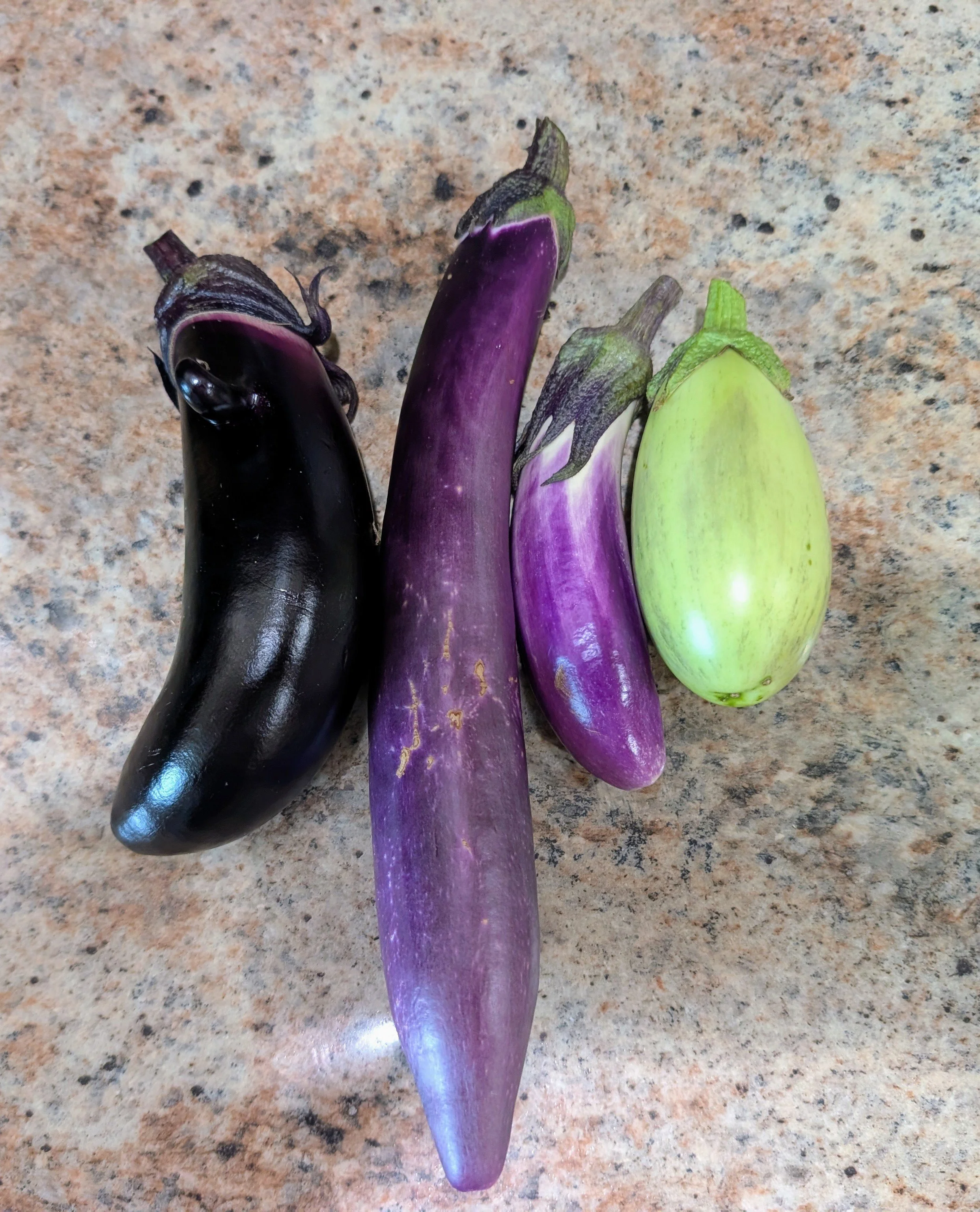
Eggplants - I planted my usual set of my own selections - Midnight Lightning, Twilight Lightning, Skinny Twilight, and Mardi Gras. All are in 5 gallon grow bags and still thriving. seeds have already been saved. Midnight Lightning planted E25-4 (saved as E26-3) - the plants had dark green foliage with prominent purple in the young leaves, and produced slender long black purple fruit. Skinny Twilight planted E25-2 (saved as E26-4) - the dark green foliaged plants with some purple shading produced slender medium dark purple fruit. Twilight Lightning planted E23-2 and E22-2 and (saved as E26-2 and E26-5) - both produced shorter plants with lots of slender fruit that were white with lavender shading. Mardi Gras planted E25-3 (saved as E26-1) produced lots of tear drop shaped green fruit with lavender streaks.
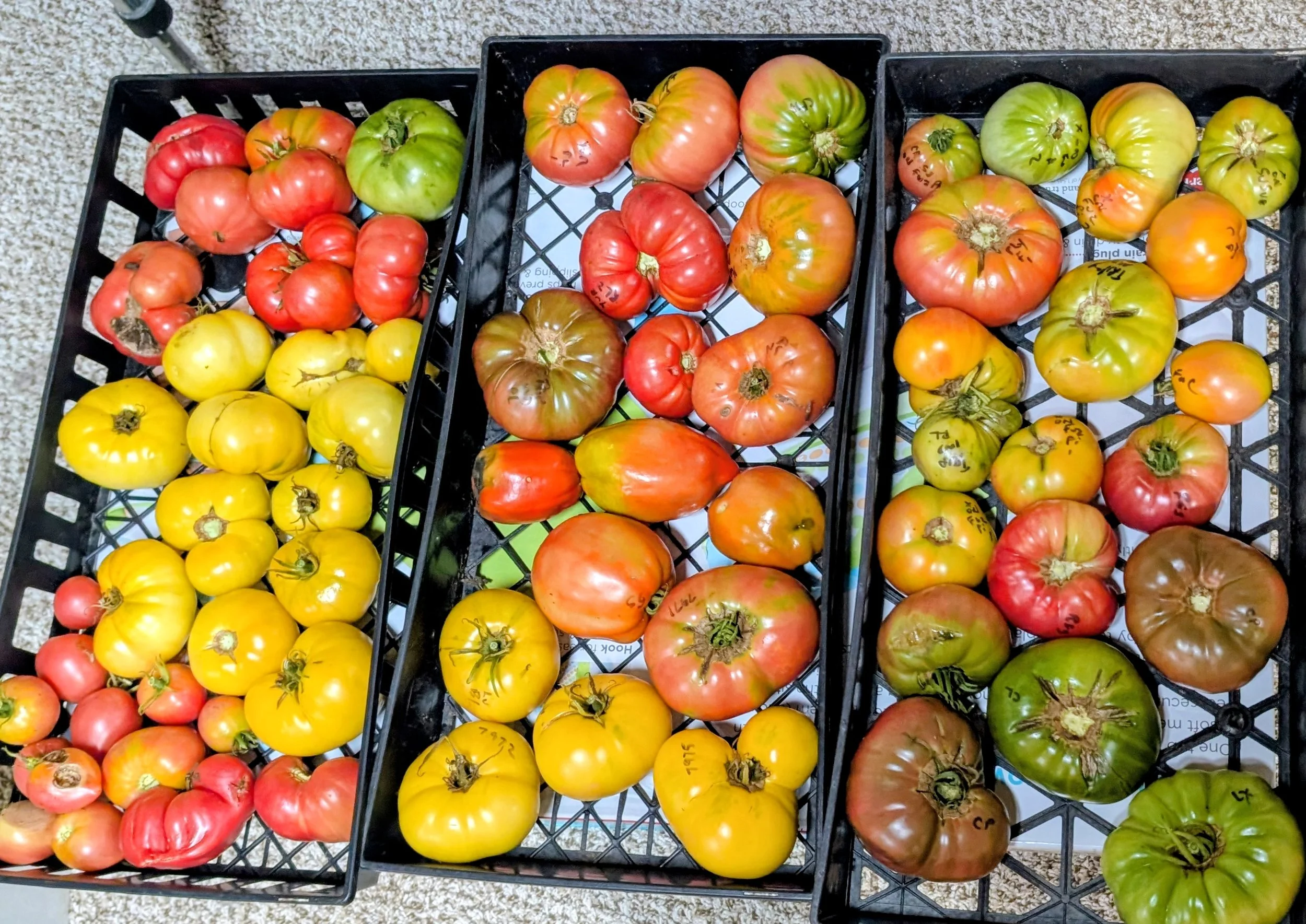
One day harvest in later Juy

Tomatoes - This is where the fun was in my 2026 garden. I will break it down by the various projects.

Old Favorites - these are the varieties I knew would be great to eat.
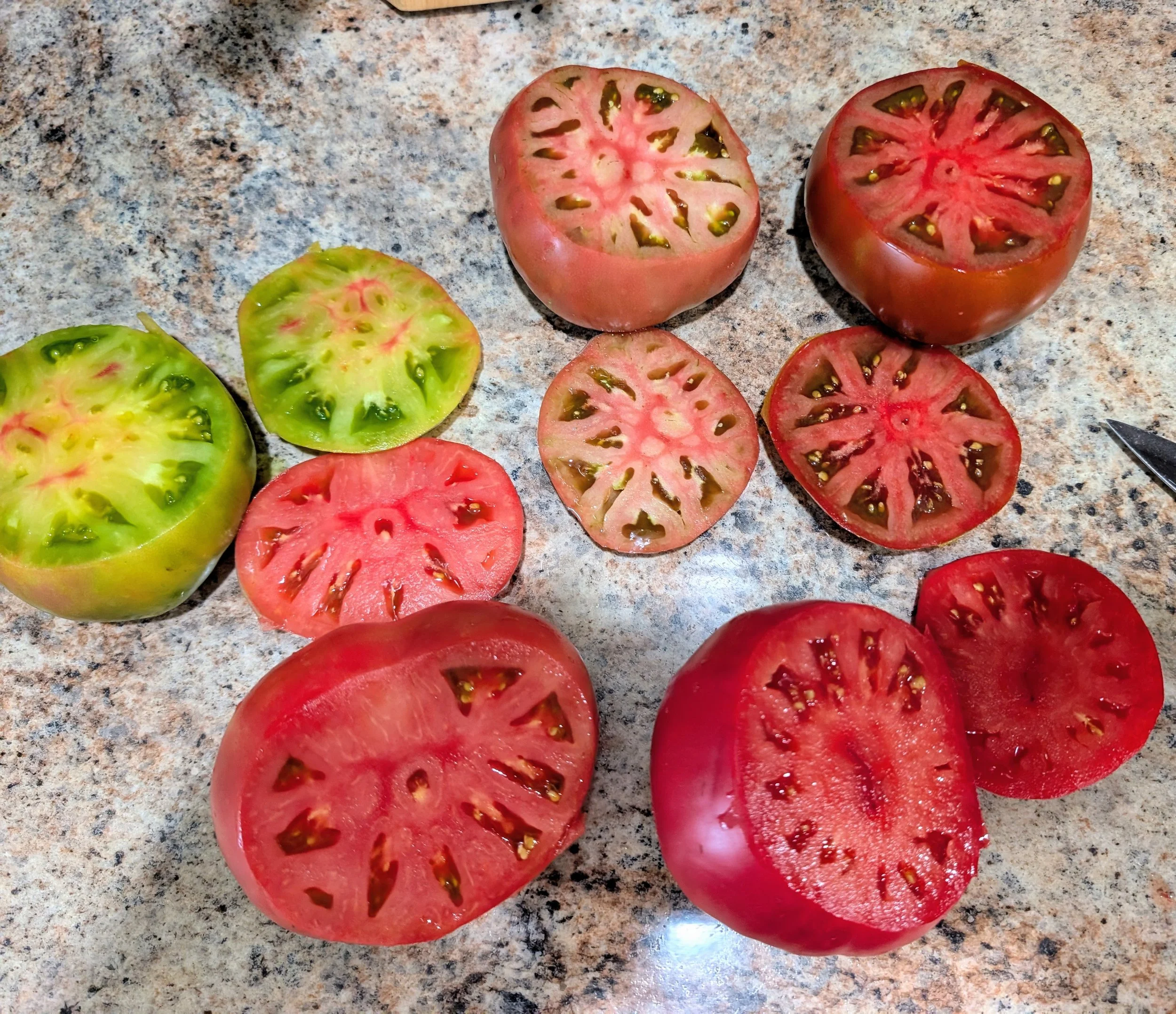
Captain Lucky far left, Cherokee Purple and Cherokee Chocolate upper center and right.

Captain Lucky - grew out seed T25-3. The potato leaf plants gave a good yield of medium to large oblate clear skinned green fleshed fruit with prominent purple blushing outside, and a red swirl in the center of the flesh. Flavor was typically superb. Seed saved as T26-2.

Cherokee Purple - grew out seed T16-102. This is only 3 generations removed from seed sent to me by J. D. Green in 1990. That was #287 - in 1993 that was grown and saved as T93-2, which was grown in 2008 and saved as T08-12 - this led to T16-102. This was my best Cherokee Purple performance in several years, with a minimum of blossom end rot. 8-12 ounce purple tomatoes were plentiful and delicious. Seed saved as T26-1.

Cherokee Chocolate - grew out seed T16-120. This is also only 3 generations removed from the year it was discovered, in 1995. T95-47 led to T03-21 - this was grown and saved as T16-120. Cherokee Chocolate was typically wonderful this year - even more productive than Cherokee Purple. Seed saved as T26-4.
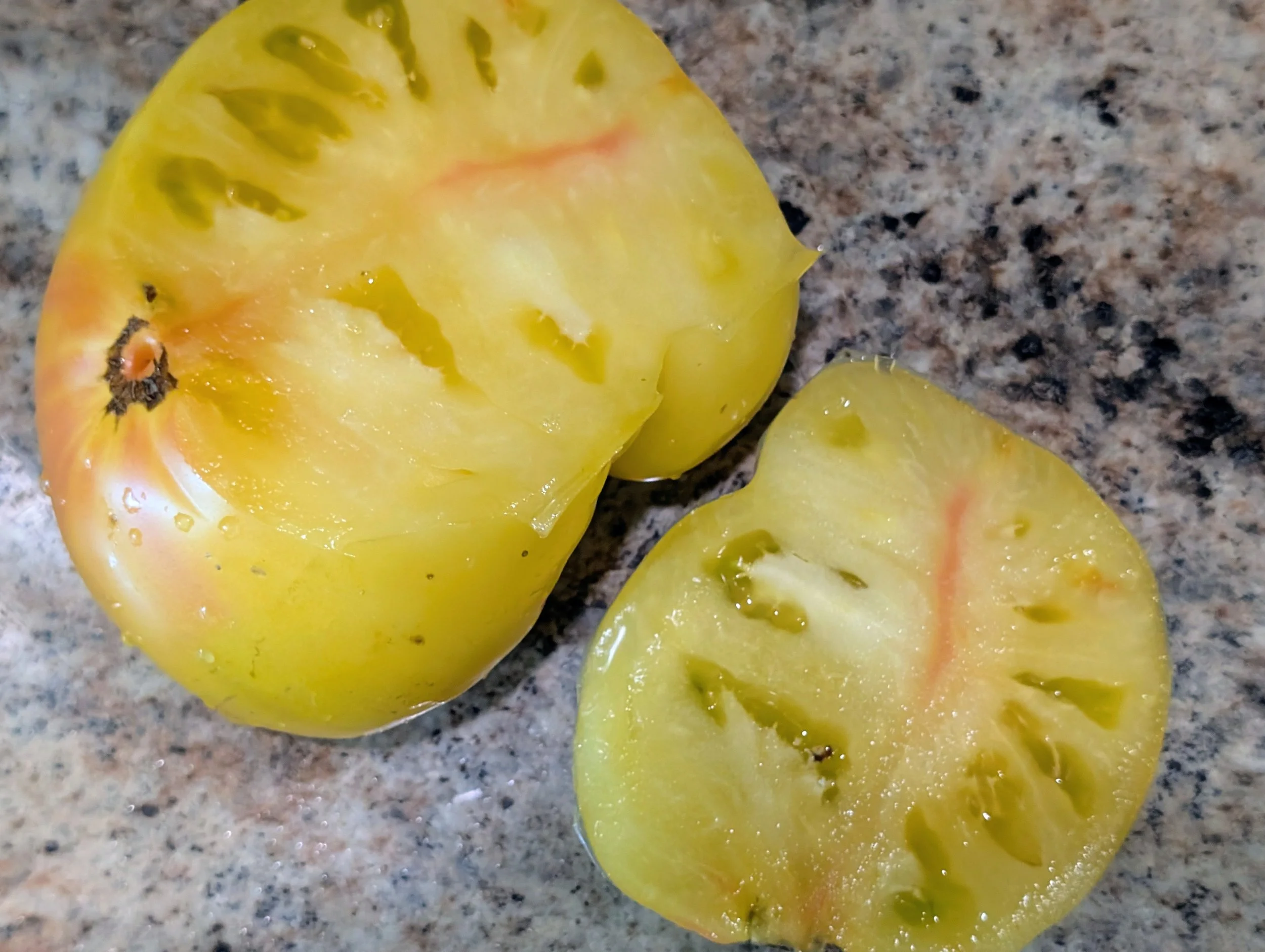
Lillian’s Yellow Heirloom interior, showing the typical hint of pink.

Lillian’s Yellow Heirloom - grew out seed T25-8. Lillian had a very good year, with a heavy harvest of medium to large oblate pale yellow superbly flavored tomatoes. This variety always meets expectations - and it is always one of the last to ripen. Seed saved as T26-3.

Lucky Cross - grew out seed T23-185. The yield was adequate but I’ve had better seasons. The size, color and flavor were spot on, however - the large yellow fruit were amply swirled with red. Seed saved as T26-6.
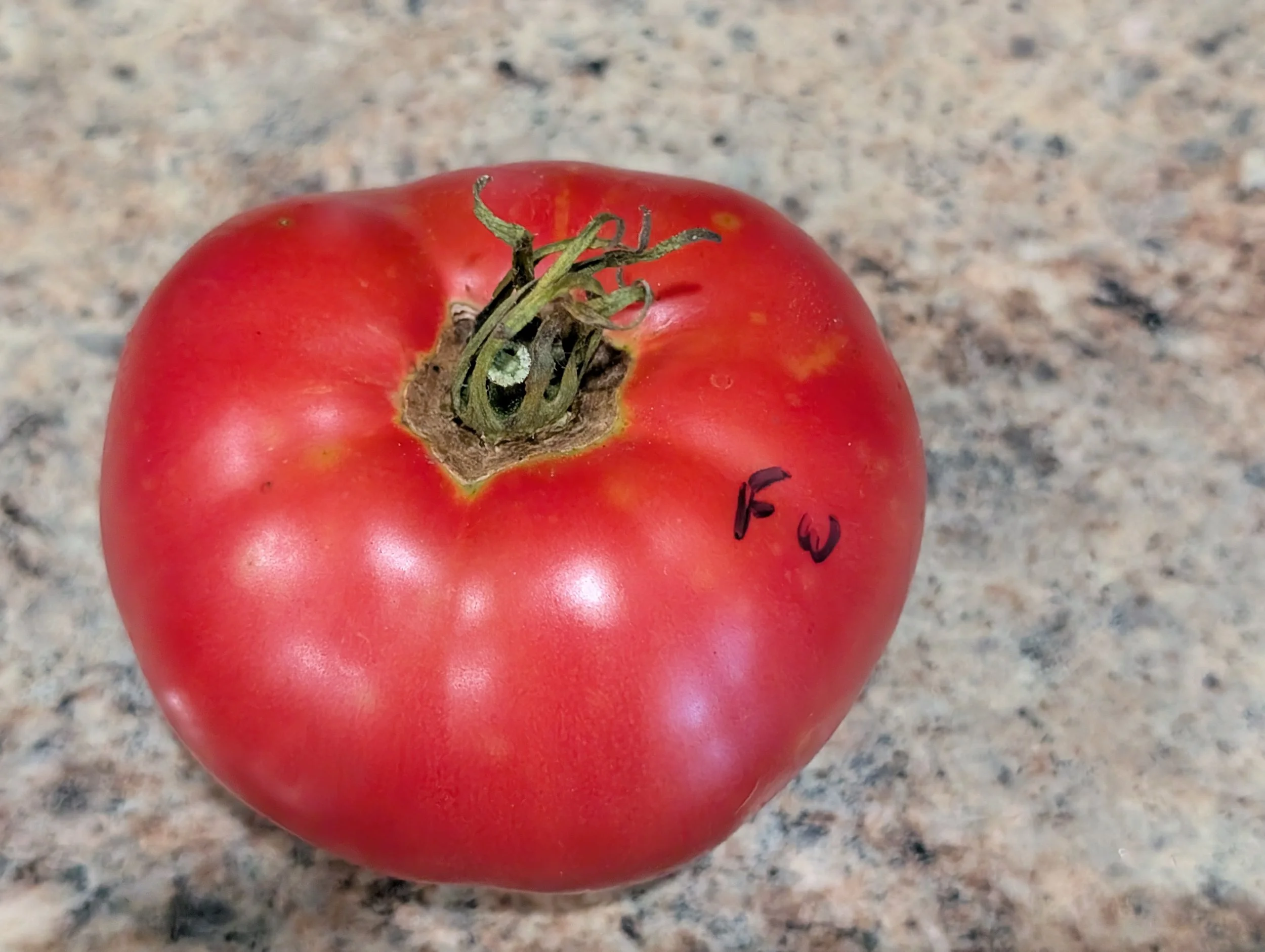
Nice sample of Ferris Wheel

Ferris Wheel - grew out seed T23-155. The plant was set to be very prolific, but showed signs of Fusarium Wilt. The plant did finally die, but not before producing lots of tasty tomatoes. The size was smaller than typical. Seed saved as T26-5.
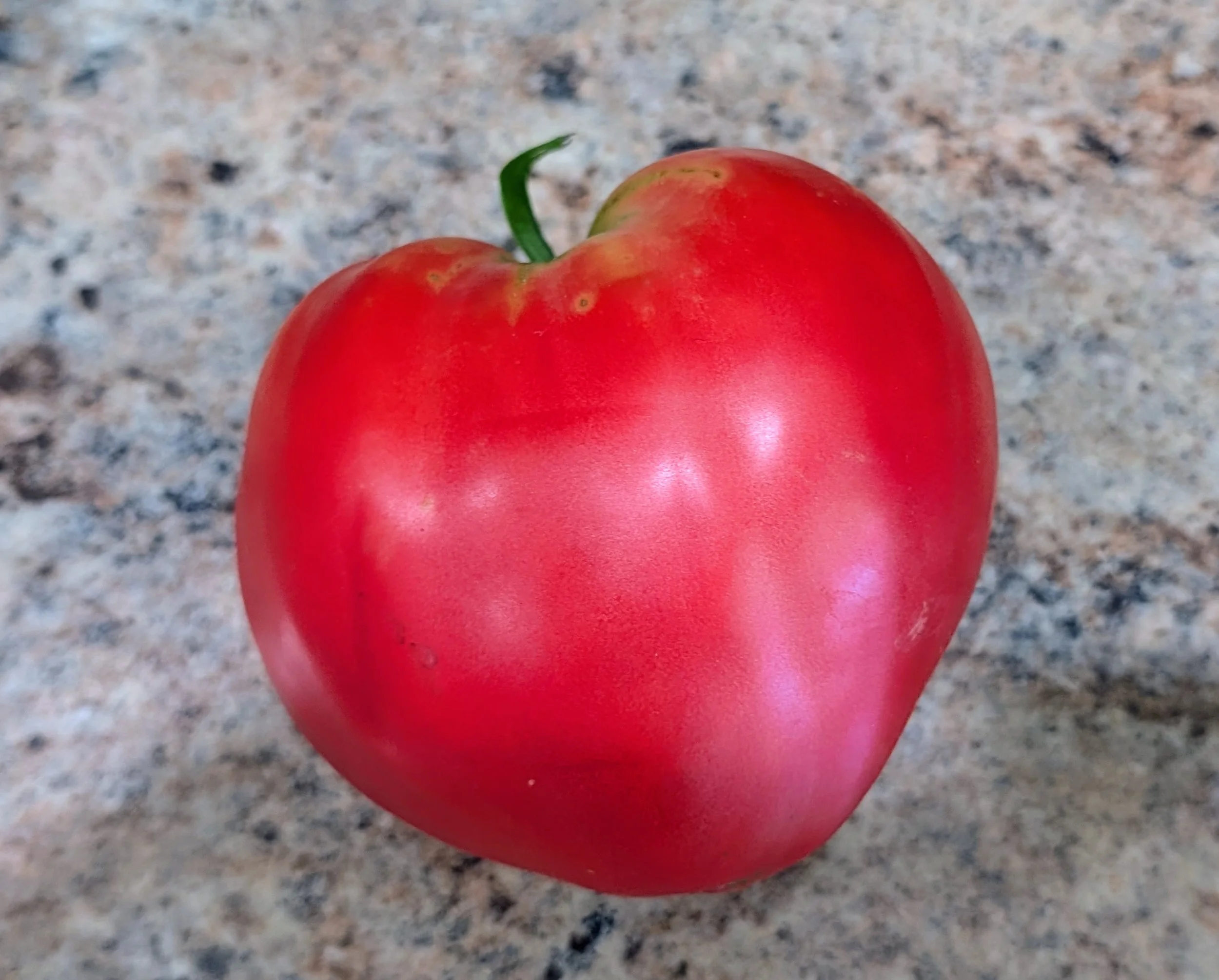
Perfect specimen of Cancelmo Family Heirloom

Cancelmo Family Heirloom - grew out seed T16-98, which was the seed saved from the first time I grew the variety, receiving it from my friend Walt Swokla. The plant started quite fragile looking but, as typical with this variety, became vigorous, with heavy fruit set. The one pound average pink hearts were just delicious. This is my favorite pink heart shaped variety by far. Seed saved as T26-9.
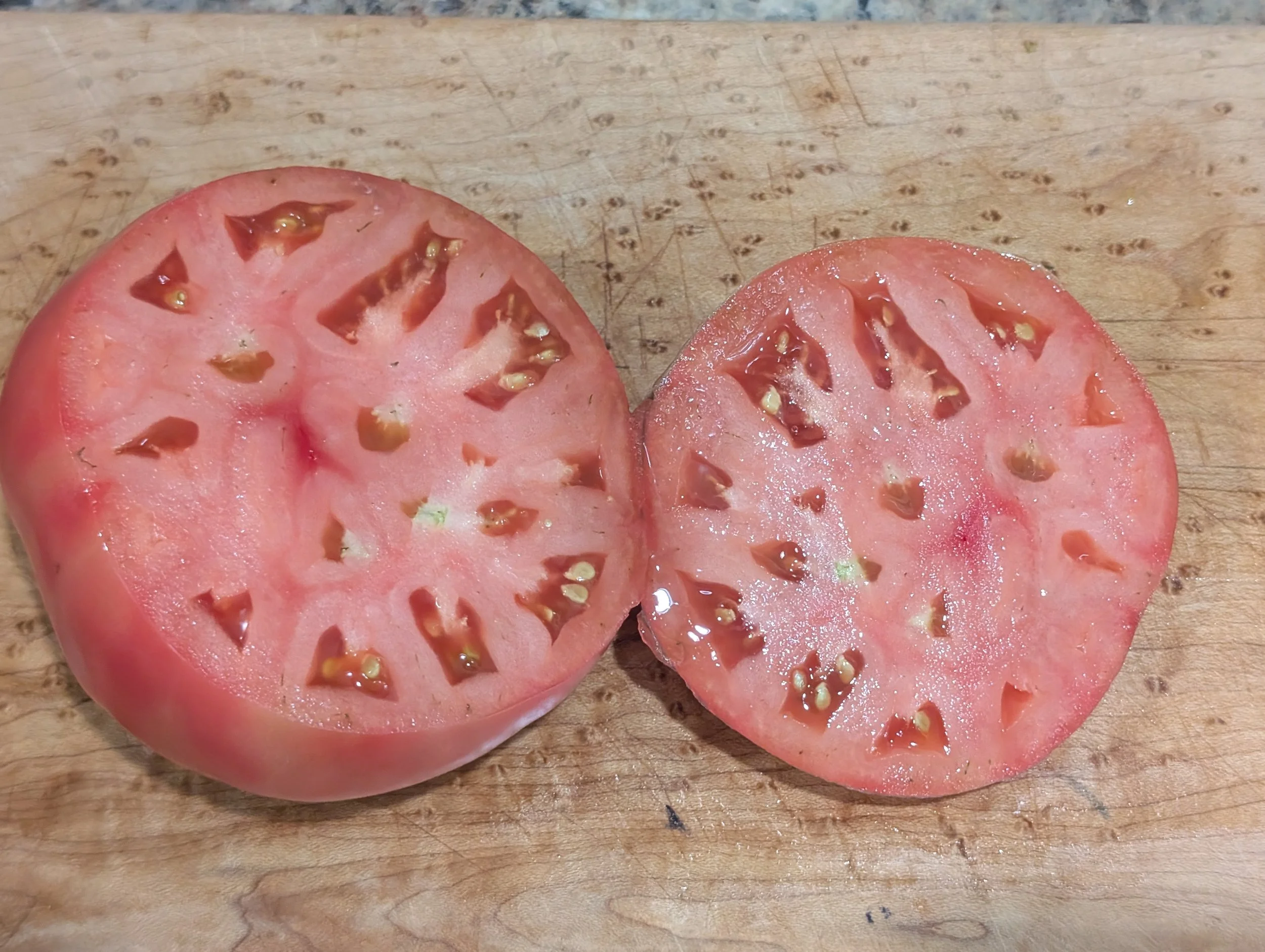
World War II interior

World War 2 - grew out seed T23-6, which was the first seed saved from my initial trial of this wonderful variety. Like Ferris Wheel, fruit set was excellent, but onset of fusarium wilt curtailed what would have been an outrageous yield. I did harvest many perfect specimens, pink 12-16 ounce beefsteak type fruit with a wonderful full flavor. Seed saved as T26-26.
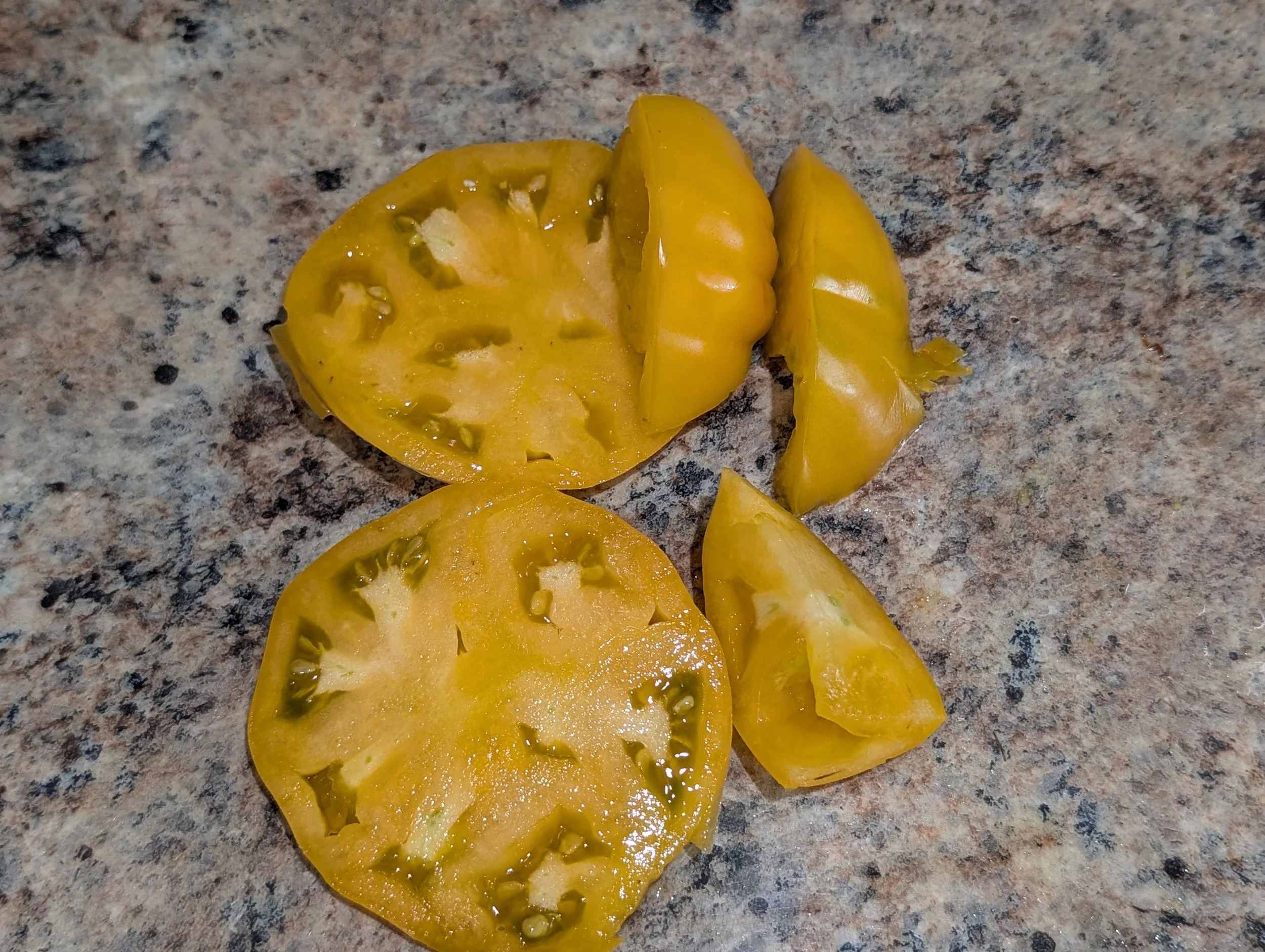
Potato Leaf Yellow interior

Potato Leaf Yellow - grew out seed T25-17. This was not the best year for Potato Leaf Yellow. Like a few others in this list, it appeared weakened by early onset Fusarium wilt. Despite that, fruit set was excellent, though the tomatoes were smaller than usual and were not quite as tasty. I noted that the flesh had small dark brown specks or shards in some of the fruit. Seed was saved as T26-24.
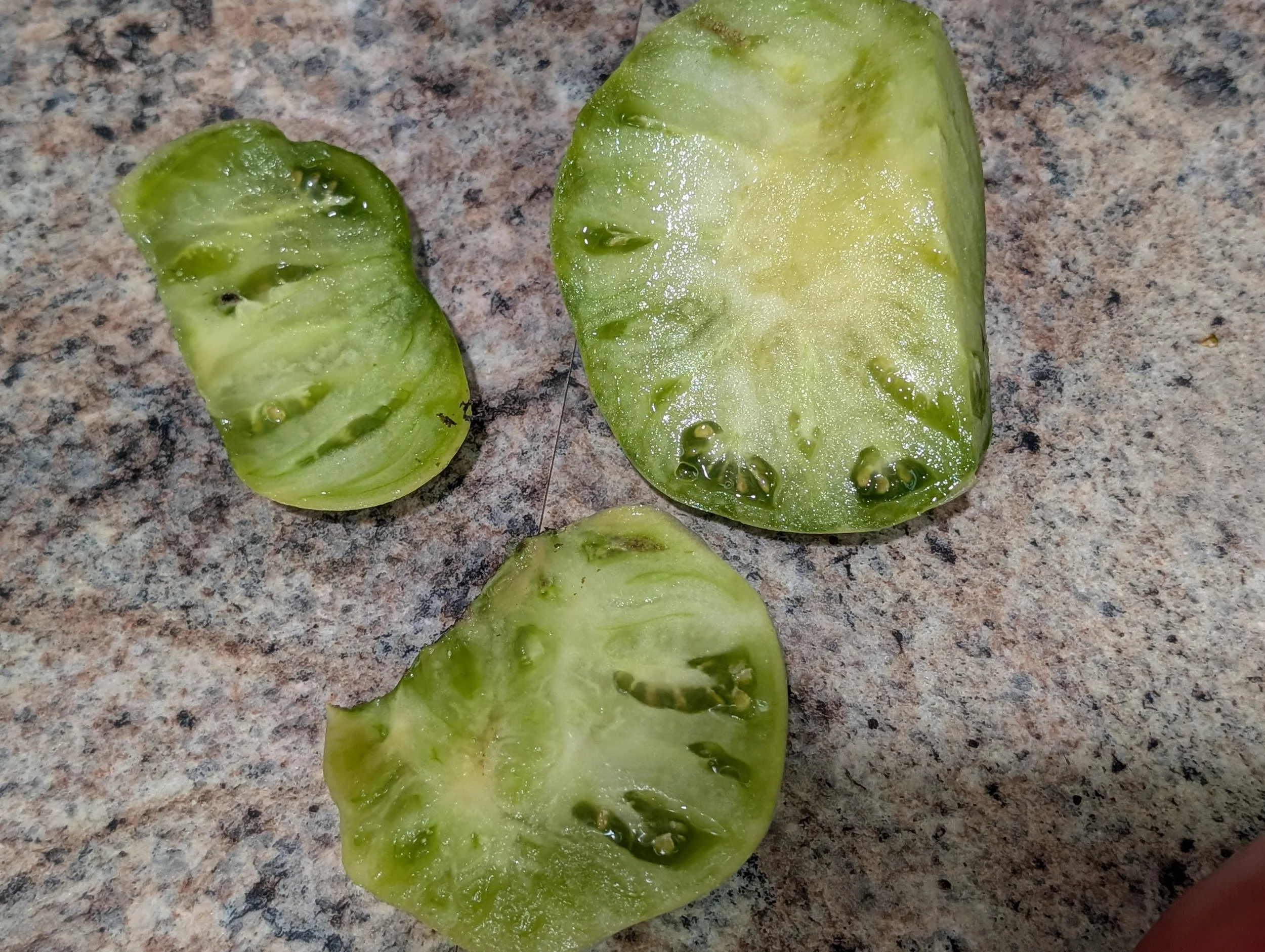
Very characteristic Green Giant interior

Green Giant - grew out seed T21-18. It has been a few years since growing Green Giant, and I am always happy to return to it in the garden. The large oblate green fleshed, clear skinned tomatoes were plentiful and delicious. One thing I always note is that Green Giant is relatively perishable when compared to many other heirlooms. Seed was saved as T26-21.
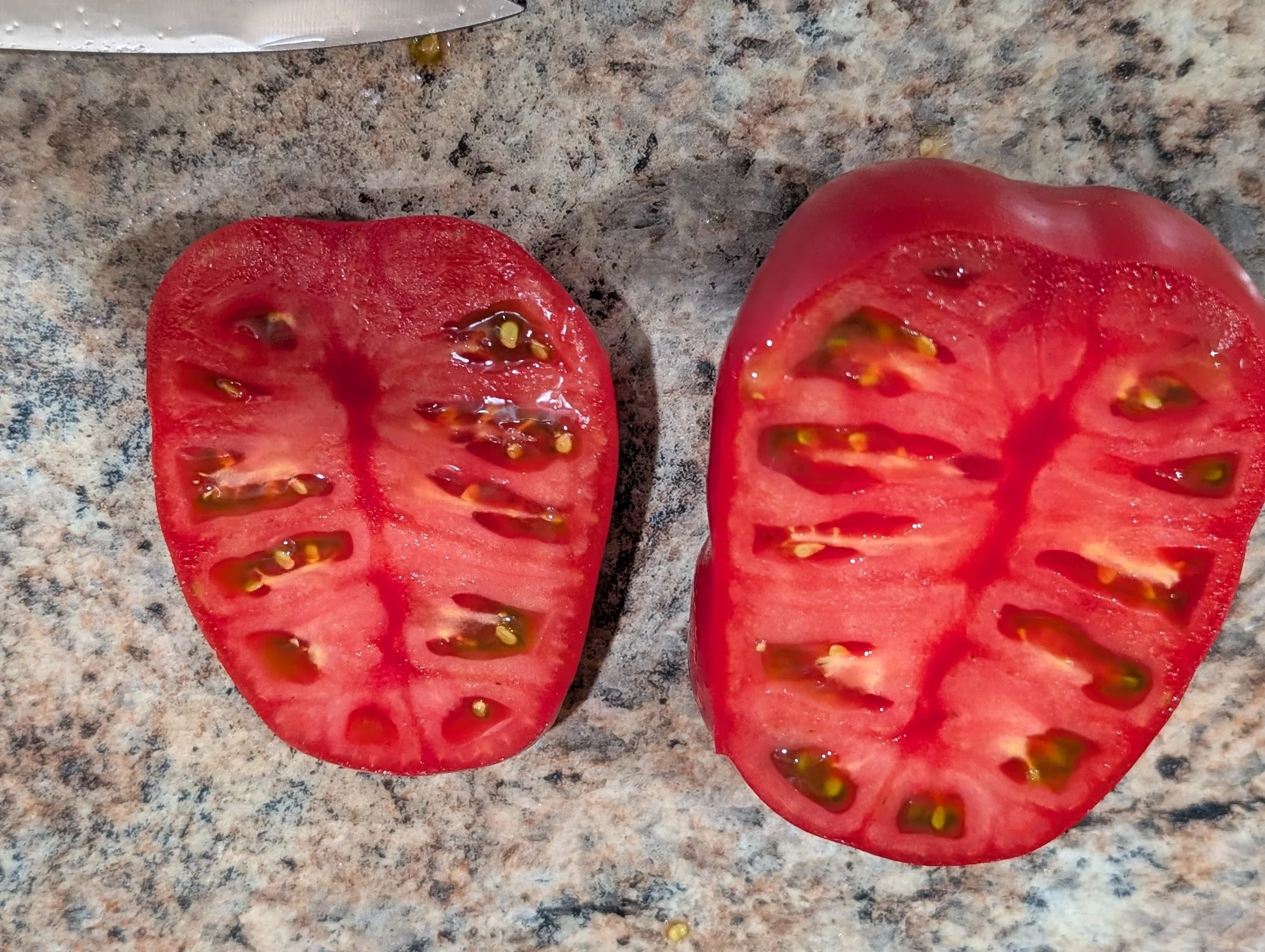
Earl interior

Earl - grew out seed T24-12. This is the last of the indeterminates that suffered from Fusarium wilt. Before succumbing, it produced a lot of delicious oblate pink tomatoes. I did note that the fruit were not quite as large, and flavor not quite as intense, as is typical. Seed was saved as T26-10.

Giant Syrian - grew out seed T21-16. I simply love this variety. It isn’t the highest yielding and is quite late, but the large to huge scarlet red blunt hearts are as stunning to see as to eat. It really is one of my favorite indeterminate heirloom varieties and it needs to be in my garden more often. Seeds are saved as T26-22.
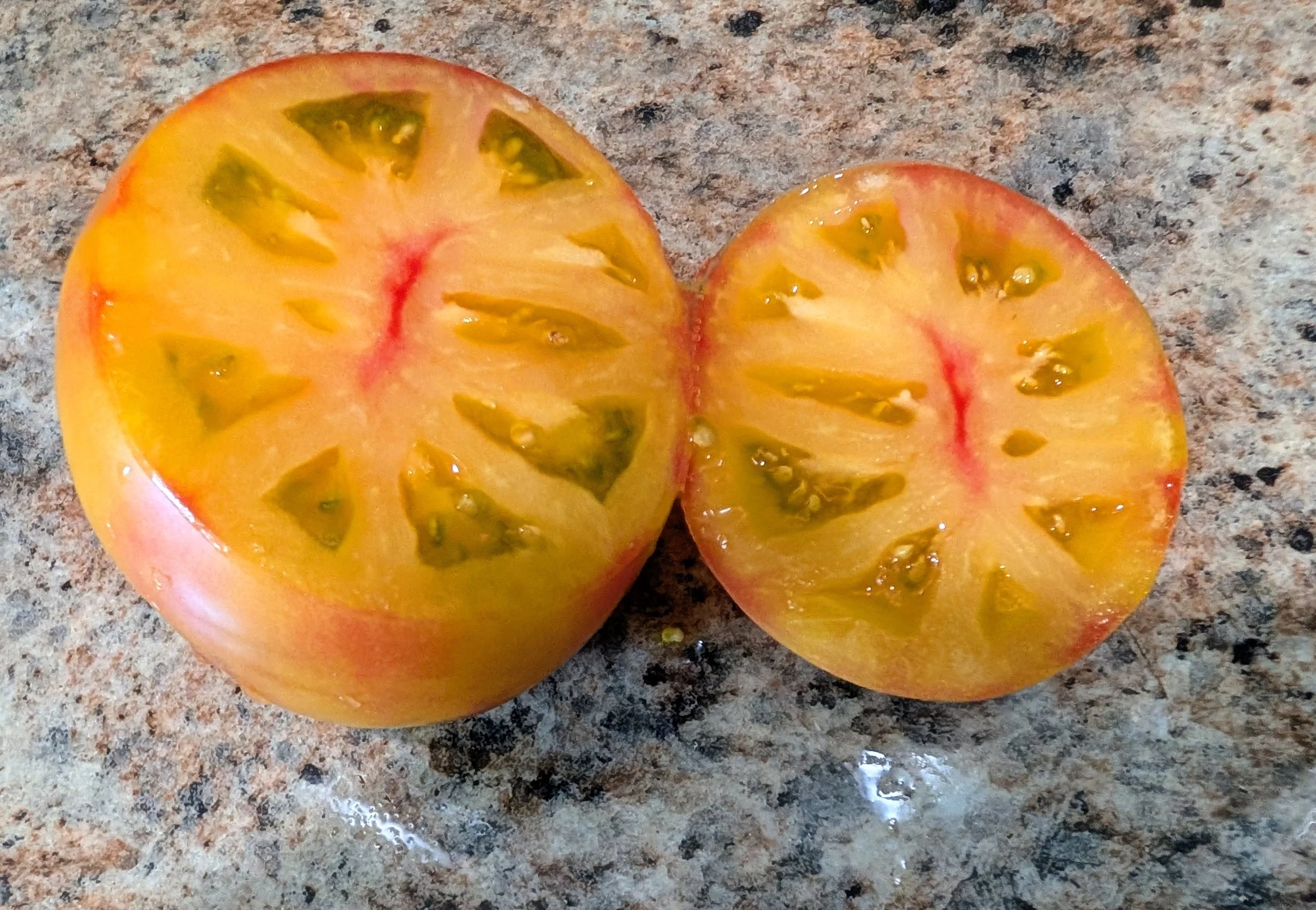
Lucky Bling interior, showing the typical prodominantly yellow interior with the center red streak

Lucky Bling - grew out seed T25-10. This has become a favorite. The variegated potato leaf plants produce plenty of medium sized oblate bright yellow tomatoes with a blush and swirl of red. The flavor is supreme. Once this is released I expect it to be a well loved variety. Seeds were saved as T26-20.
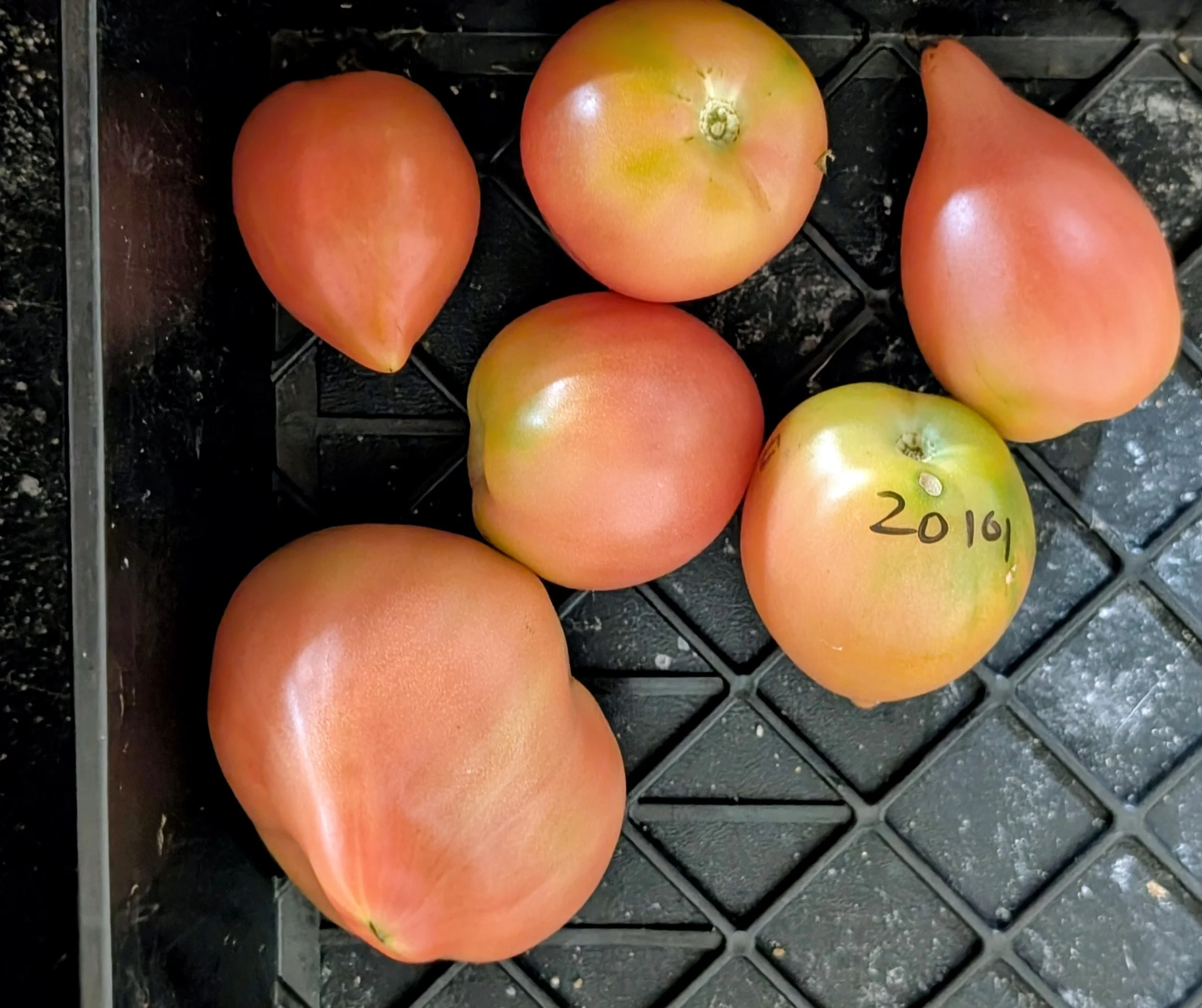
A selection of nealry ripe Dwarf Liz’s Teardrops

Dwarf Liz’s Teardrop - search for tomatoes with seeds. This variety, which I named for Sue’s sister Liz, has been stubborn to finish off. Originating from a cross between Sun Gold F1 and Dwarf Pink Passion (the Steamy dwarf family), I quickly found what I was looking for with regard to shape and size. The main issue is that it is typically completely seedless. This year, I got a bit of luck, however.

Selection T20-100 grew into a compact bushy dwarf loaded with small to medium small smooth perfect “tops” - mini hearts, with a nice sweet flavor. Eventually, it provided a small amount of seeds from late set fruit, saved as T26-49.

Selection T20-101 grew pretty much exactly the same as T20-100. It likewise provided a small amount of seeds from late set fruit, saved as T26-50. The next step for this variety is to see if volunteers who grow either of these T26 lots wind up with tomatoes that have viable seeds. If they do, we can work toward release of the variety.
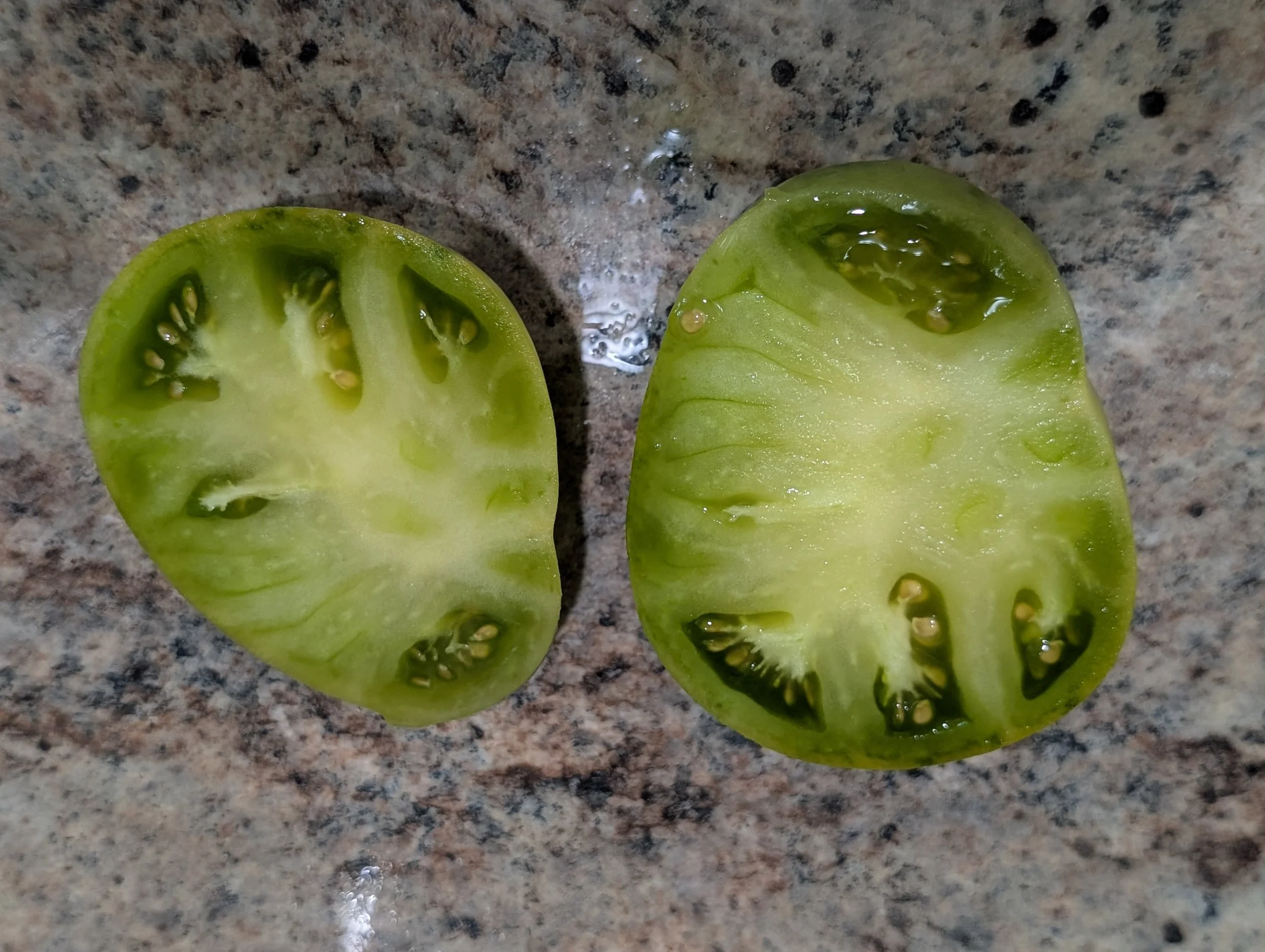
Lillian’s Envy - the new name for Not Lillian’s Yellow T25-47

Not Lillian’s Yellow T25-47 was planted - this came from #8054, as grown by my friend Elijah. This came from a regular leaf seedling in T23-10. My goal was to confirm the clear skin green flesh coloration and very good flavor achieved in 2025. I am happy to report that it did indeed - this is a very high yielding medium sized clear skin green flesh tomato with excellent flavor. This result was achieved by all to whom I sent seeds. Seeds were saved as T26-33. This variety is now known as Lillian’s Envy.
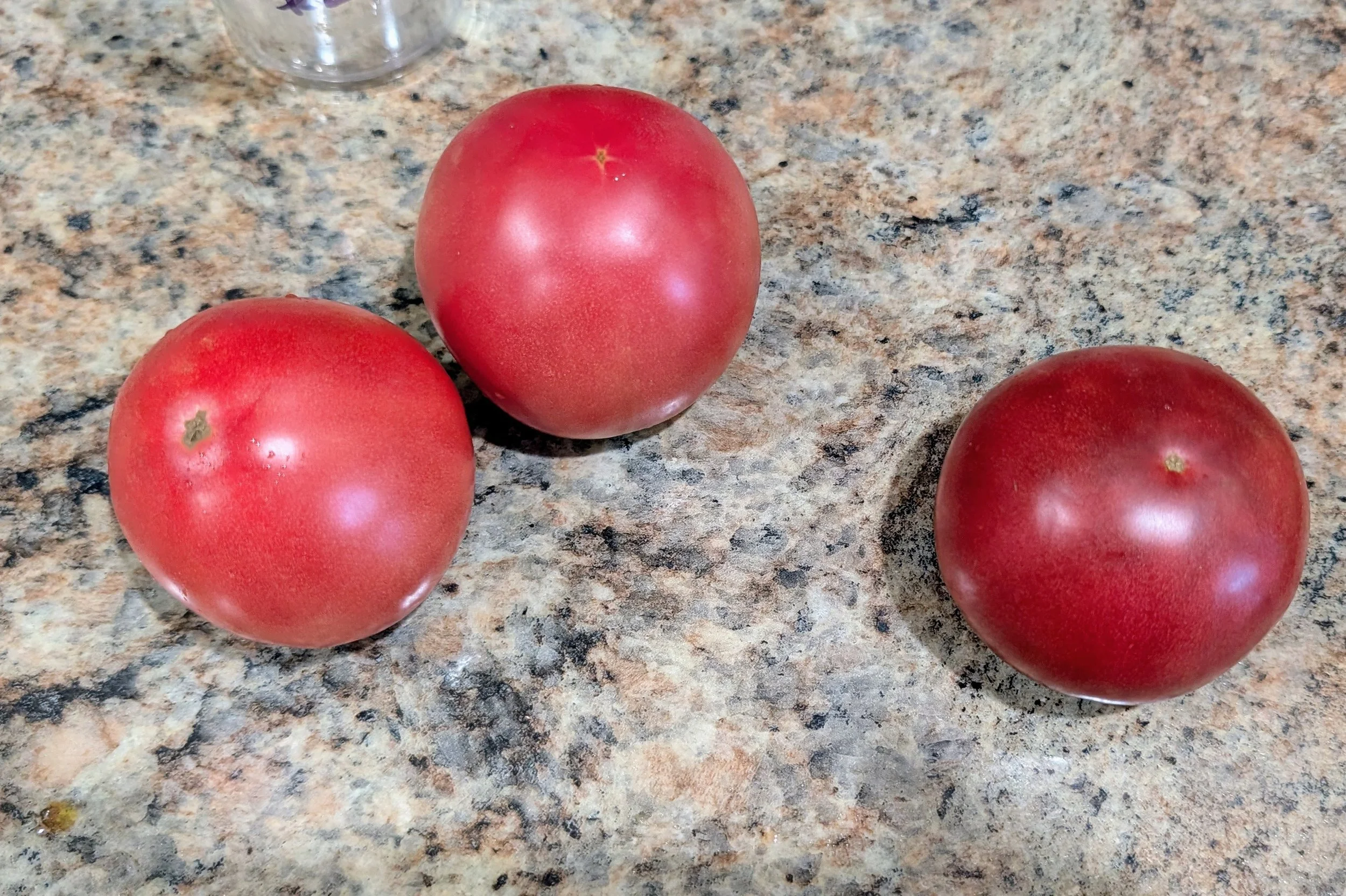
Not Pale Perfect Purple on the left (pink color), and the target authentic Pale Perfect Purple on the right
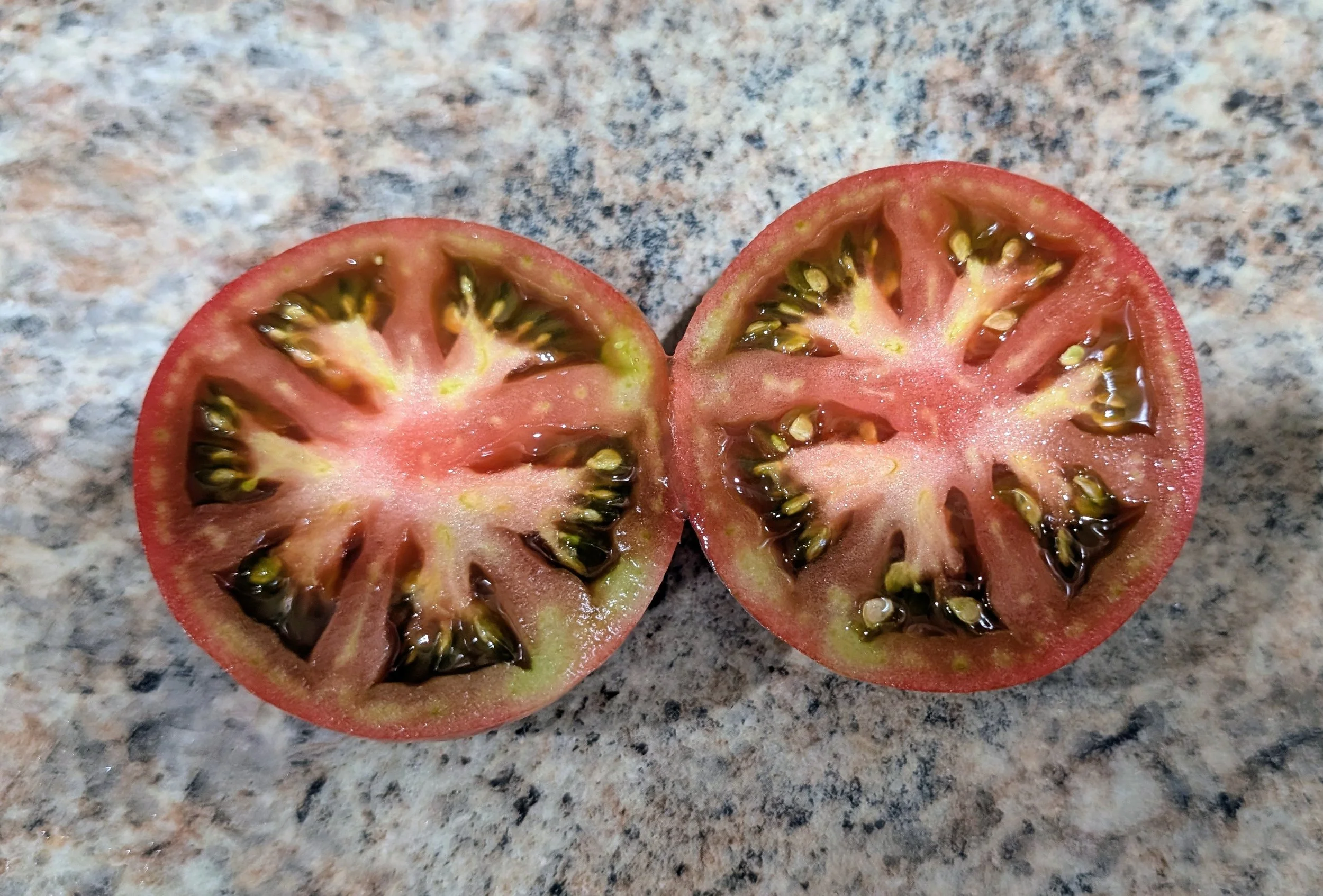
Interior of Tad Smith sample of Pale Perfect Purple

Pale Perfect Purple - This variety came up as a topic in a tomato discussion forum between friends on Instagram. I did a bit of research and found that it was often shown as pink in photographs - even in Carolyn Male’s book. I grew it many years ago and it was definitely purple. I no longer had good saved seeds, so set off to search for the real thing. Four selections were planted, and two happily gave success.

Via Denise Salmon, from Solana Seeds, sample #8178 - this produced medium sized round pink tomatoes on an indeterminate potato leaf plant. The seed was saved as T26-48. This was not correct.

Via SSE - sample donated by Jeff Dawson, sample #8195. This produced the same result as the Solana seed sample, above. The seed was saved as T26-47. This was also incorrect.

Via Denise Salmon - from Ontario seed bank, sample #8196 - Bingo! This seed produced the desired result - lots of round medium purple fruit on an indeterminate potato leaf plant with delicious flavor. The seed was saved as T26-69. This is what Pale Perfect Purple should be!

Sample from the creator, Tad Smith, sample #8197. I managed to track Tad down and he sent me some seed that he had stored. I grew it and ended up with the same result as the one from the Canada seed bank - the seed was saved as T26-70. This is also the true Pale Perfect Purple.

Glory selections named by Marsha Eisenberg - these are advanced generations from my cross of Dester X Gloria’s Treat, which I named the Glory family. I realize that Heide Dolan is also working on selections from the Glory cross, and look forward to trying her named selections from this cross. It is no surprise that these mimic the Ivalde family to some degree, in that Dwarf Gloria’s Treat is a member of the Ivalde family.
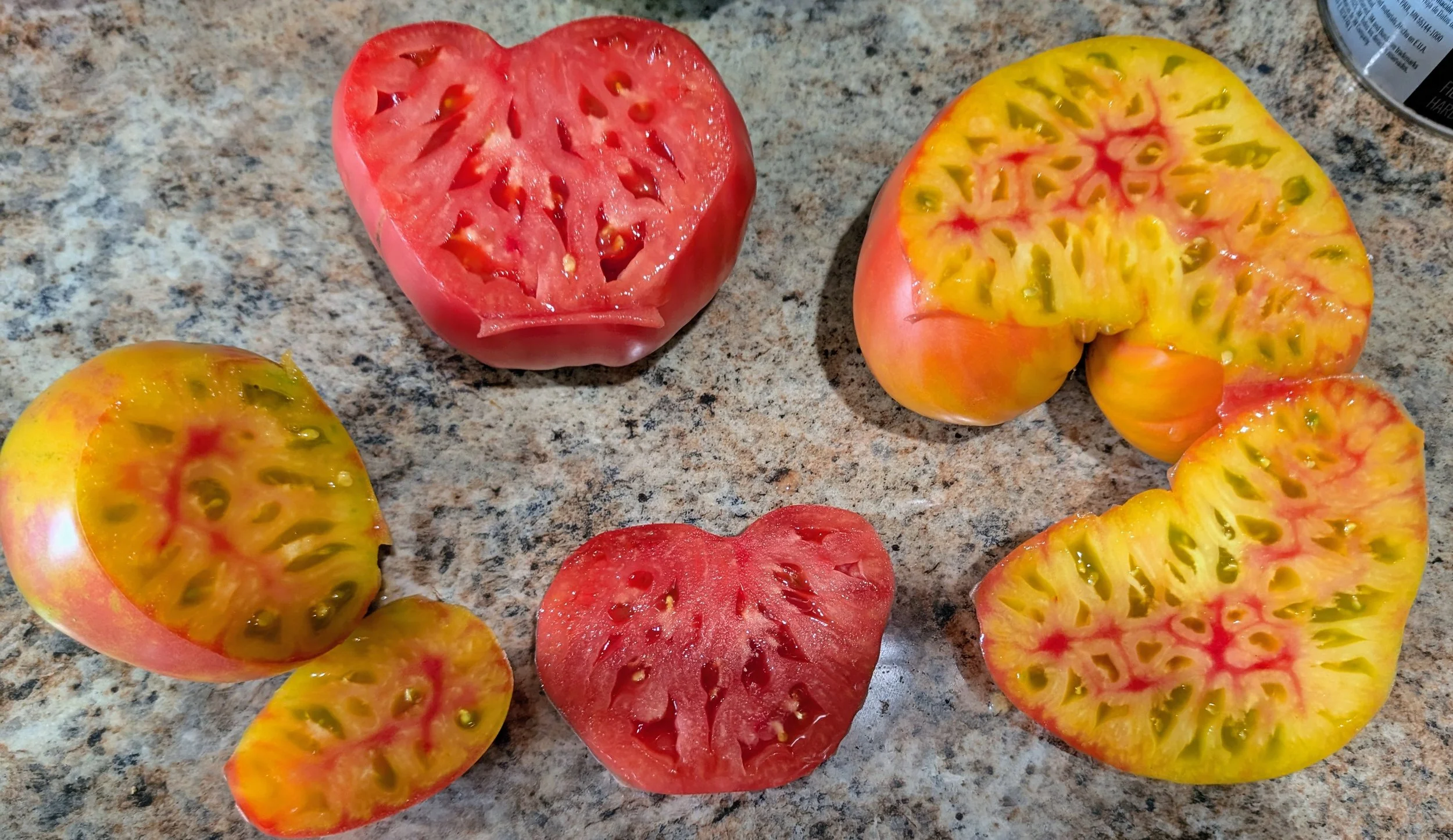
L to R - Pleaser, Resistance, Avenue K Garden

Resistance - I planted the F5 generation seed #8101 sent by Marsha. She described this as regular leaf, large pink beefsteak type, comparable to Sonrojo Monster from the Ivalde family. This is the result I achieved - the plant was prolific, and the pink oblate fruit were quite large and delicious. I saved seed as T26-35
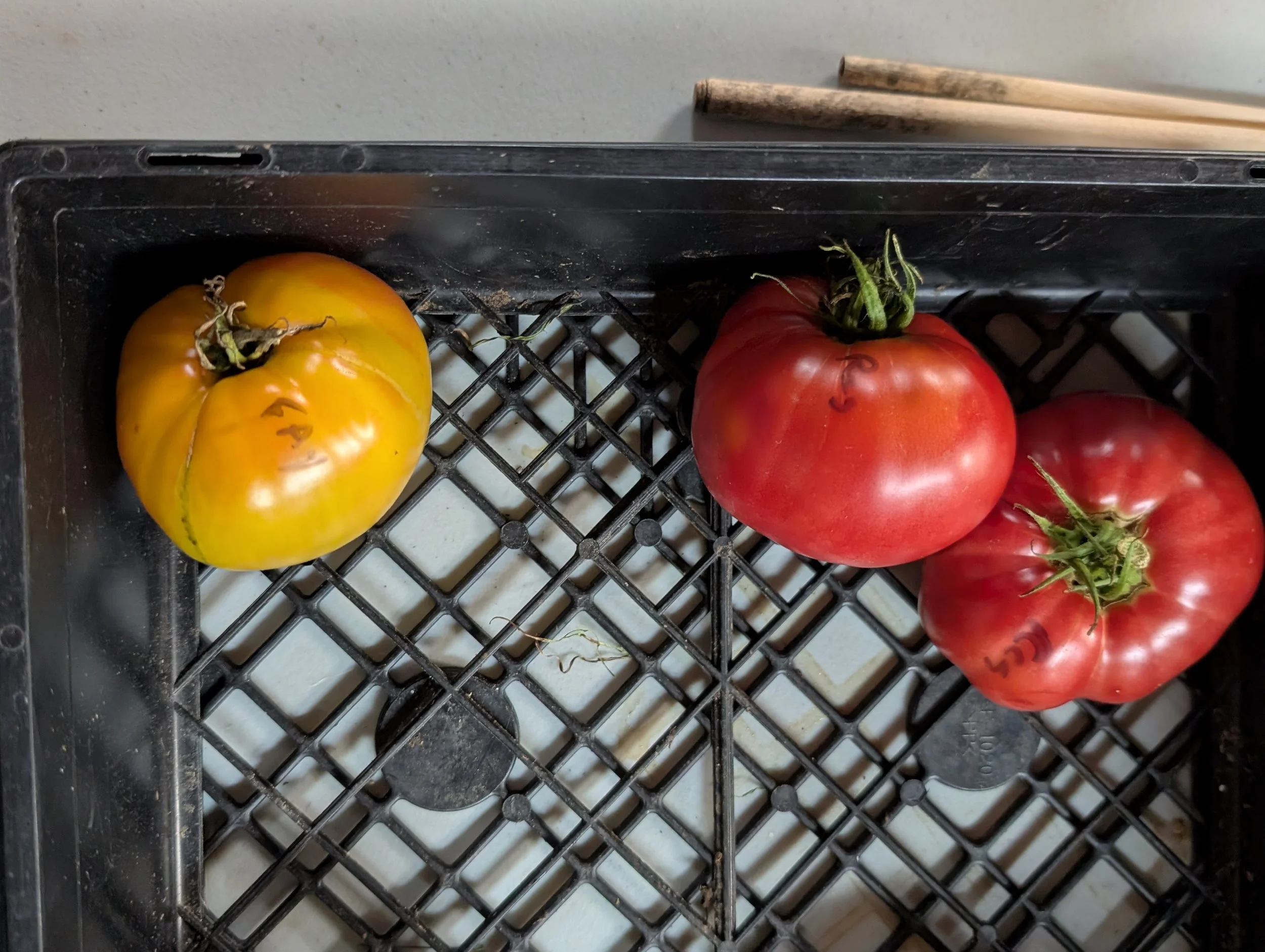
Faye Carrie, left yellow tomato

Faye Carrie - I planted the F5 generation of seed #8100 sent by Marsha. She described this as a potato leaf bicolor heart, comparable to Dwarf Gloria’s Treat. My plant struggled with the effects of herbicide from the planting mix, but did give a decent yield of medium sized bicolor hearts. I didn’t taste them. Seed was saved as T26-38. This needs another chance but I feel that Dwarf Gloria’s Treat is far superior in every way at this point.
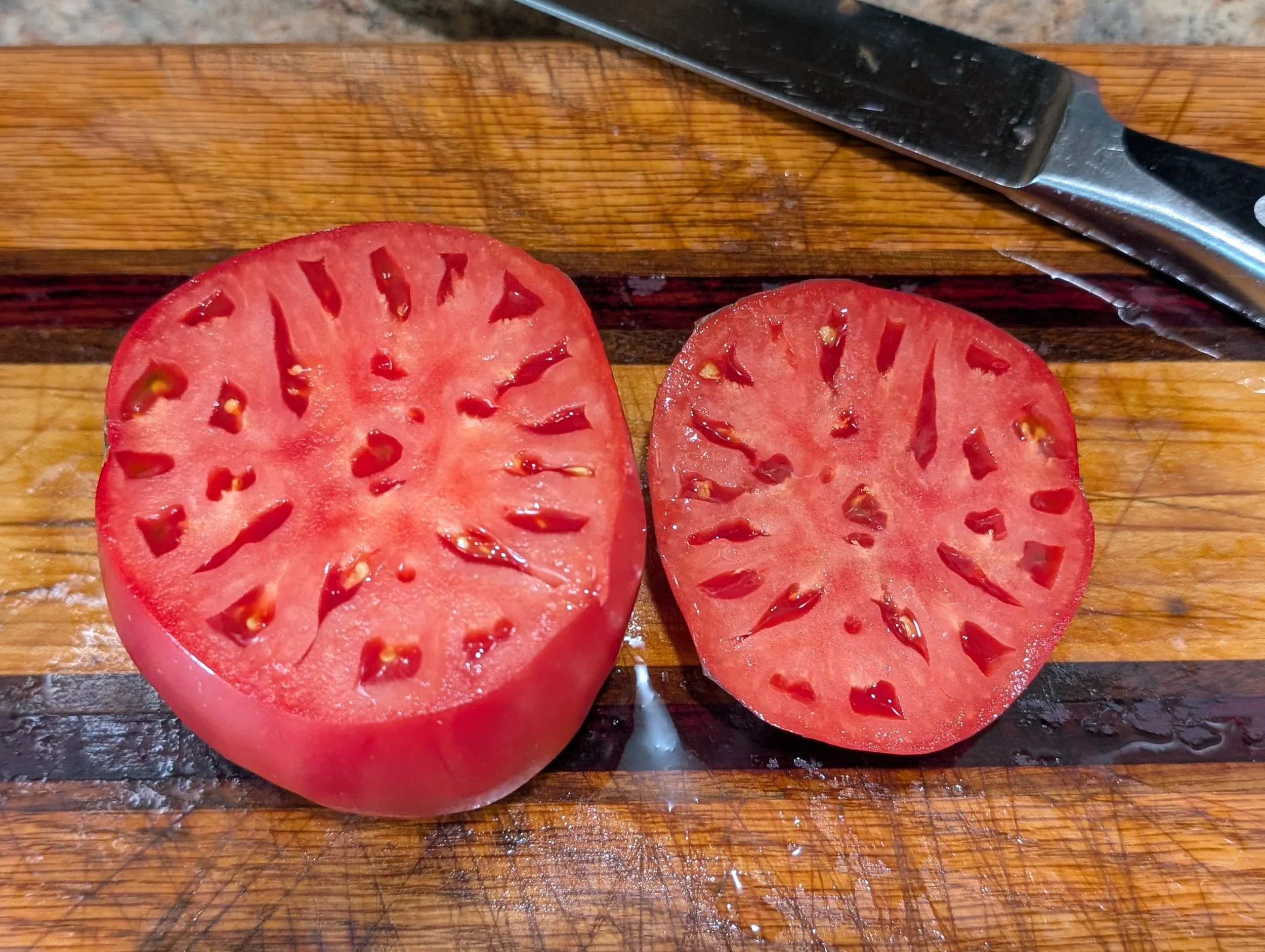
Dwarf Marsha’s Favorite

Marsha’s Favorite - I planted the F5 generation of seed #8103 sent by Marsha. She described this as a regular leaf very large pink beefsteak, also comparable to Sonrojo Monster. I did get a similar result, but felt that the size was quite variable, and some even tended to blunt heart shape. The flavor was excellent - seed was saved as T26-37
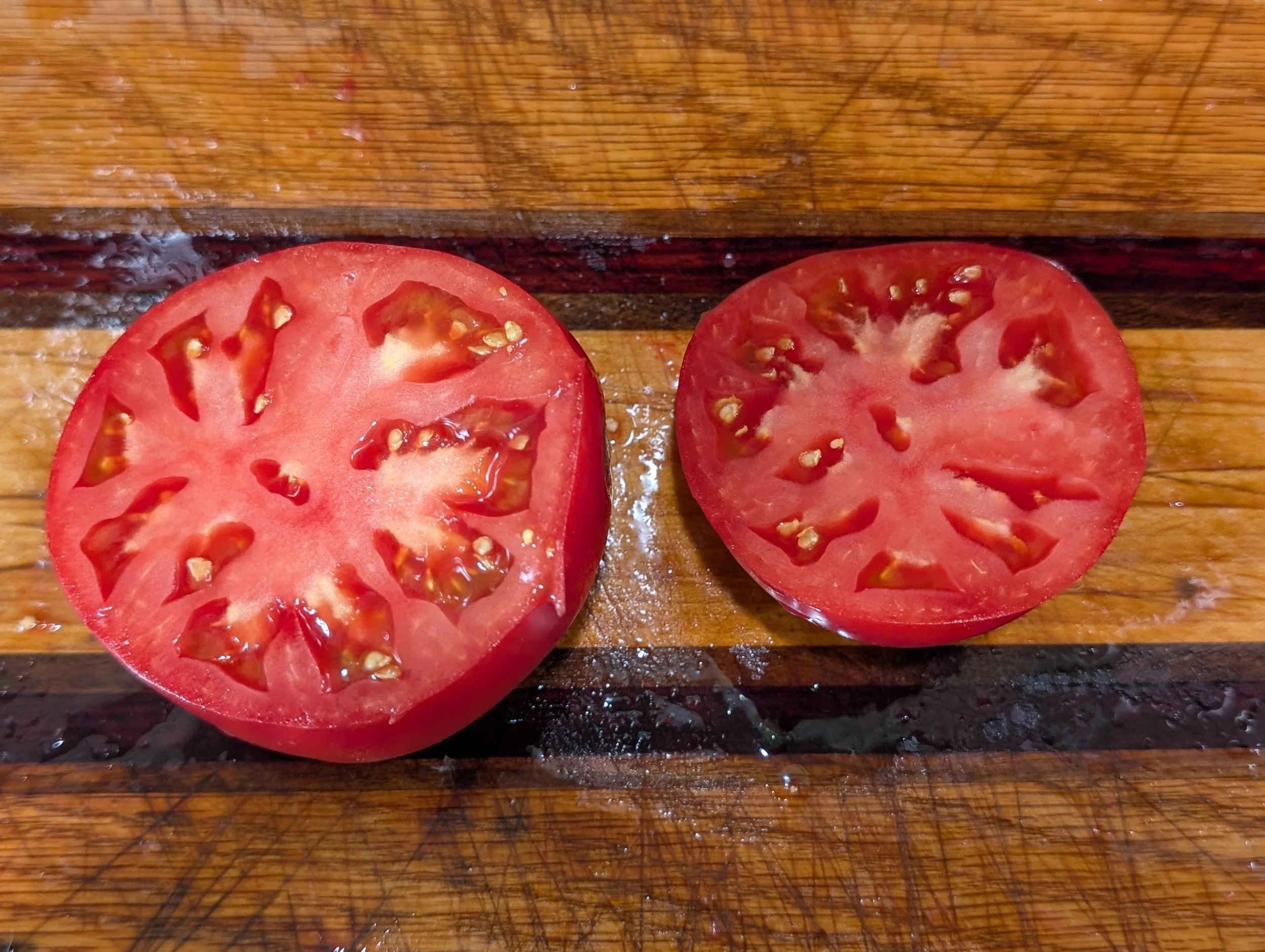
Dwarf Glinda’s Hat, interior

Glinda’s Hat - I planted the F5 generation of seed #8105 sent by Marsha. She described this as a regular leaf medium sized pink heart, comparable to Big Valentine, This also had some effects of herbicide damage, but did yield a decent number of pink heart shaped fruit with very good flavor. I find Dwarf Big Valentine to be much larger. Seed was saved as T26-36.
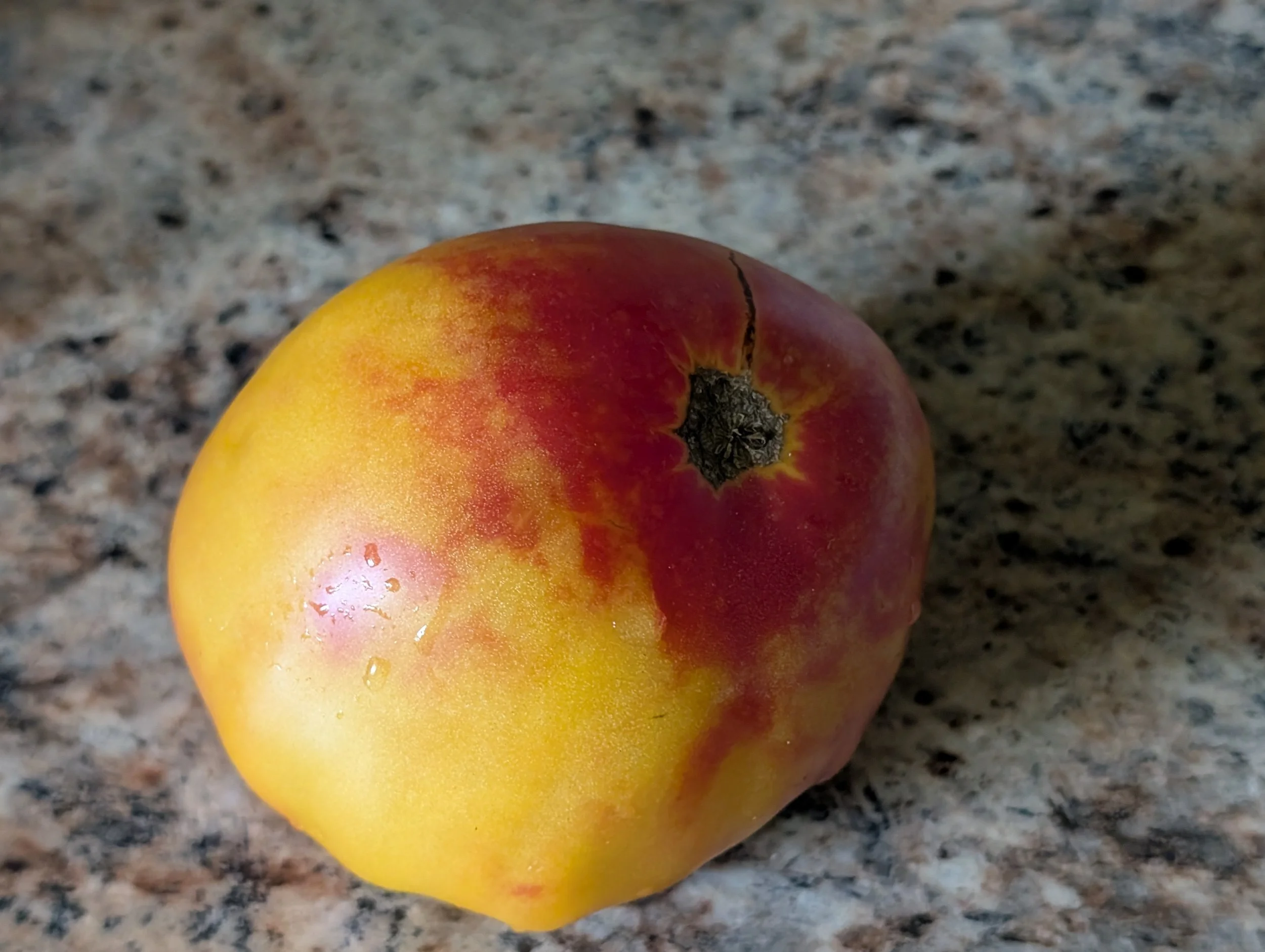
Dwarf Avenue K Garden, blossom end
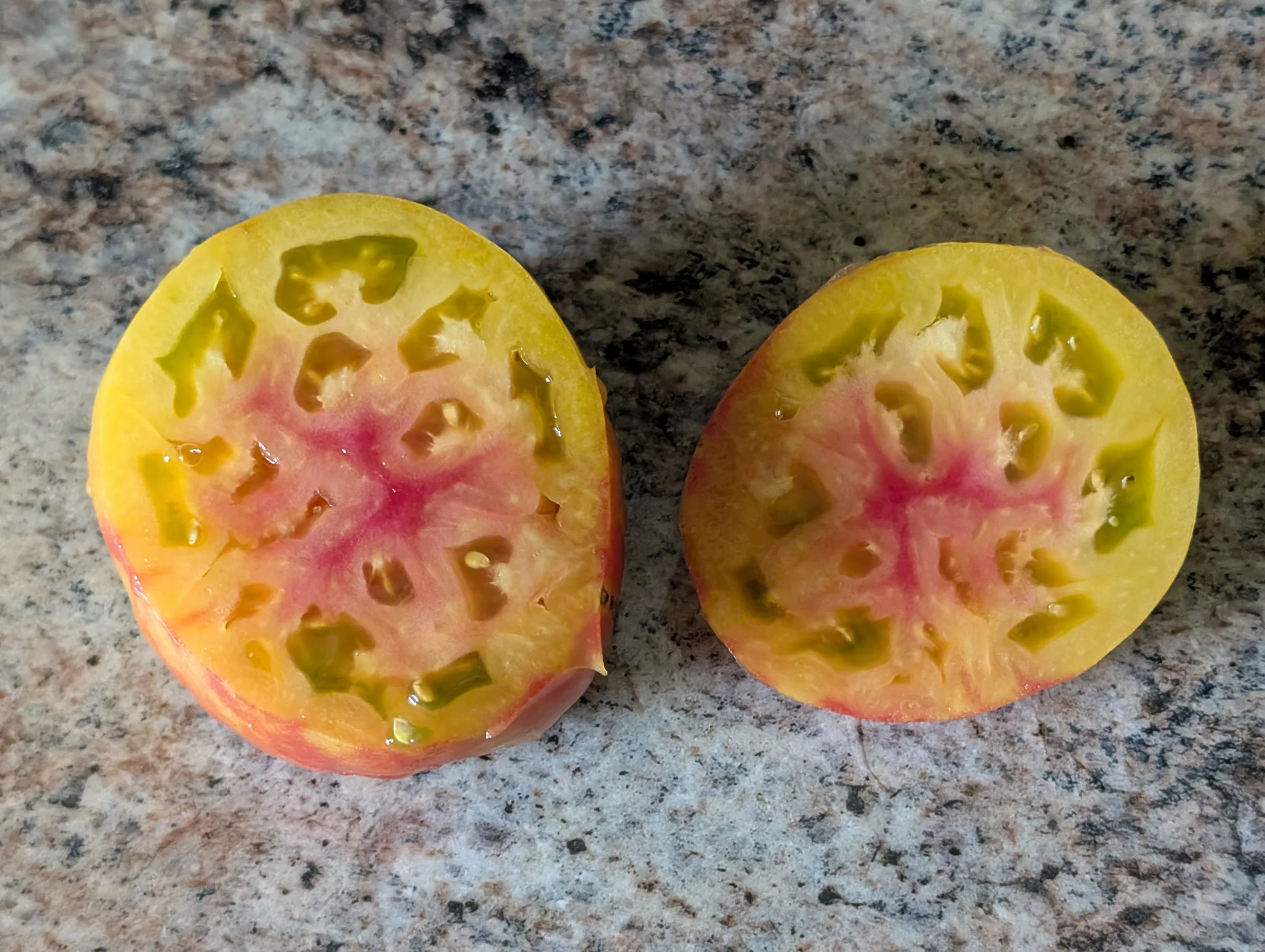
Dwarf Avenue K Garden, interior

Avenue K Garden - I planted F5 generation seed sent to me by Marsha as #8102. Marsha described this as a regular leaf good sized bicolor beefsteak, comparable to Dwarf Awesome. I really loved this one - it did tend on a few fruit to blunt heart. Flavor and texture are excellent. I saved seed as T26-62

Pleaser - I planted F5 generation seed from Marsha as #8104. Marsha described this as a potato leaf bicolor beefsteak., comparable to Dwarf Choemato. I noted a bit of a tendency toward heart shapes - but loved the color, flavor and productivity. I saved seeds as T26-61

Lillian Rose - When I crossed Cherokee Purple with Lillian’s Yellow Heirloom to create the Epic Family, I was astounded at the quality of the hybrid. One of the first selections I came across was a potato leaf medium sized purple pink tomato with a prominent yellow shoulder which I named Lillian Rose. Attempts to replicate that selection have thus far failed. In this year’s garden I grew out 8 selections in hopes of finding that initial potato leaf selection fruit type. Though the project didn’t succeed, I got to eat some superb tomatoes that did not hit the mark of my target. I felt that I ended up with 3 general tomato types - a yellow that was excellent - as well as distinct from Lillian’s Yellow; a pink with some yellow that approached my target, and a nice pink that is essentially Sullivan Rose. My next act for the Lillian Rose search is to grow out potato leaf plants from the original F2 seed.
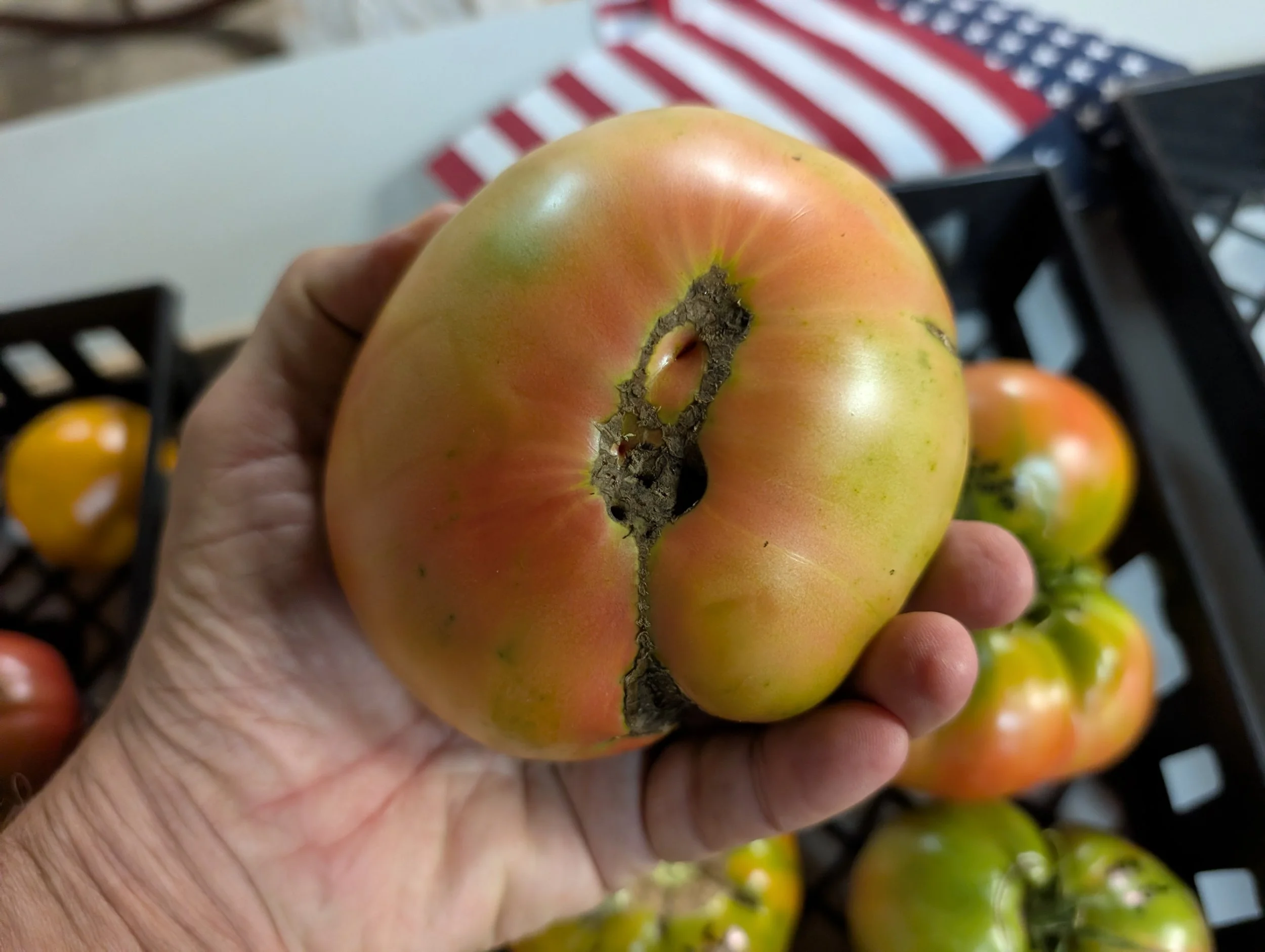
Lillian Rose attempt from T23-133

selection #T23-133. This was grown in 2023 from T22-15, which was seed from the target fruit. T23-133 came close but did not quite match my expectations. This year I grew one plant from T23-133 - it was potato leaf and produced lots of medium to large oblate pink fruit with some yellow mottling. The flavor was excellent. Seed was saved as T26-13. It isn’t Lillian Rose as I envision it, but it is not bad at all!

selection #T23-23. This was also grown in 2023 from T22-15. The one plant in my 2026 garden was very similar to T23-133 - even down to the slight bit of yellow mottling. I really liked it very much. Seed is saved as T26-14.
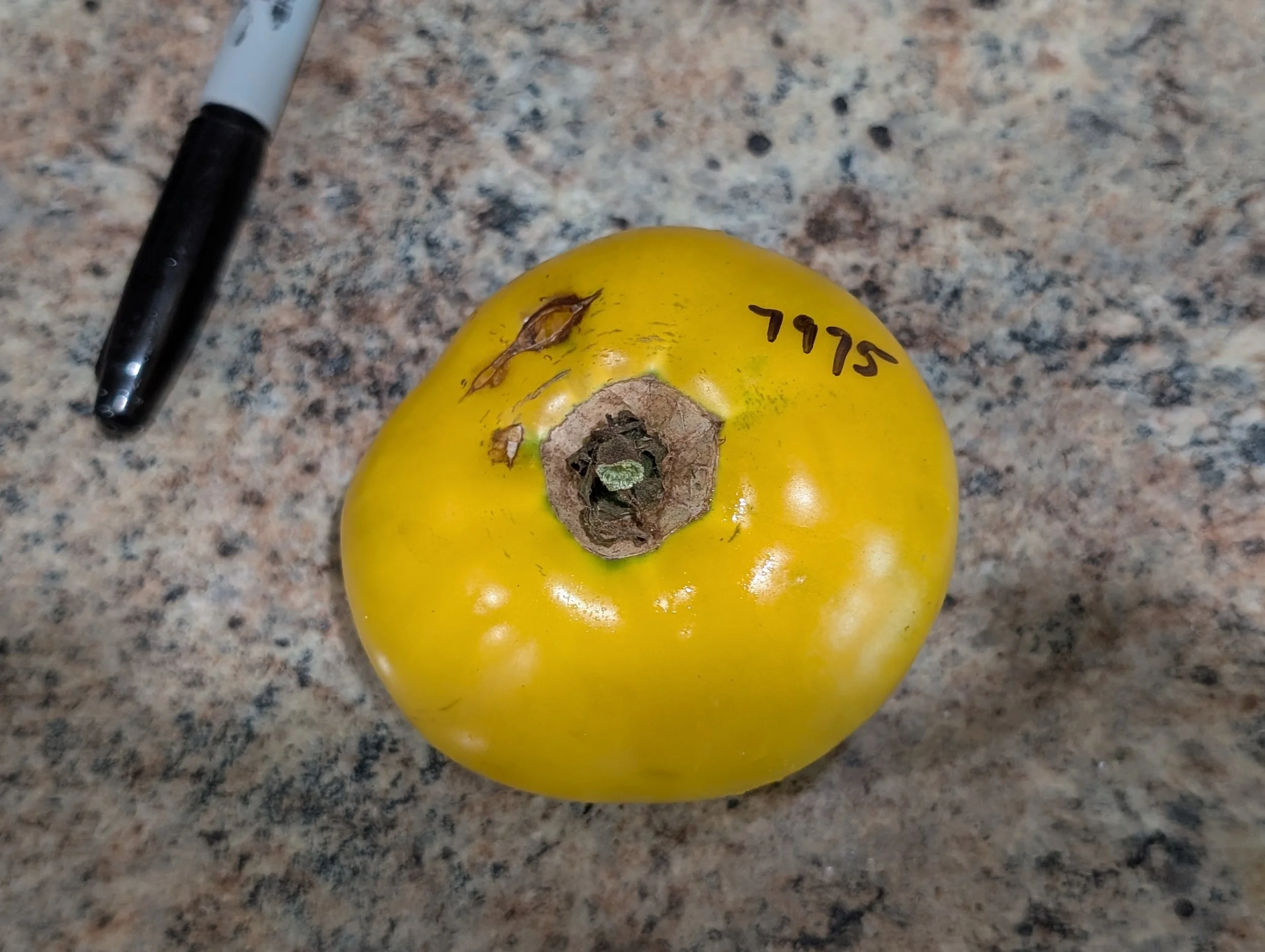
Lillian Rose attempt from #7975, stem end

selection #7975 was sent to me by John Arnold in 2023. It was grown from T22-15 - he got a yellow tomato. My plant from #7975 also gave me a medium to large yellow tomato with delicious flavor. The seed is.saved as T26-15. All of the yellows in this little project are different from the parent Lillian’s Yellow Heirloom and are well worth trying.
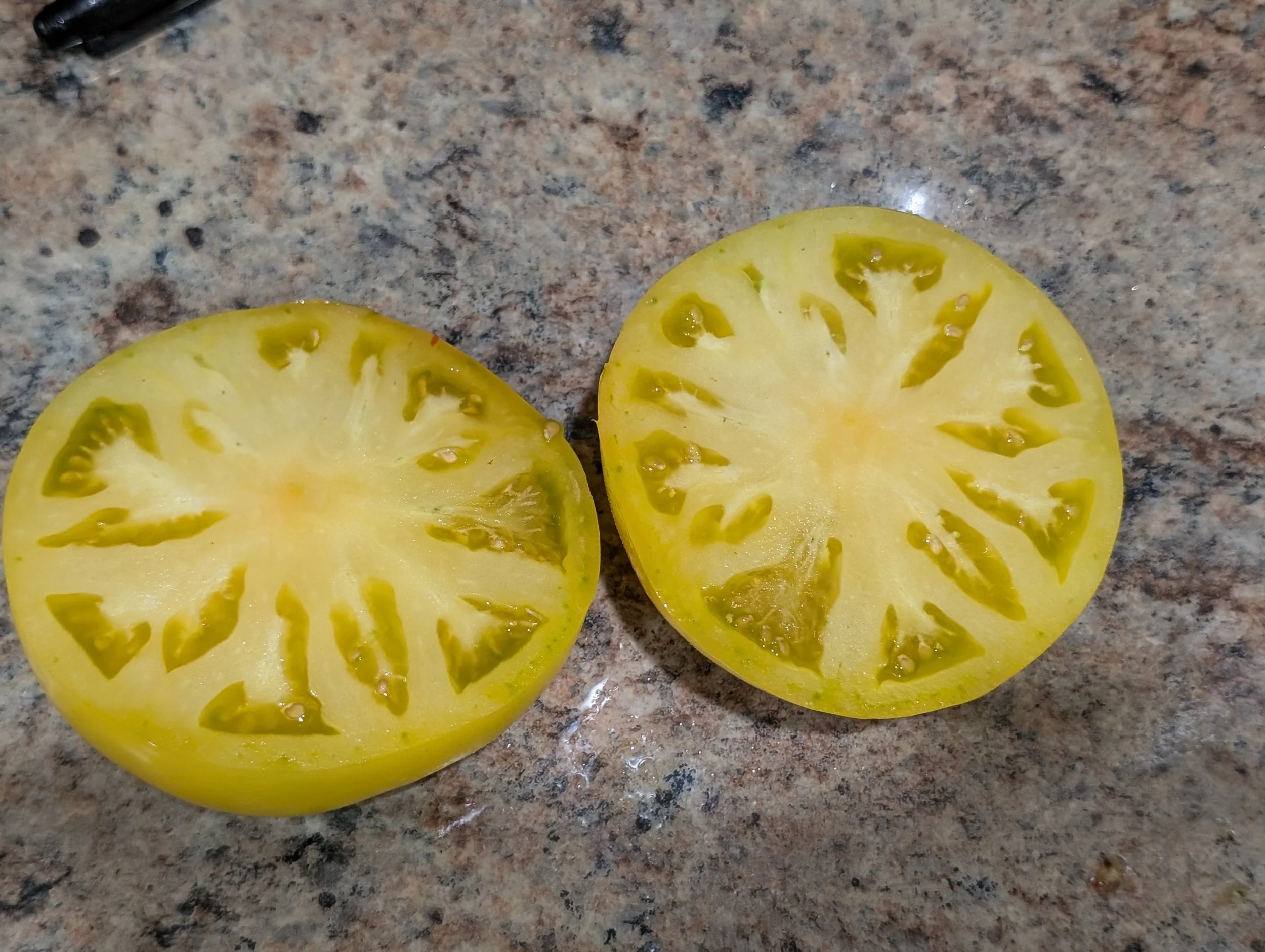
Lillian Rose attempt from #7950, interior

selection #7950 was sent to me by Bill Minkey - he also grew it from T22-15. He noted that it matched my Lillian Rose target, but my plant this year produced another wonderful yellow tomato. The seed is saved as T26-16
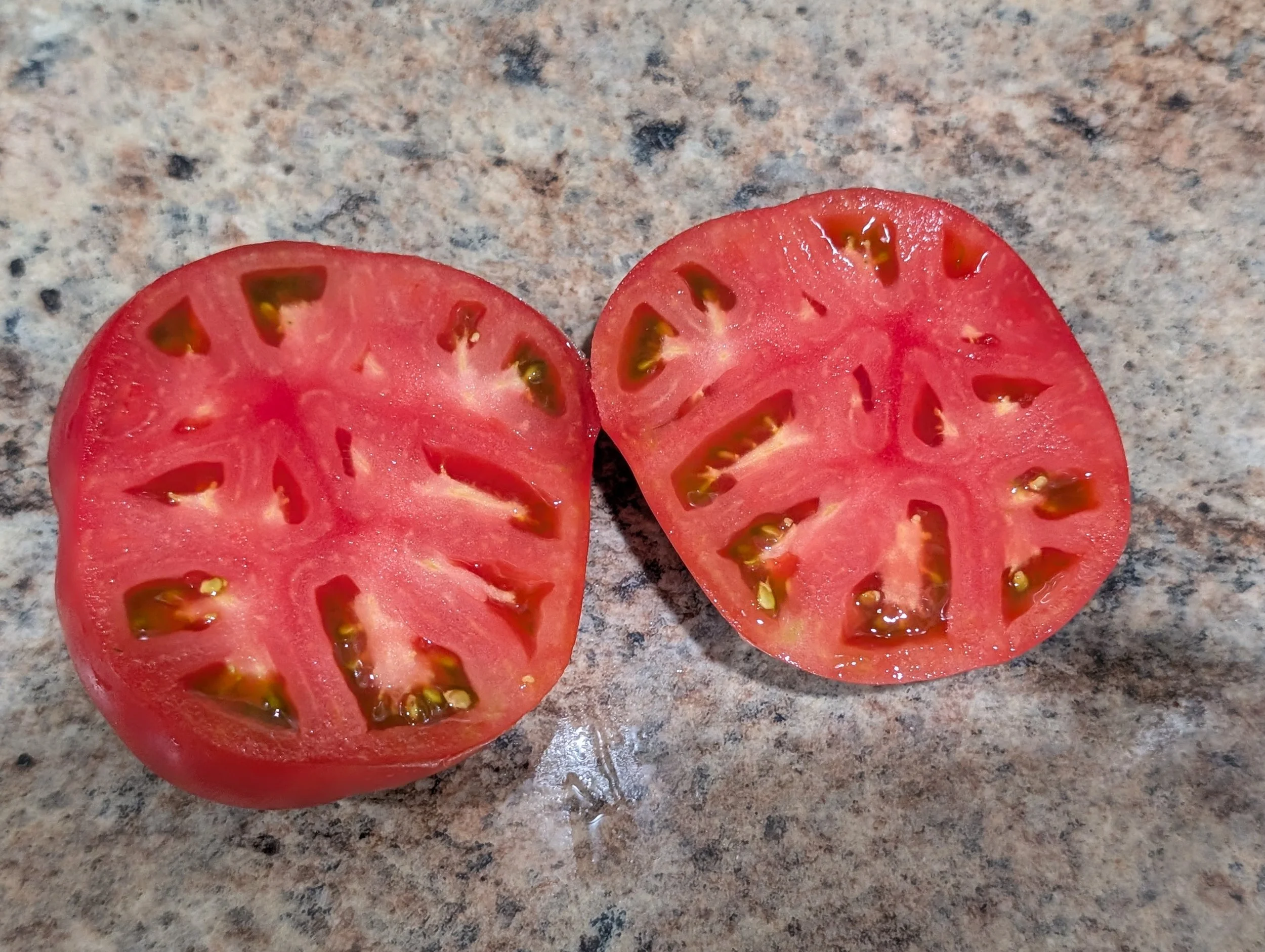
Lillian Rose attempt from #7974, interior

selection #7974 was sent to me by John Arnold - he grew it from T22-15 and described it as a pink tomato. I got a pink tomato as well, with excellent flavor, and consider this to be Sullivan Rose. Seed is saved as T26-17
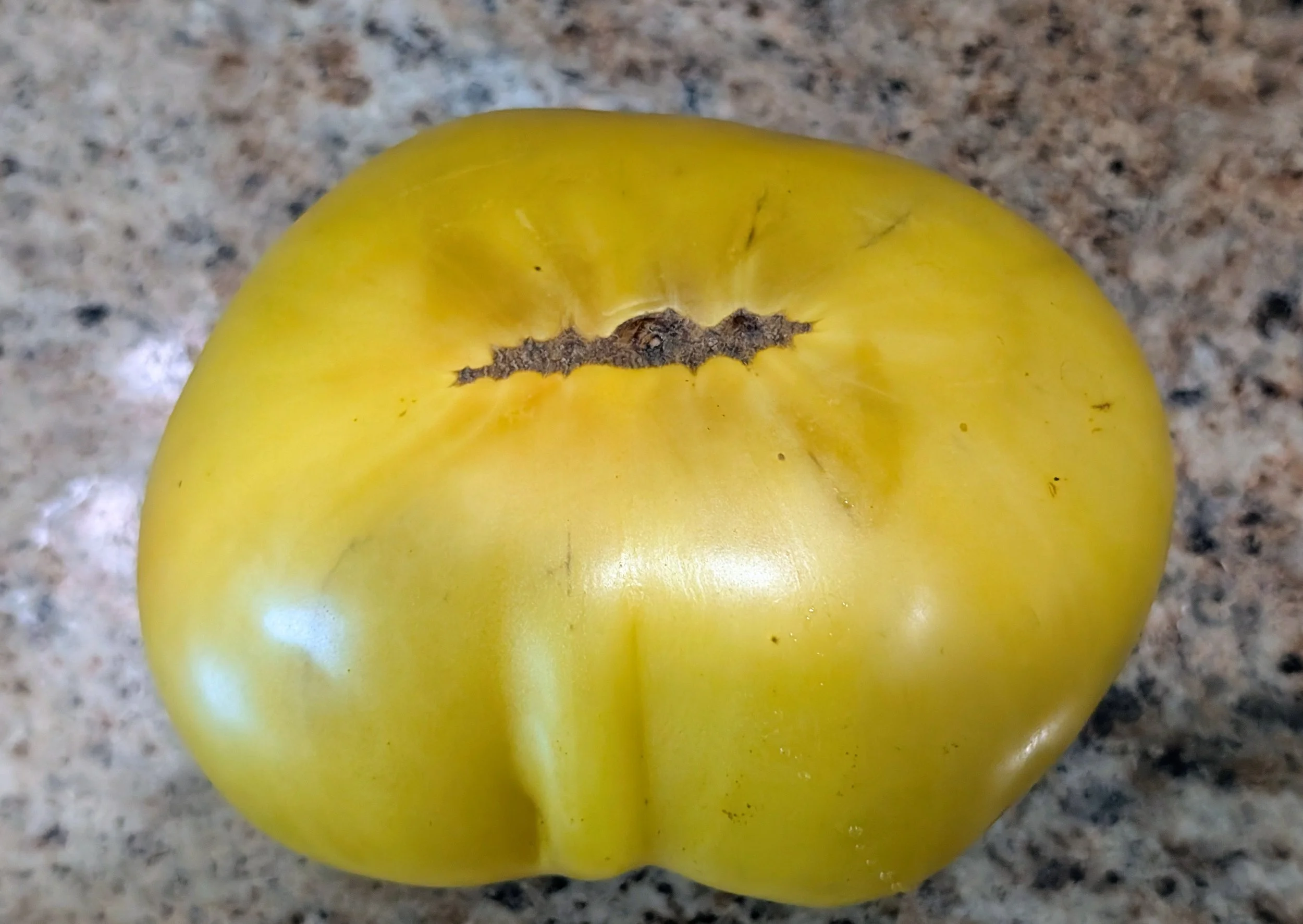
Lillian Rose attempt from #7972, blossom end

selection #7972 was sent to me by Jen Zawokski. She also grew it from T22-15, and didn’t include a description except to say it was a “best” tomato. I grew out one potato leaf plant and it produced loads of large oblate delicious yellow fruit. Seed is saved as T26-18
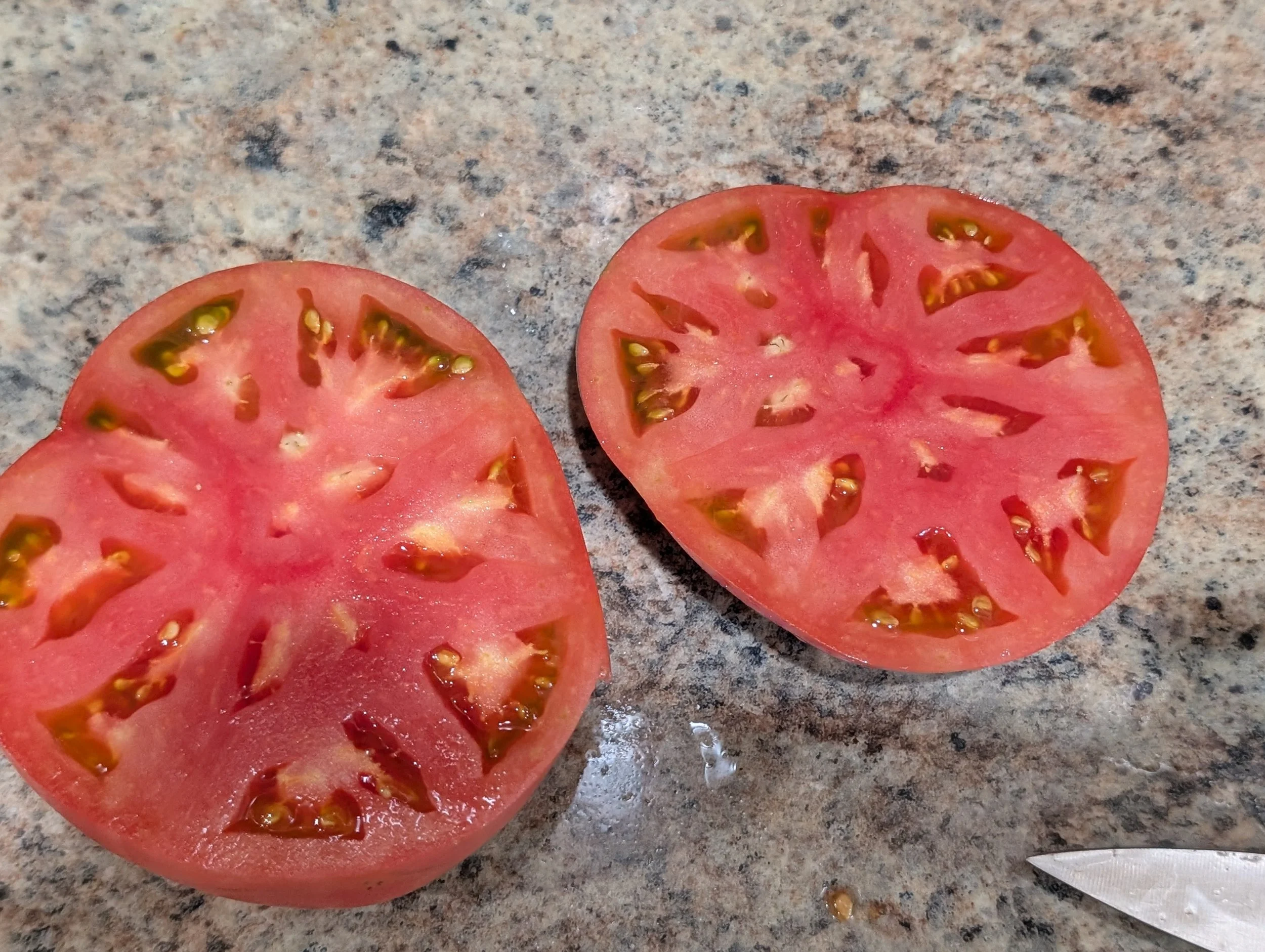
Lillian Rose attempt from #7971, interior

selection #7971 was sent to me by Mike Stiger, which he grew from T22-15. He ended up with one he named as Sullivan Rose - which I grew last year. My result this year is indeed what I experienced as Sullivan Rose. The seed is saved as T26-19. This is a fine tomato.
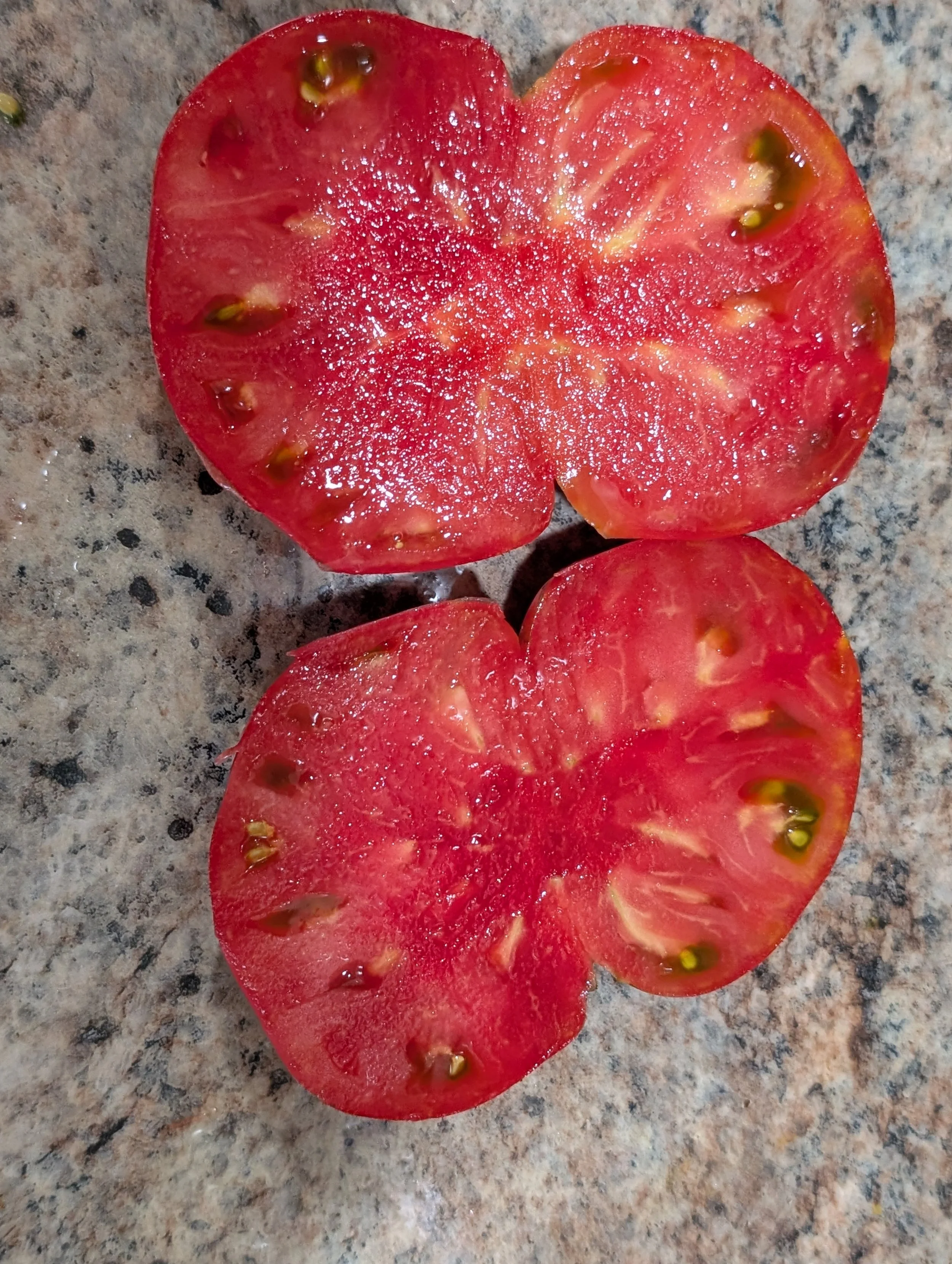
Lillian Rose attempt from T22-15, interior

selection #T22-15, seed saved from my named Lillian Rose, produced lots of large pink tomatoes with some yellow in the flesh - so it was close. The flavor was outstanding. Seed was saved as T26-27. This is well worth taking forward.

Yurple F2 - this project is a search for an Uluru Ochre colored tomato from a cross done by Alex Moring - Cherokee Purple X Potato Leaf Yellow, given the family name Yurple by Alex. I grew out his hybrid last year and obtained huge pink tomatoes on a regular leaf indeterminate plant - seeds saved as #T25-4. I planted a number of T25-4 and, as predicted, 25% of the seedlings were potato leaf. I decided to plant 2 potato and 2 regular leaf plants.
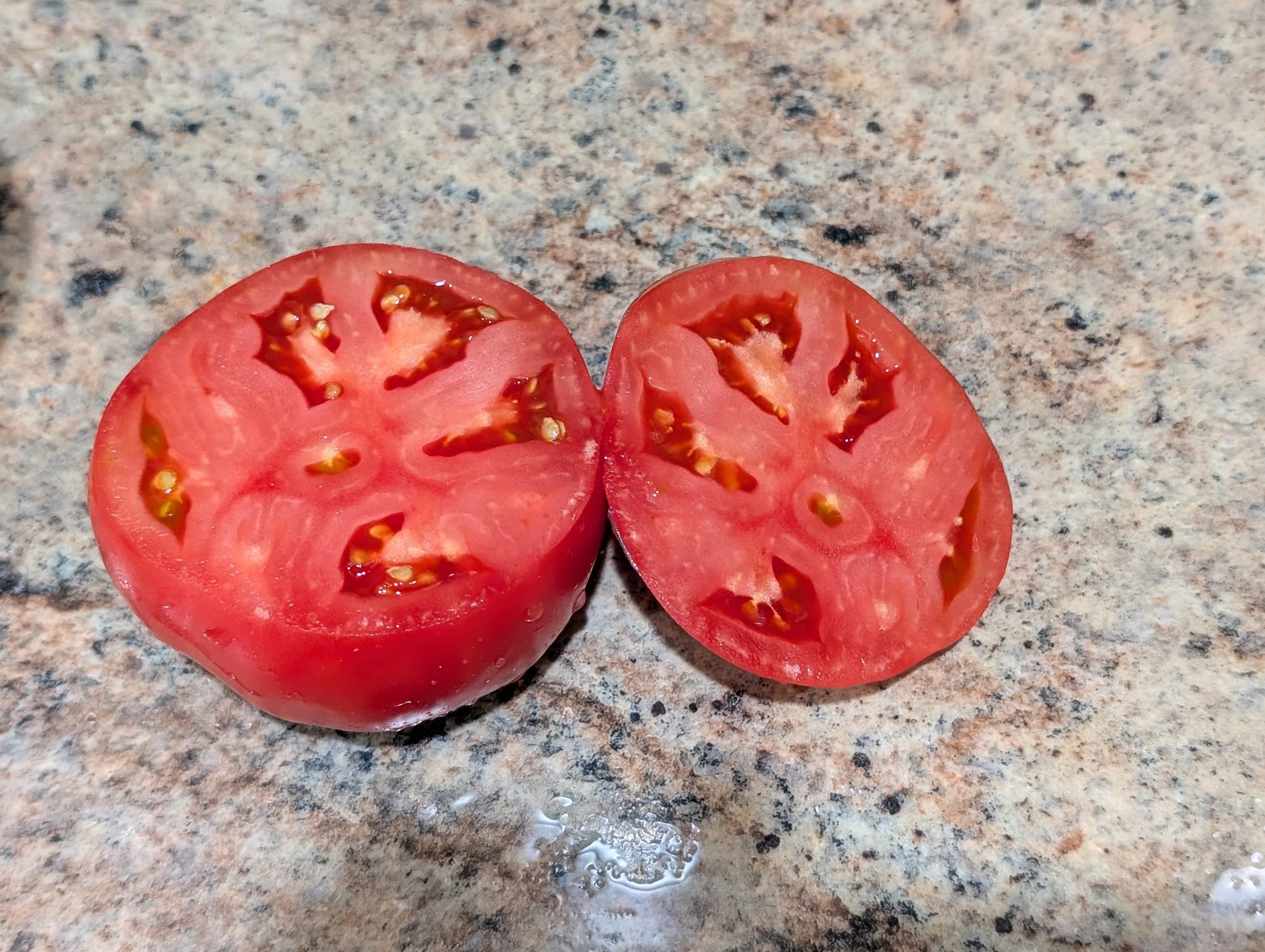
Yurple F2 potato leaf plant 1 fruit - this shows the interior structure of Potato Leaf Yellow.

Yurple F2 Potato Leaf selection #1 resulted in a heavy yield of medium to medium large smooth pink delicious tomatoes. Seeds were saved as T26-11.
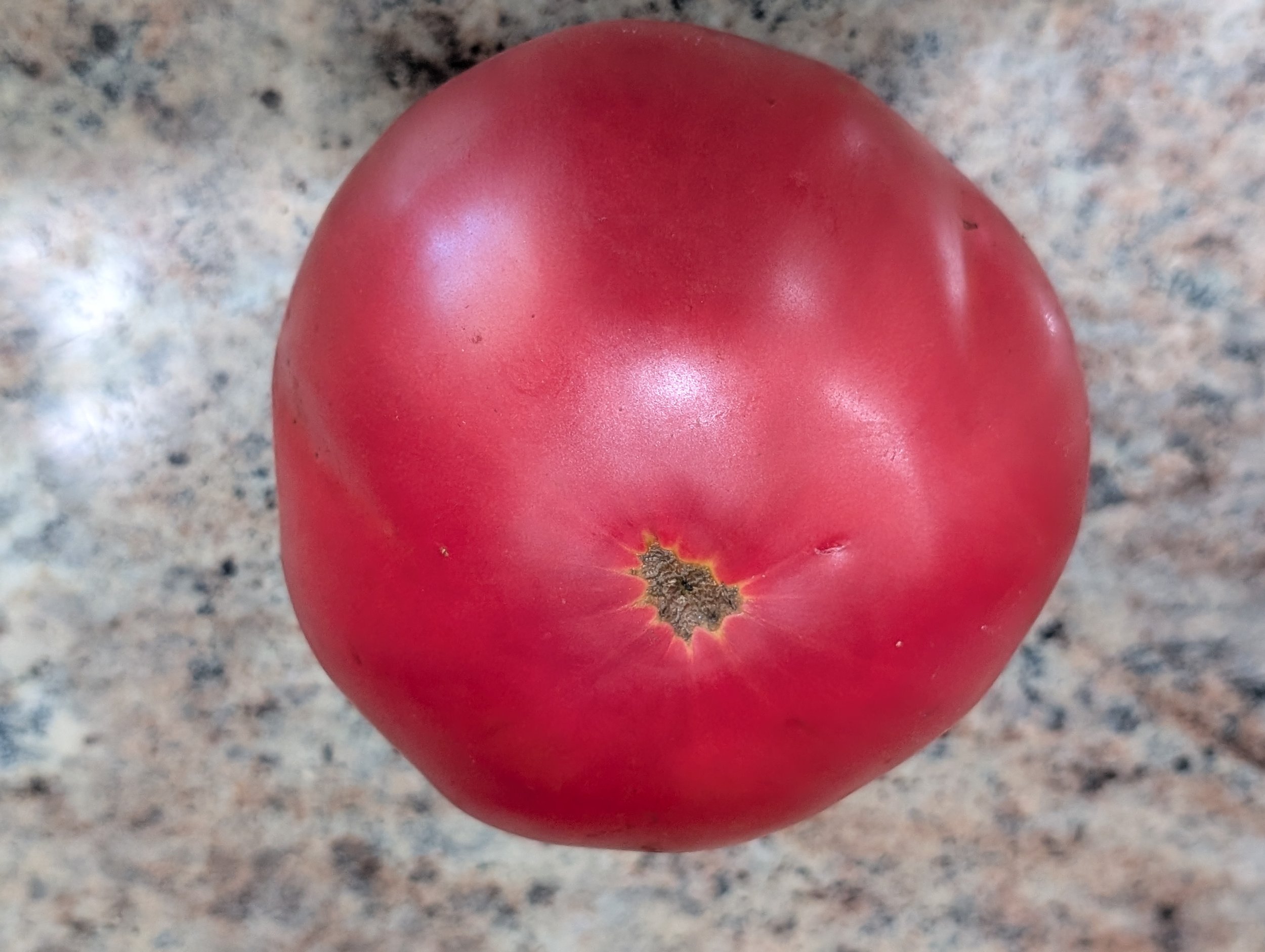
Yurple F2 Potato Leaf Plant 2, buttom
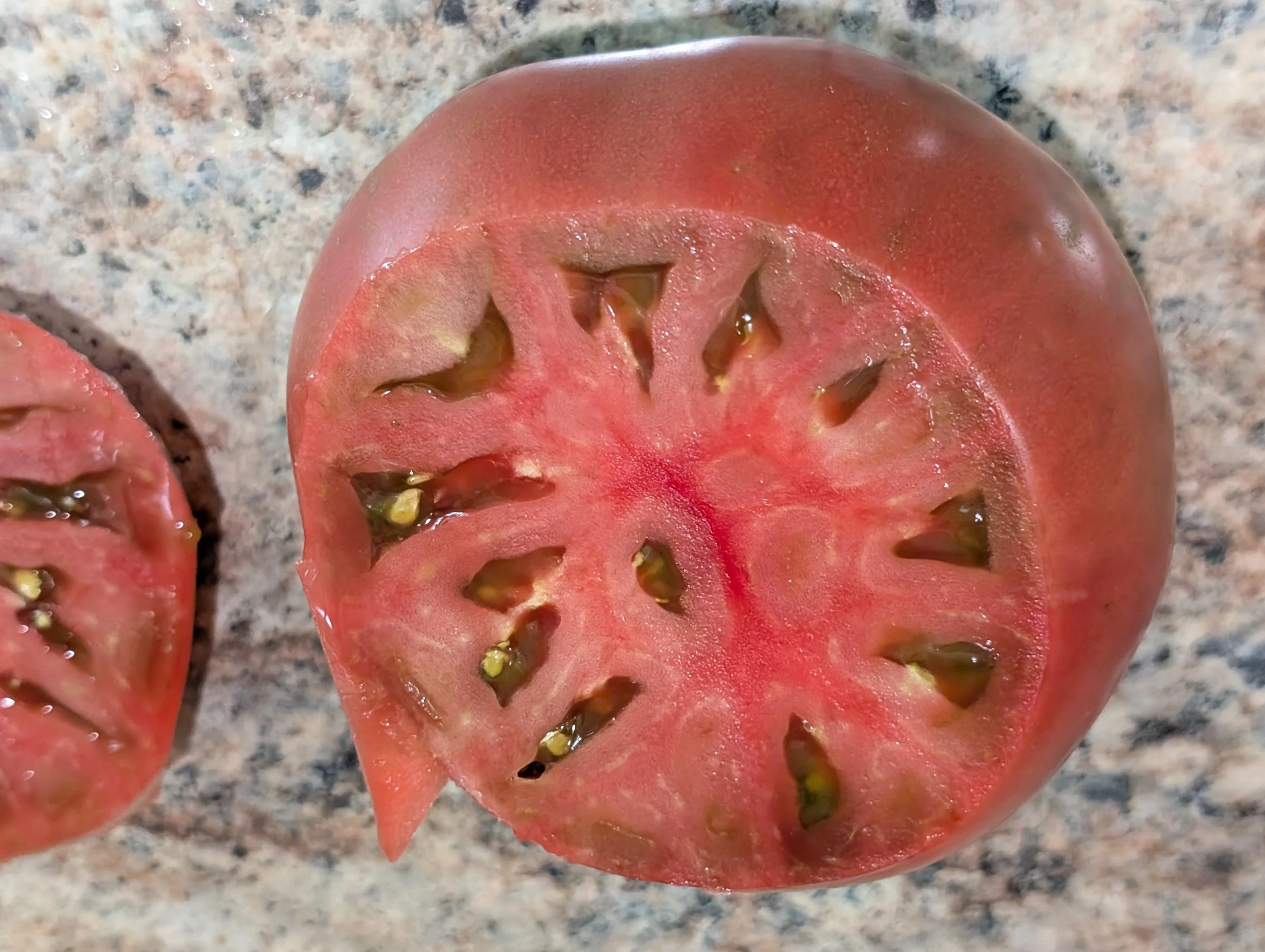
Yurple F2 potato leaf plant 2, interior. Structure is more like Cherokee Purple

Yurple F2 Potato Leaf selection #2 - This was one of the stars of the garden. The vigorous potato leaf plant was highly prolific, with large to very large oblate to nearly round purple tomatoes with a fine flavor. The seeds were saved as T26-28. I think that this is likely worth pursuing.
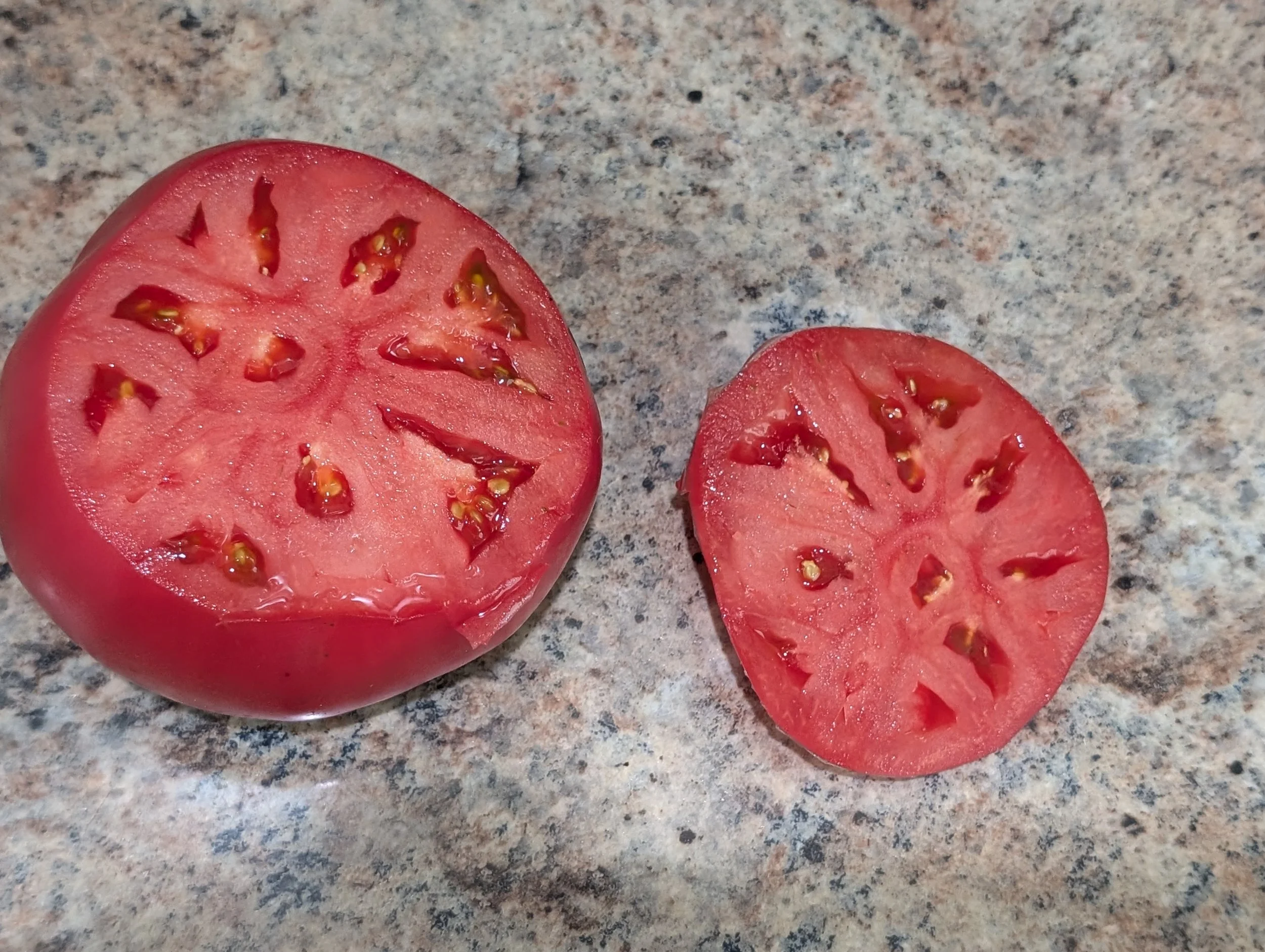
Yurple F2 regular leaf plant 1, interior. This also shows the interior of the Potato Leaf yellow parent.

Yurple F2 Regular Leaf selection #1 - This was the first plant in the garden to suffer signs of Fusarium Wilt, which severely curtailed the potential of the plant. I did get to harvest and save seeds from the medium to medium large oblate pink tomatoes, but did not taste them. The seeds were saved as T26-8
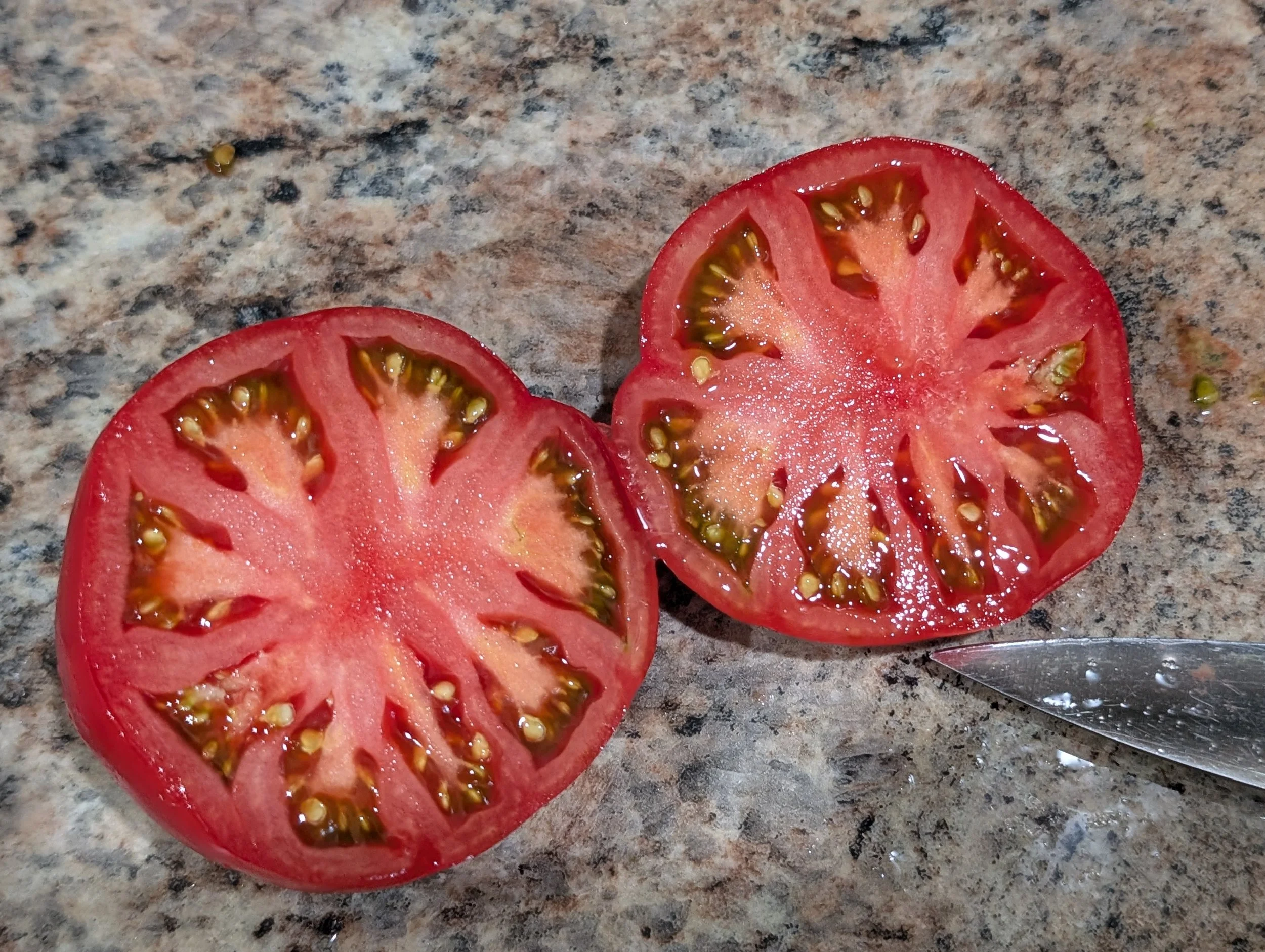
Yurple F2 Regular Leaf selection #2 - This fared much better in health and yield than Regular Leaf plant #1. The large pink fruits were just delicious. The seeds were saved as T26-12. With so many great regular leaf pink tomatoes in circulation, I don’t believe that this one is worth pursuing. Sadly, with my 4 plants from Yurple F2, I didn’t achieve the Uluru Ochre color I hoped for (but Alex did!).
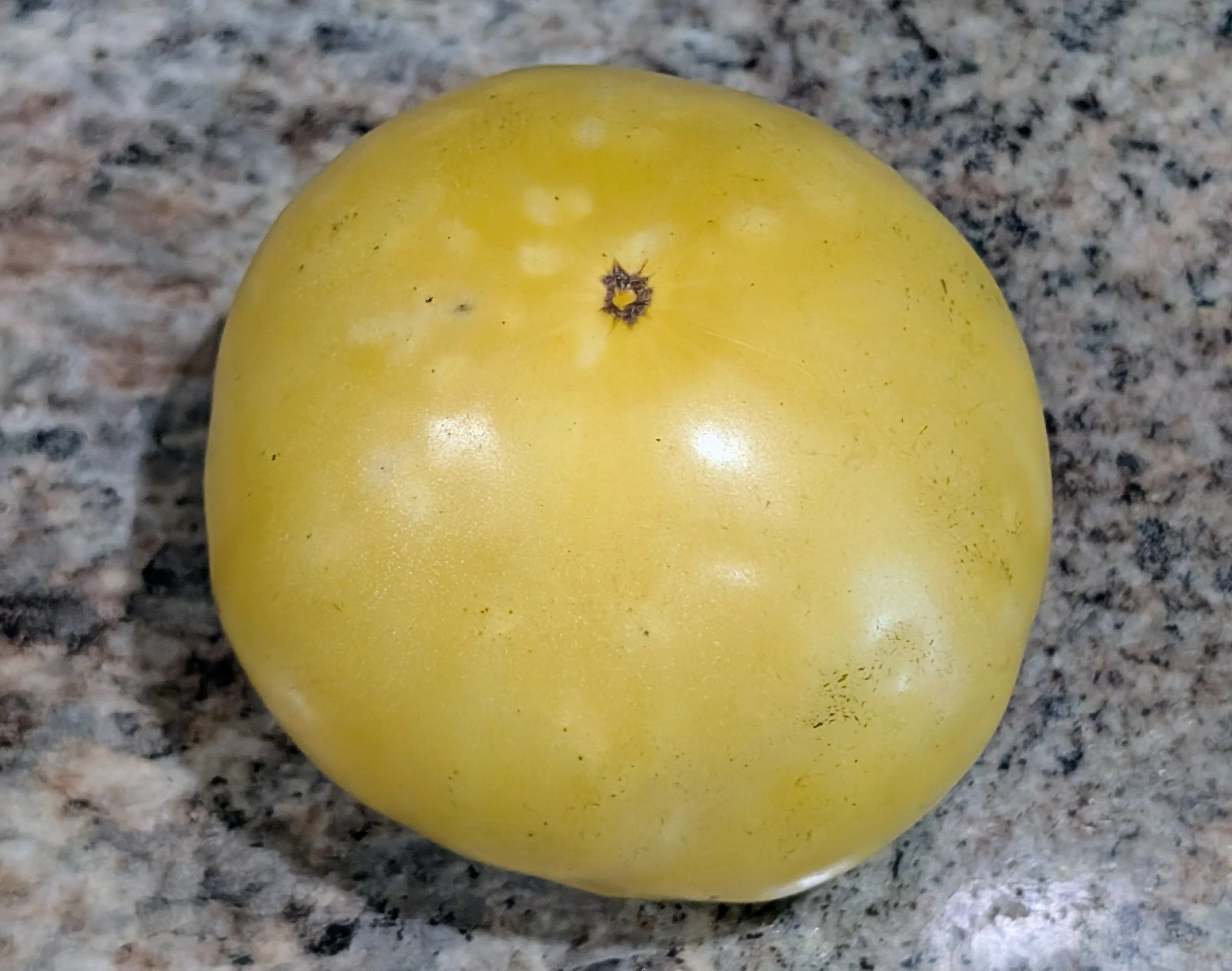
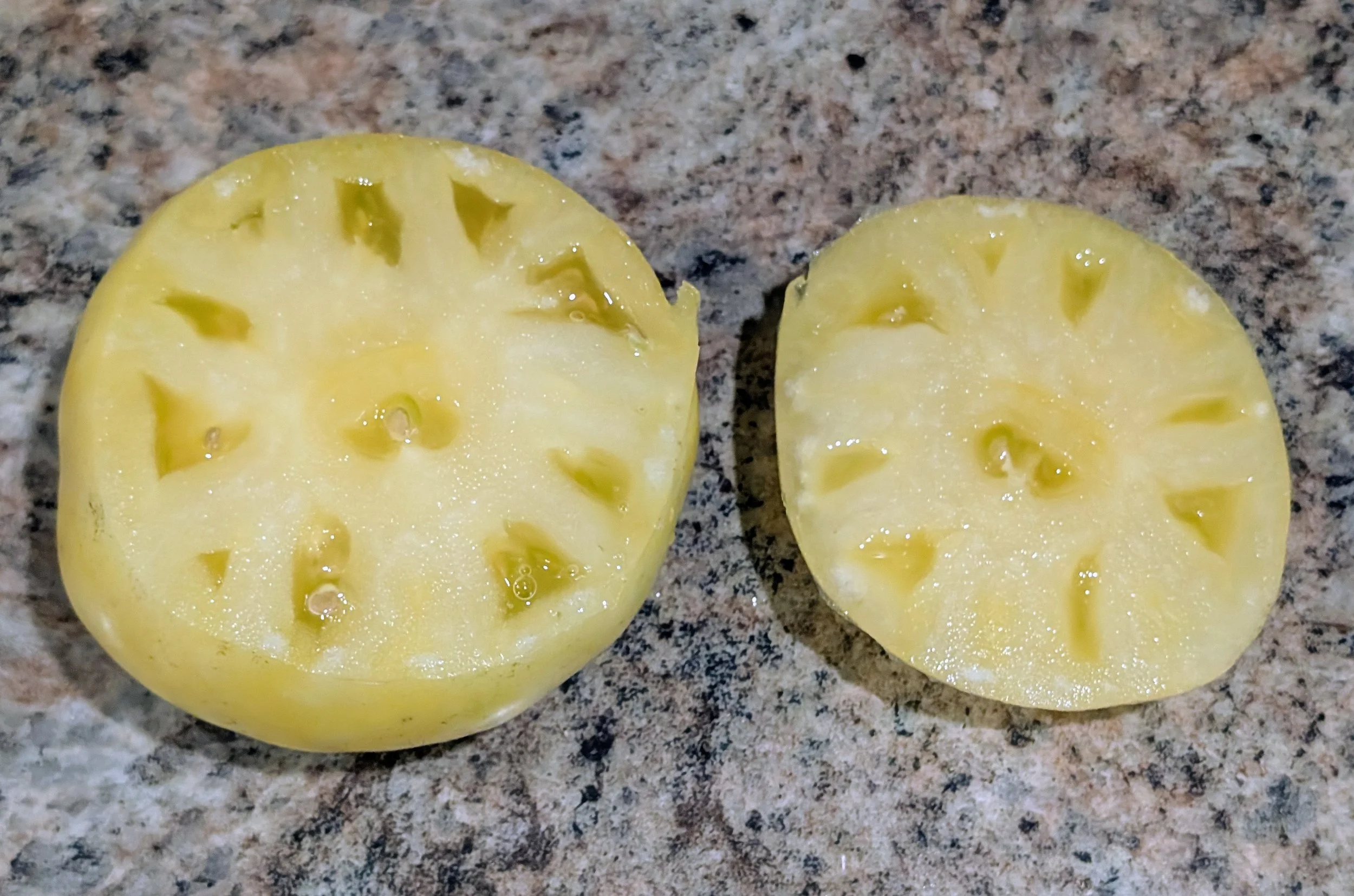
Dwarf Eli’s Surprise - planted #T25-32.The chartreuse leaf, potato leaf, variegated leaf tall dwarf plant gave medium sized delicious ivory tomatoes. This tomato was named for our grandson Eli, and is a unique tomato for gardeners to try. The seed was saved as T26-7

New F1s - test grows
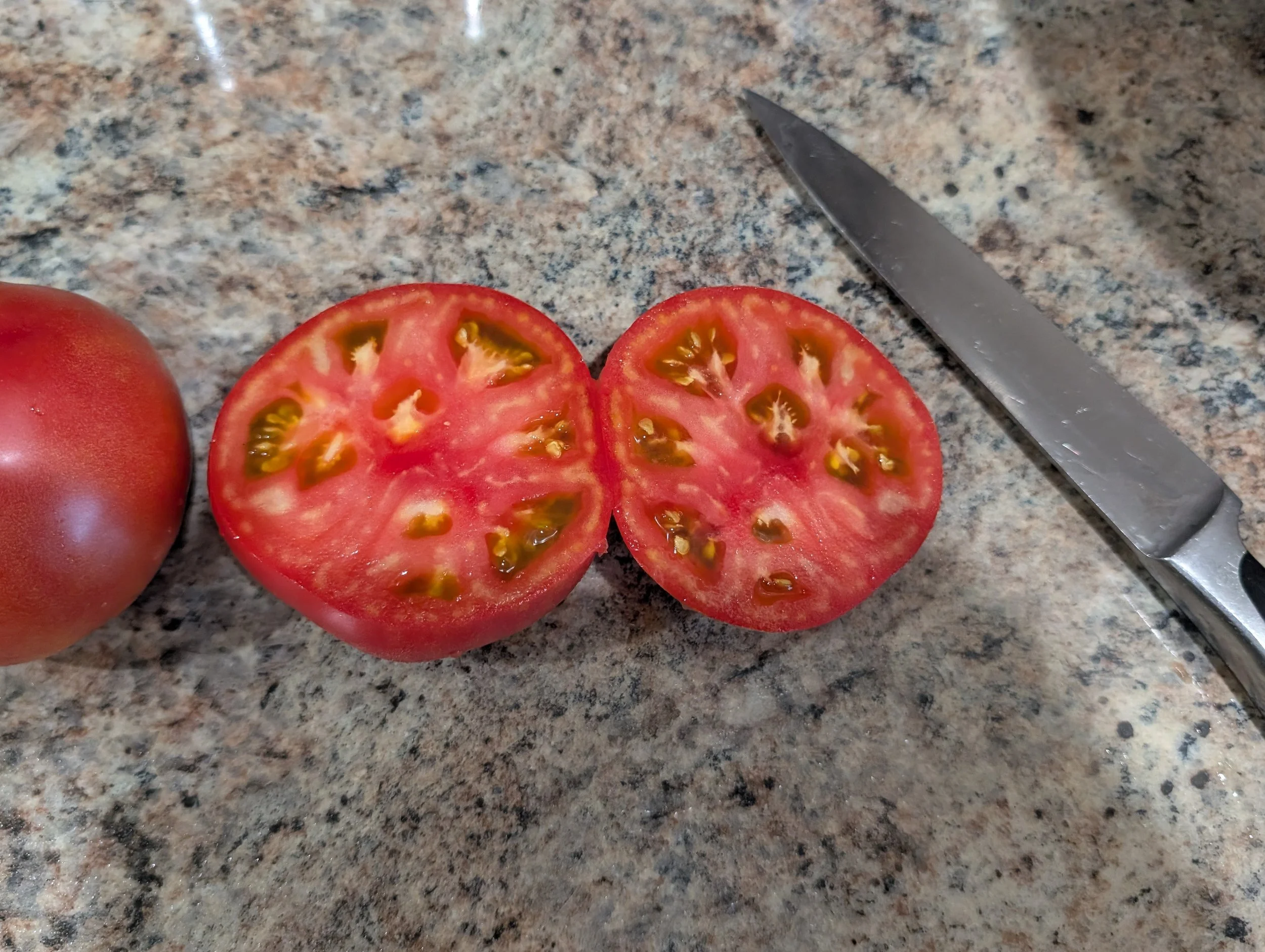
Dwarf Eli’s Surprise X Fuzzy Pink. Like the cross below, I confirmed that this was indeed the cross via the test planting, due to a few chartreuse plants. Pollen from Dwarf Eli’s Surprise was applied to Fuzzy Pink flowers. Confirmation of the cross was made when the resulting plants were regular leaf and non-fuzzy and indeterminate. The indeterminate productive plants yielded round medium sized pink tomatoes. To get this, I planted T25-89. The seeds from the resulting fruit were saved as T26-29. A test planting confirmed the cross, as there was an array of leaf types, plant types, leaf colors and fuzz levels. It is going to take a large planting next year to determine what I wish to pursue.
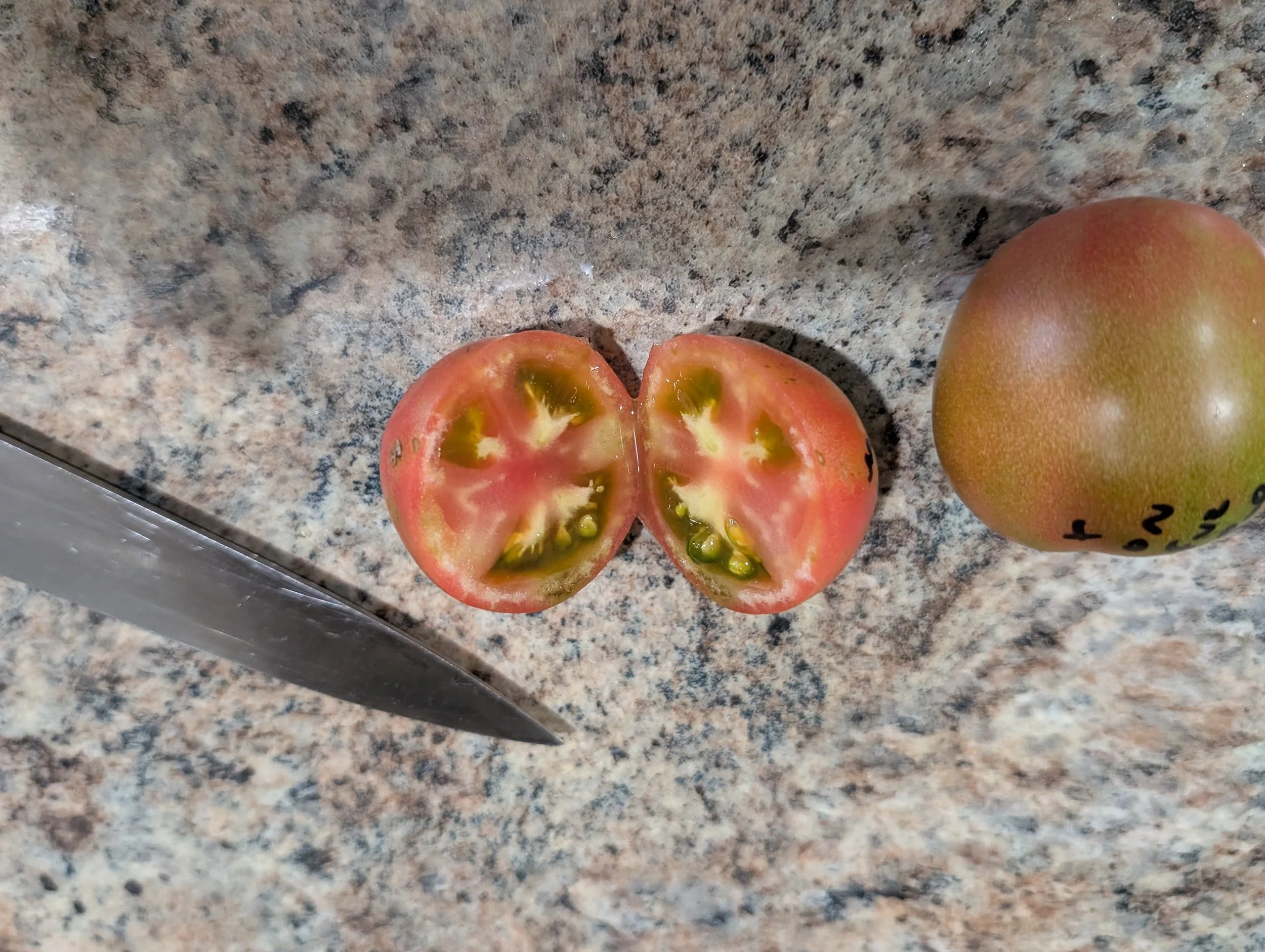
Dwarf Eli’s Surprise X Fuzzy Purple. The reason that I feel this is the cross emerged in the test planting. I did apply Dwarf Eli Surprise pollen to a flower on Fuzzy Purple. I planted T25-38, and a regular leaf, indeterminate non fuzzy plant resulted - the fruit were pink and small to small medium sized. .Seed was saved as T26-32. A test planting showed a mixture of many plant types - regular and potato leaf, chartreuse, fuzzy, even variegation. I do think that this is worth pursuing as a way to get a fuzzy leaf Dwarf Eli’s Surprise, but it is going to take a large planting to find the various possibilities.
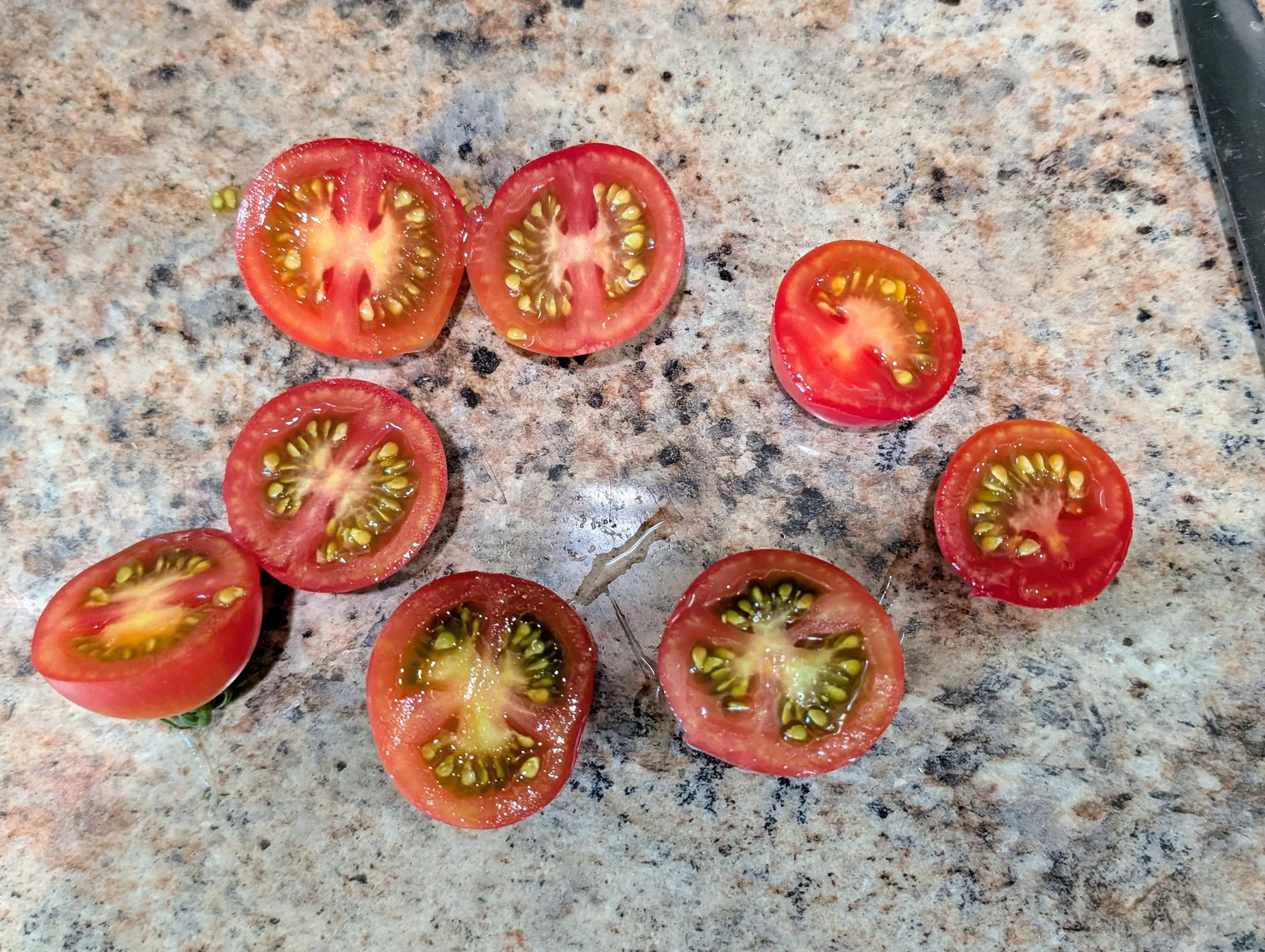
Dwarf Eli’s Surprise X undetermined. I tried a number of crosses onto Dwarf Eli’s Surprise, so will need to wait to see which one took. I planted T25-32 and found one regular leaf indeterminate plant. Growing it out, it provided loads of large pink cherry tomatoes, which is a bit of a mystery - none of my attempted crosses would have given fruits of this size in the F1. . I saved seeds as T26-64. A test planting showed a variety of outcomes - dwarf, indeterminate, potato leaf, regular leaf and chartreuse - none with variegation. I think this is likely a bee cross between Dwarf Eli’s Surprise and a cherry tomato, and feel that this is not really worth pursuing.

Potato Leaf Yellow X undetermined. Planted T25-17. One seedling was regular leaf, which is what was grown out. I did attempt a cross using pollen from Rufus Rainbow onto Potato Leaf Yellow. The large pink fruit provided seed that was saved as T26-67. A test planting showed a mixture of regular and potato leaf, but none showed variegation. I therefore have no idea what crossed with Potato Leaf Yellow (thanks, bees!) - and also think that this is not worth pursuing.
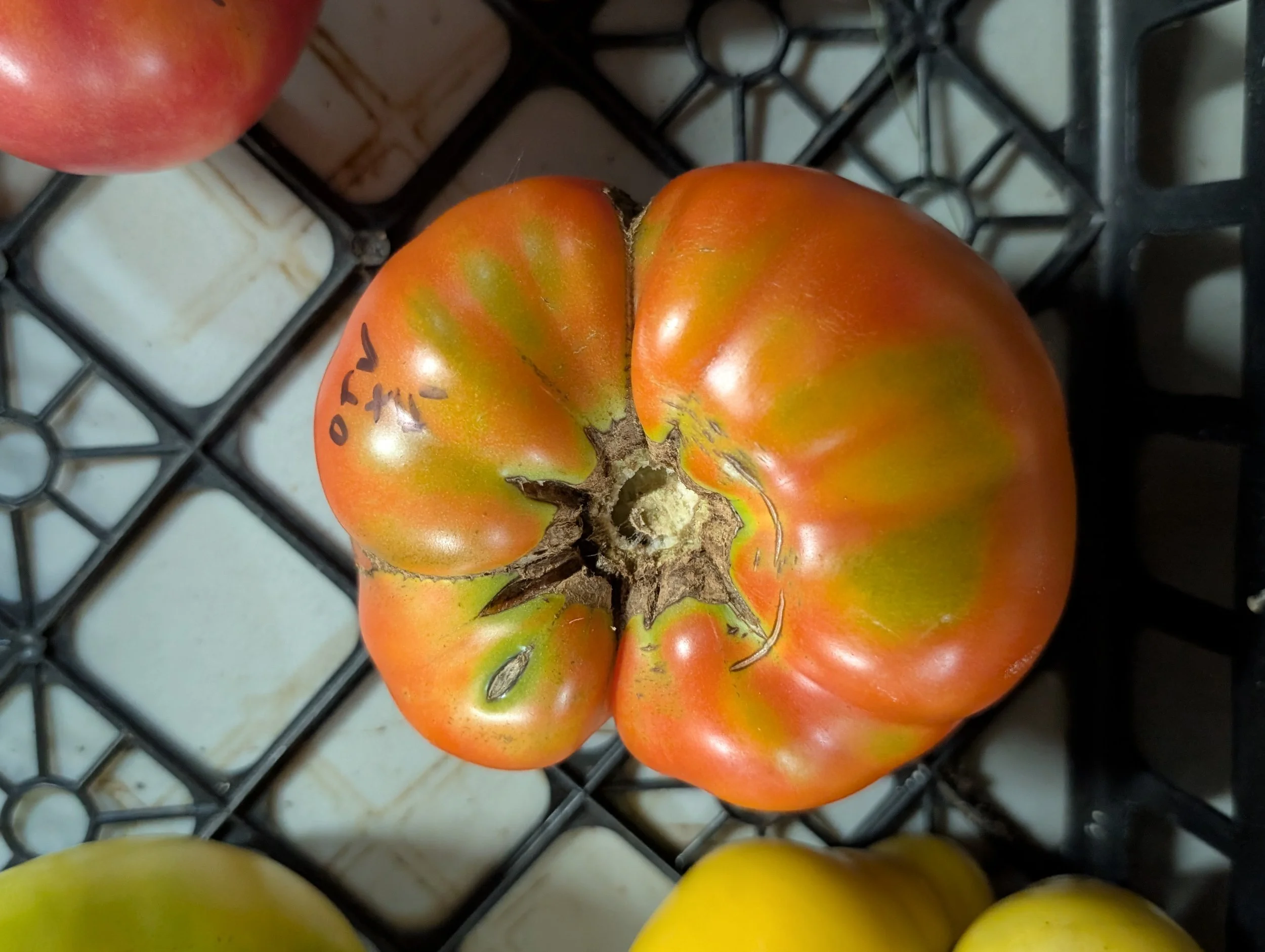
OTV Brandywine X undetermined. Planted T25-15 and ended up with one regular leaf indeterminate plant. I did attempt a cross onto OTV Brandywine last year, using pollen from Honor Bright. The fruit was large and scarlet red. Seed was xaved as T26-31. A test planting showed a mix of regular and potato leaf seedlings, but none showed the tell tale yellow leaf tendency of Honor Bright. It is therefore clear that I have no idea what OTV Brandywine was crossed with. This may not be worth pursuing.
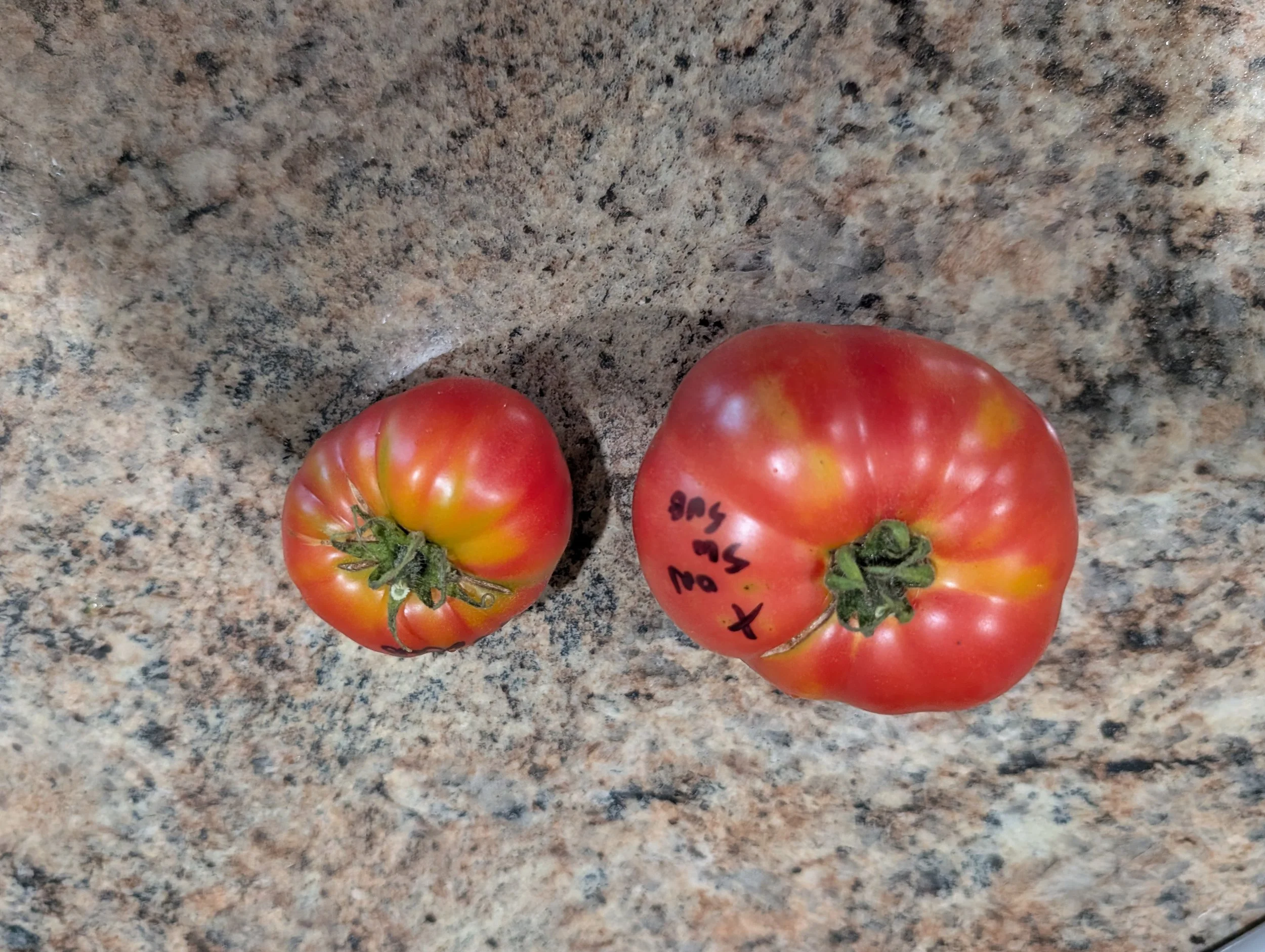
Dwarf Sweet Sue X Fuzzy Pink. Planted T25-44. The regular leaf indeterminate plant produced a heavy yield of oblate, slightly ridged tomatoes that were pink in color. Because the cross was Fuzzy Pink pollen on to Sweet Sue flowers, the confirmation of the cross was regular leaf, indeterminate and non-fuzzy plants. Seeds were saved as T26-30. A test planting showed great diversity - indeterminate, dwarf, various gradations of fuzzy, potato leaf and regular leaf. I am going to need to plant a minimum of 40 seeds to find what I seek next year - a fuzzy, dwarf growing potato leaf plant.
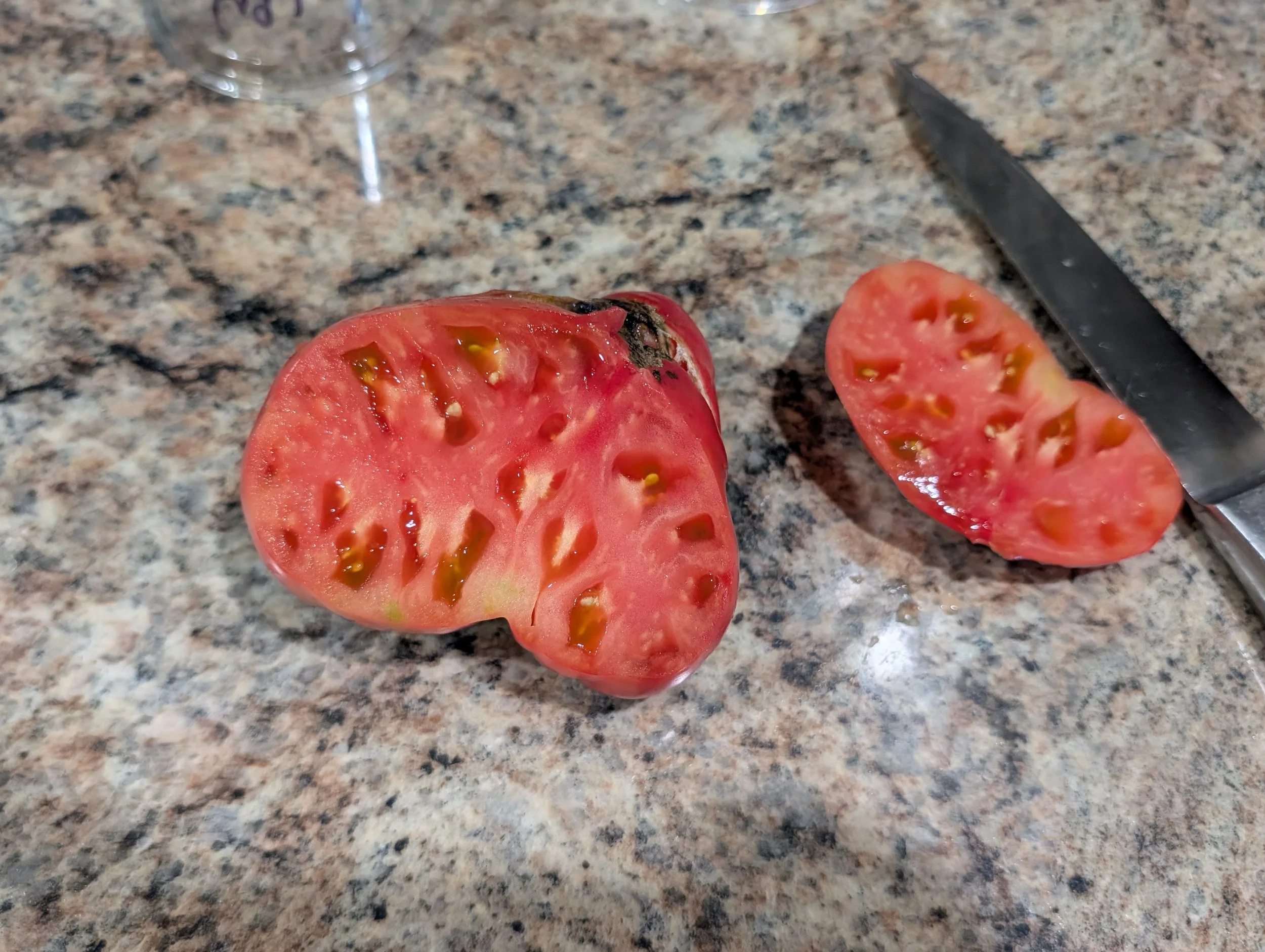
Off leaf type from Dwarf Sweet Sue X Fuzzy Pink. Planted T25-44. This leaf type was grown separately - the leaves curled more, and the oblate pink fruit were more heavily creased and a bit larger. It was saved as T26-34. A test planting showed no variability at all - this just may be an unfuzzy selection of the Fuzzy Pink (I’ve heard that it is virtually impossible, due to genetics, to get 100% stable fuzzy open pollenated selections). I don’t feel as if this is worth pursuing.

Captain project - this was described in great detail in the prior blog - link is here.

Triply project F2 selections. Triply is my cross between the hybrid of Dwarf Choemato and Dwarf Walter’s Fancy with Cherokee Purple. I grew the hybrid last year - it was an indeterminate delicious prolific round medium large pink tomato. For this year’s selection work, I grew out T25-2 - the F2 generation seed. I ended up choosing all variegated specimens to plant, as described below. The results were truly exciting.
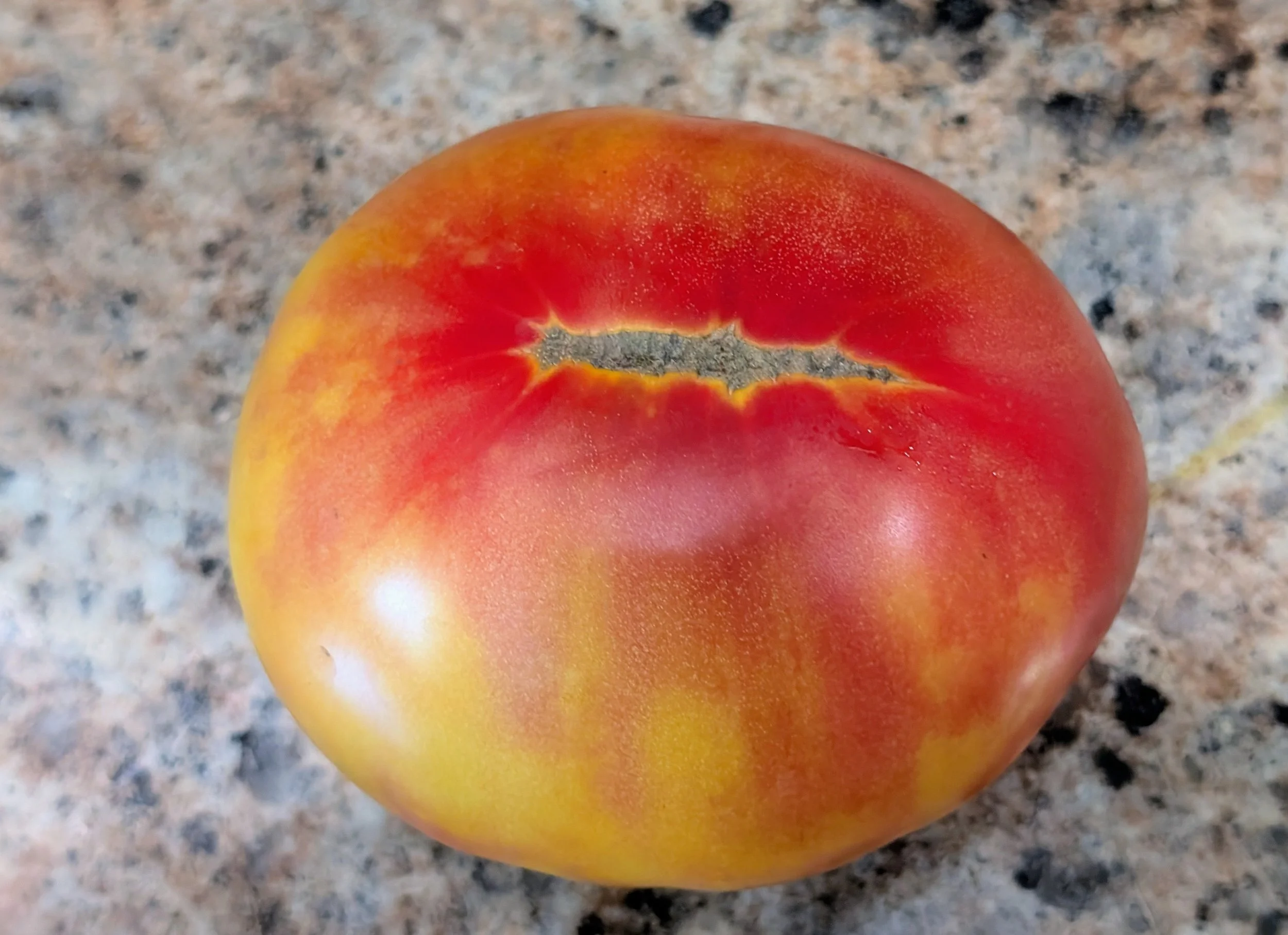
Craig’s Folly, blossom end
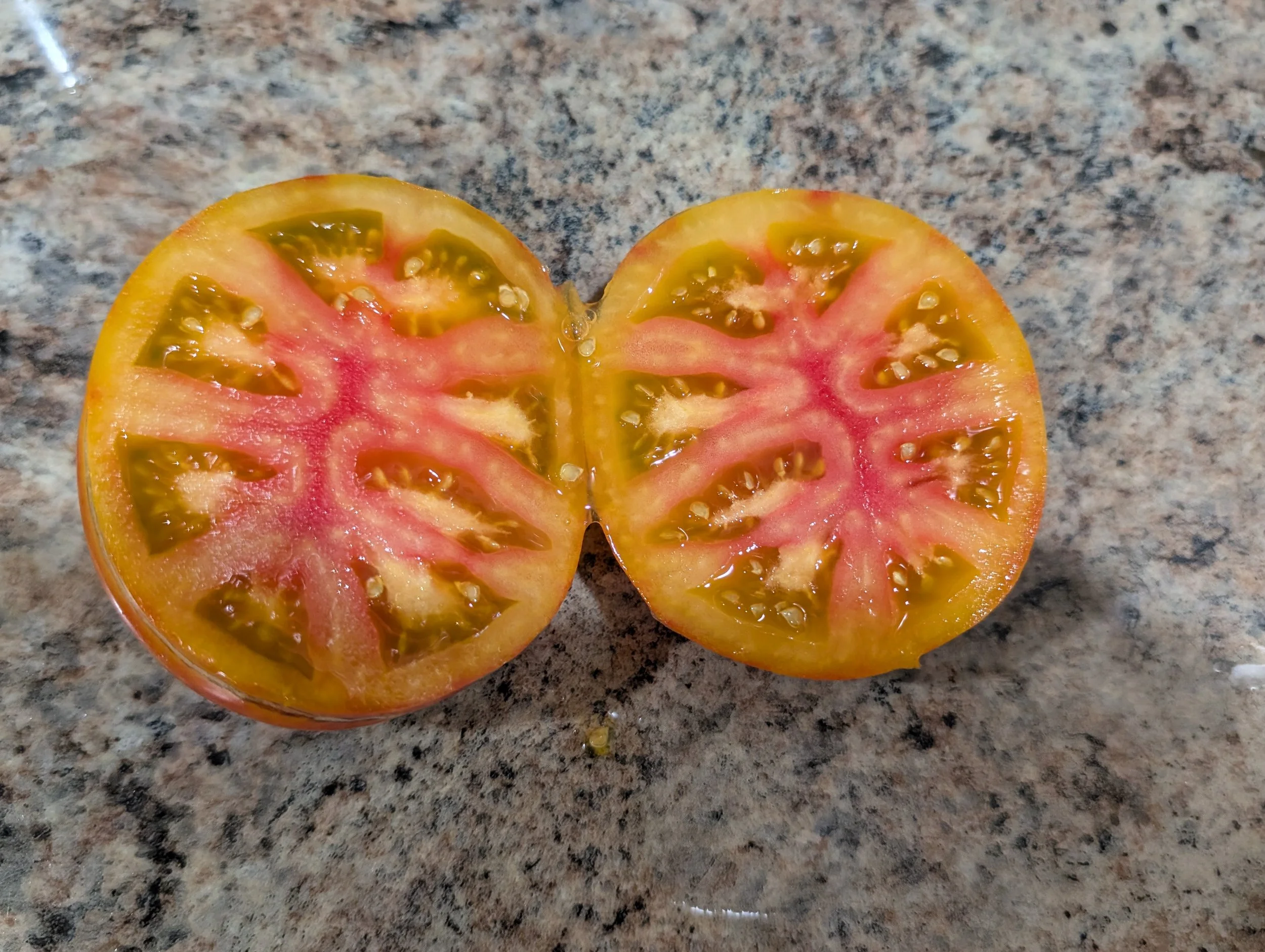
Craig’s Folly, interior

The regular leaf variegated leaf indeterminate plant provided totally delicious, full flavored medium to medium large smooth, oblate yellow tomatoes with significant red swirling and streaking inside and out. It is still early days, but this is so promising it got a name - my name, in fact. The F3 seed was saved as T26-68 - and is named Craig’s Folly. It will need significant testing going forward prior to release.
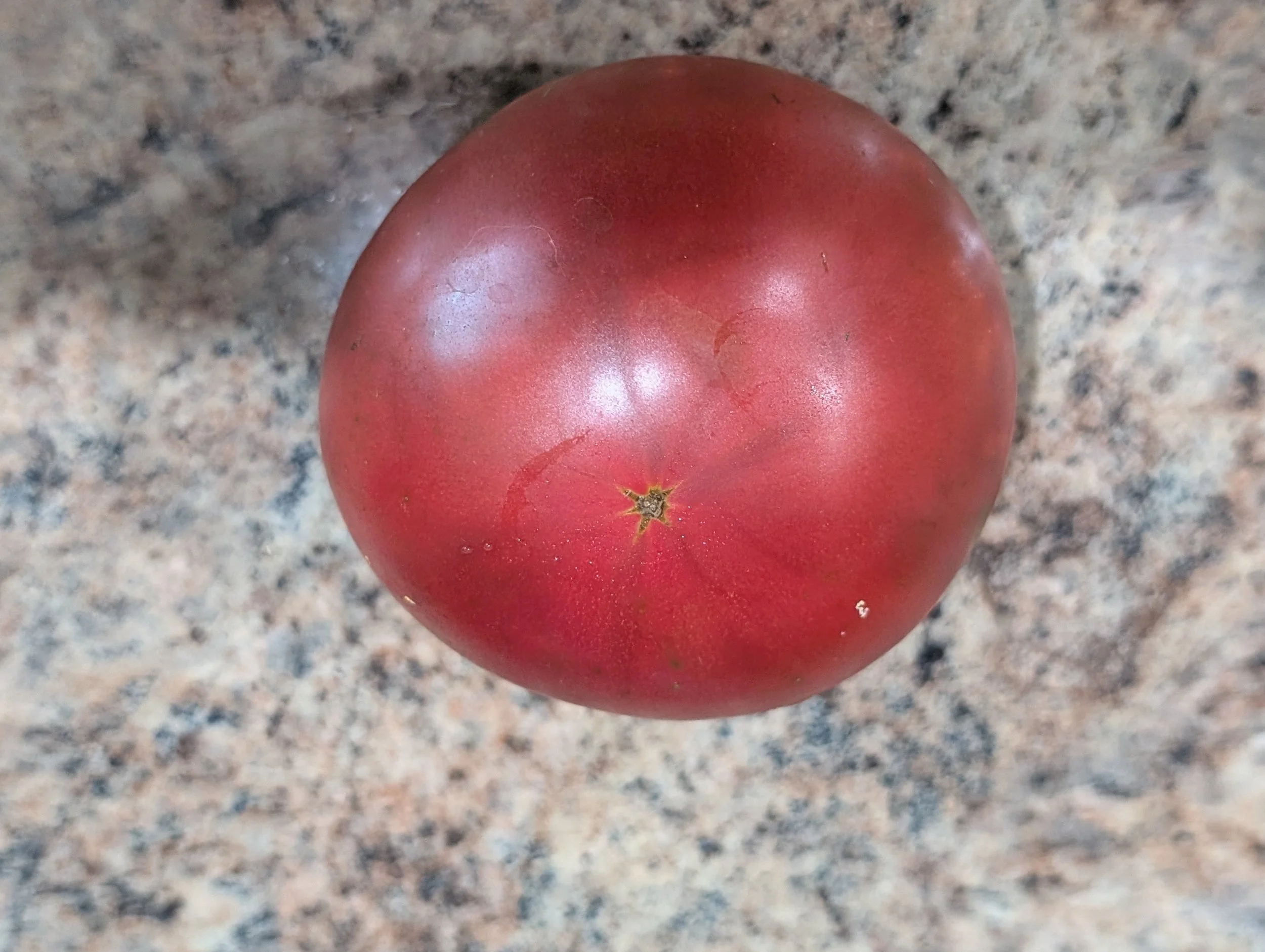
Variegated potato leaf purple blossom end
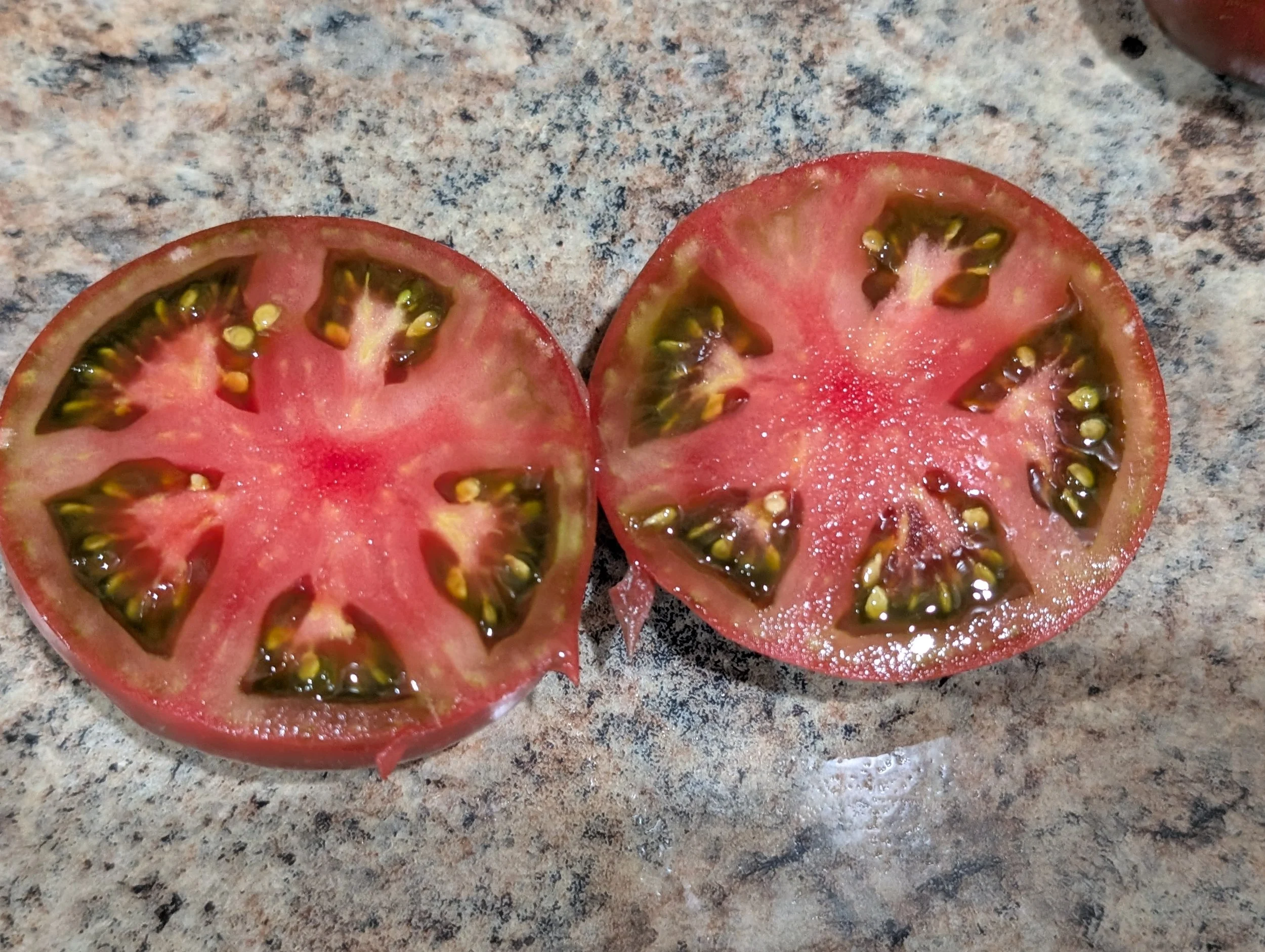
Variegated potato leaf purple interior

The potato leaf variegated leaf indeterminate plant was highly productive, affording medium to medium large purple tomatoes with a delicious flavor. The seed was saved as T26-25. Whether this merits naming and release depends upon how it compares to Polish Bling, another purple tomato with variegated potato leaf foliage. I tend to think that they are quite different in fruit size, shape and flavor.
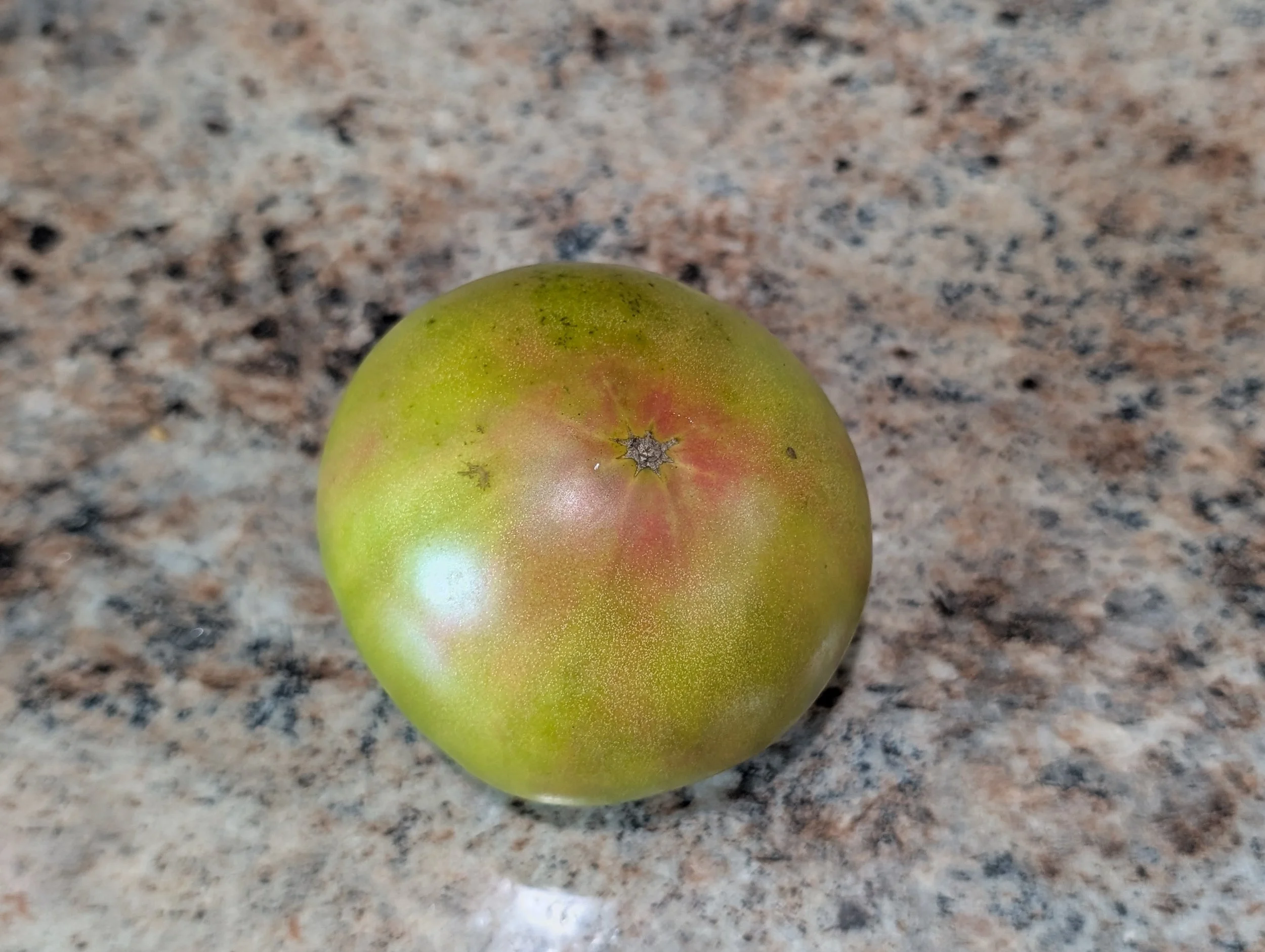
Variegated potato leaf dwarf plant 1 fruit, blossom end
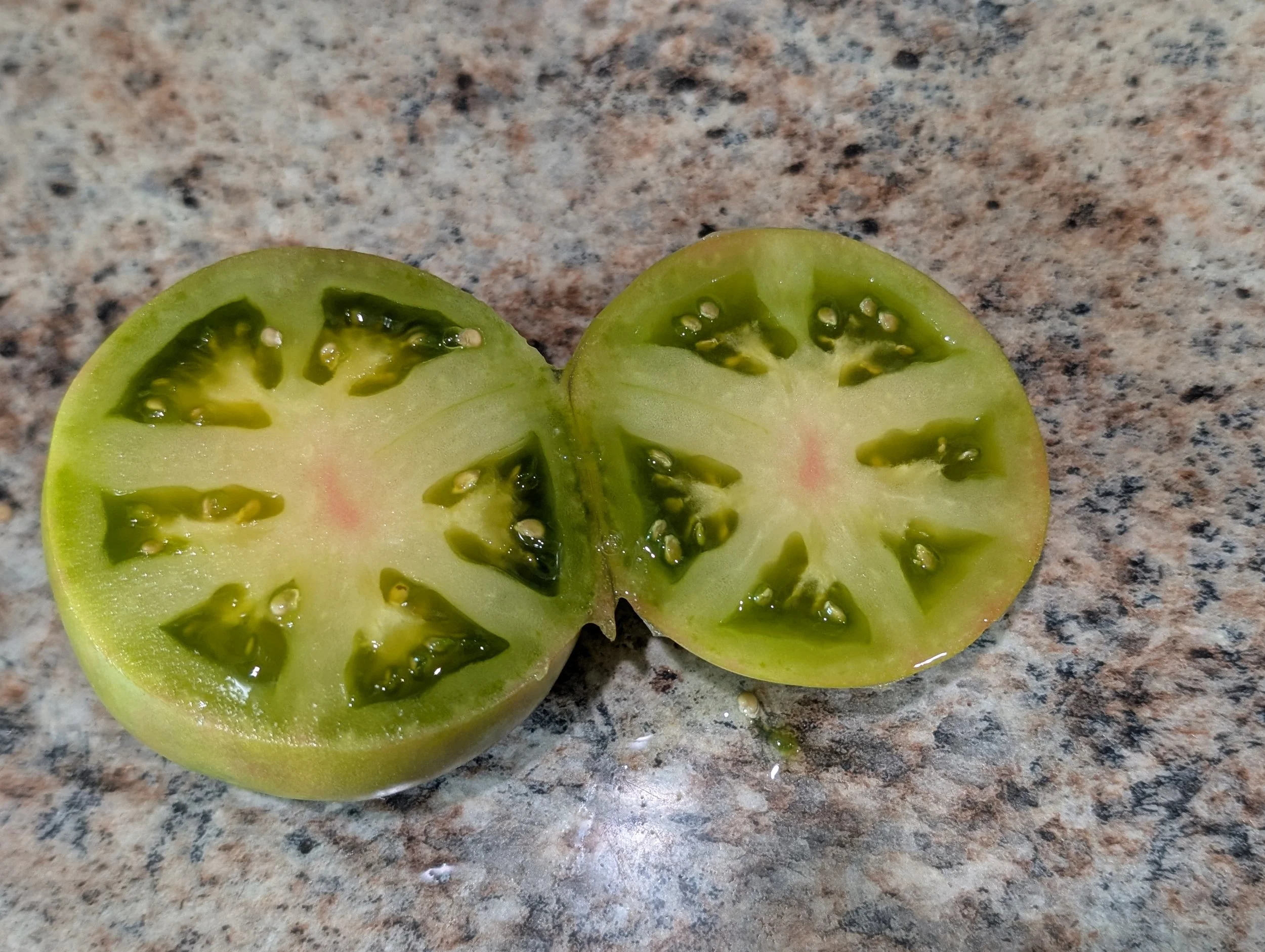
Variegated potato leaf dwarf plant 1, interior

The dwarf variegated leaf potato Leaf #1 was planted in a raised bed. I was delighted to find that the fruit were green fleshed when ripe. The exterior color was green with a faint punk blush at the very blossom end. The flavor was very good. The seed is saved as T26-72. This is very promising and will require some selection work.
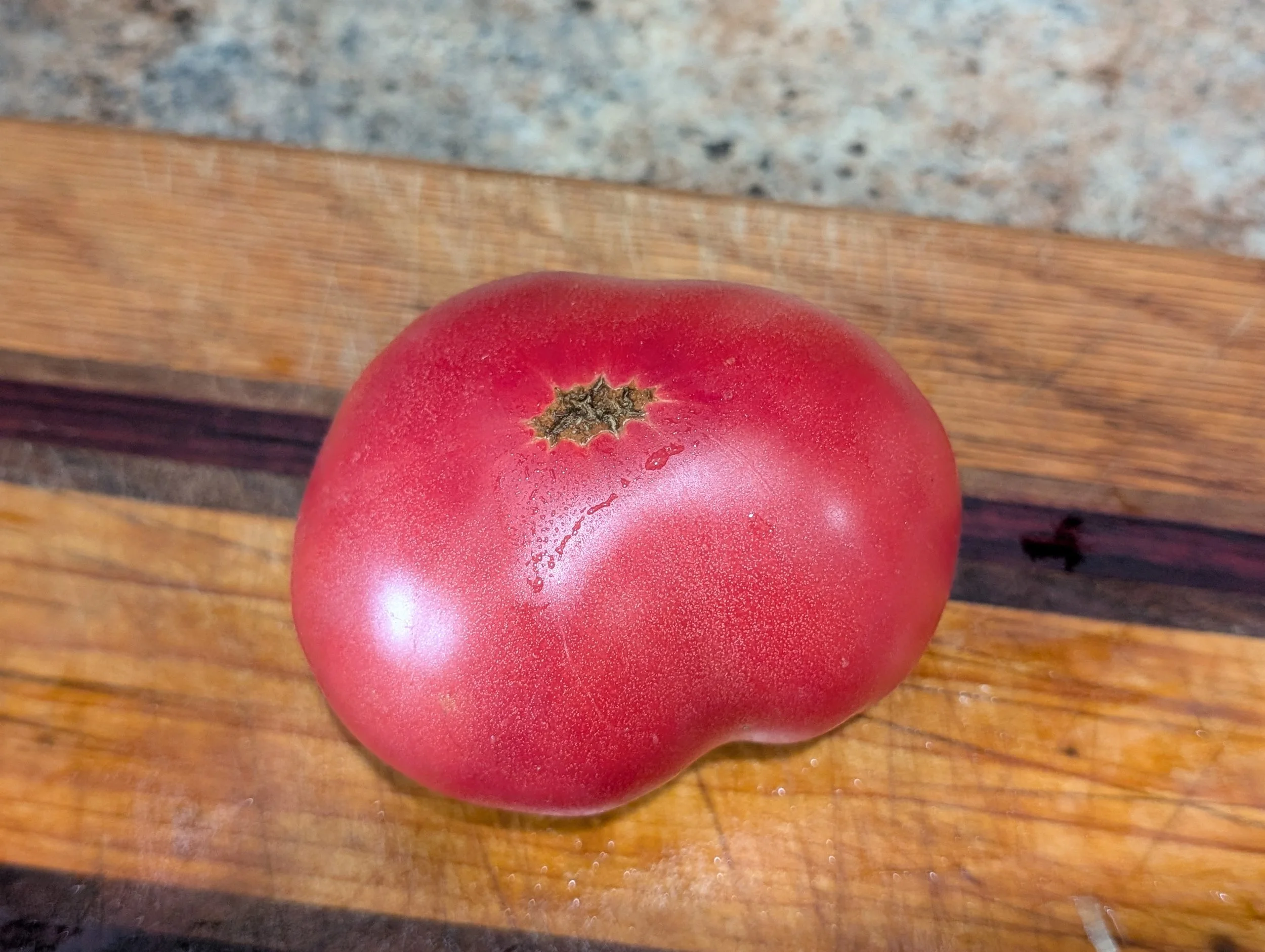
Variegated potato leaf dwarf plant 2, blossom end
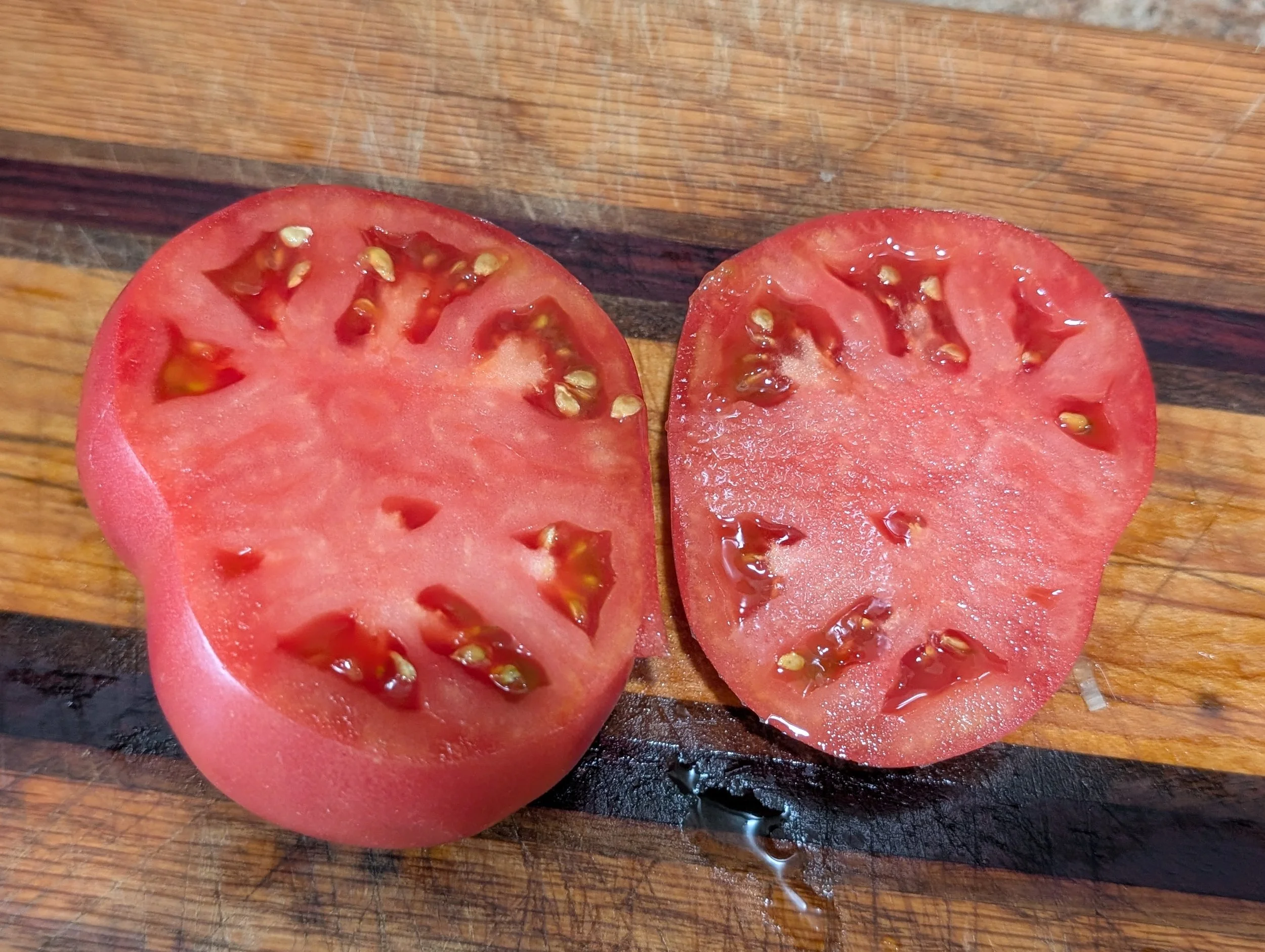
Variegated potato leaf dwarf plant 2, interior

The dwarf variegated leaf potato Leaf plant 2 provided a very different result. The plentiful oblate medium sized fruit were pink, with a well balanced pleasant flavor. The seed was saved as T26-73. This may not be as high a priority as potato leaf plant 1, but still provides an interesting little project going forward.
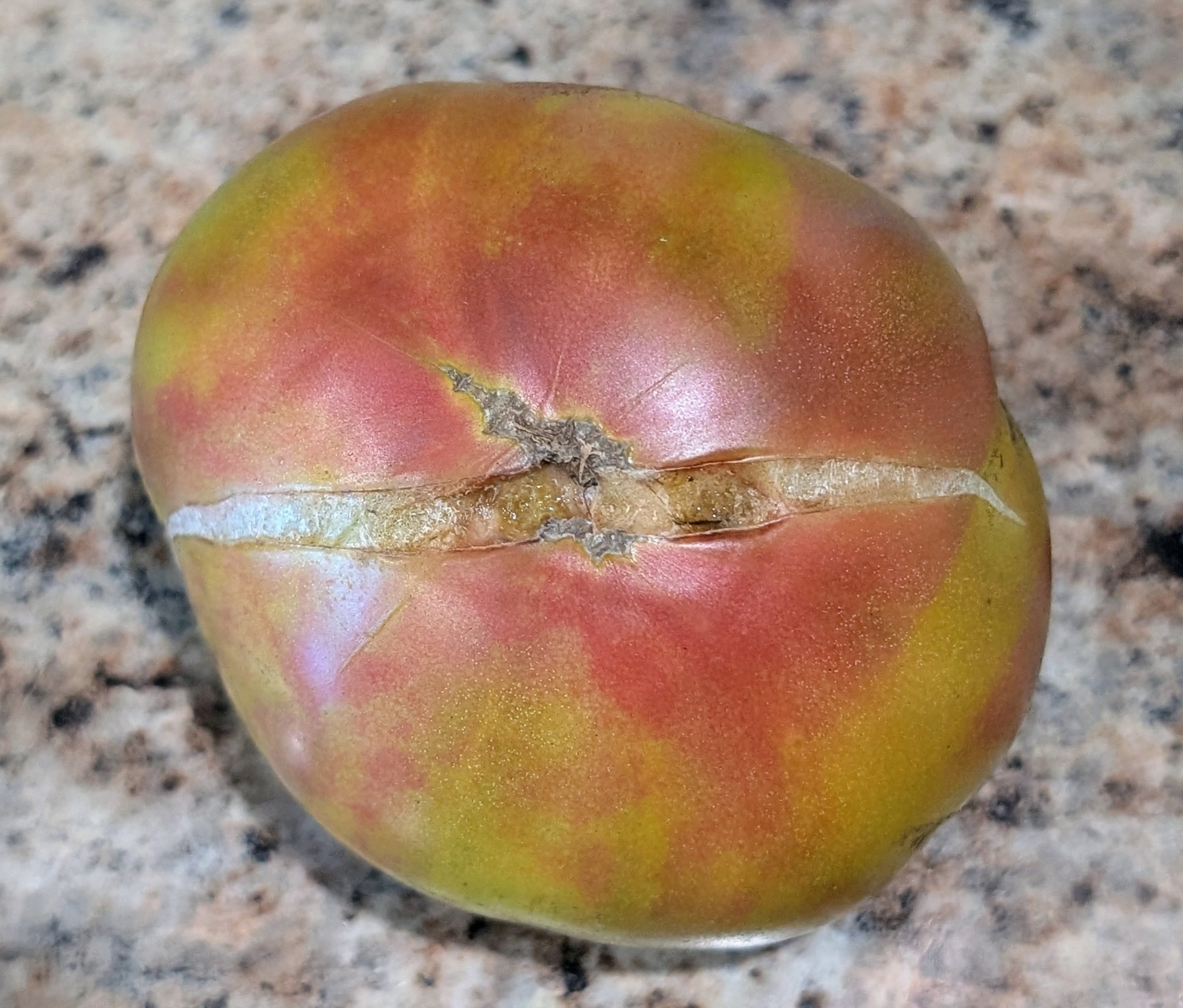
Variegated regular leaf dwarf fruit, blossom end
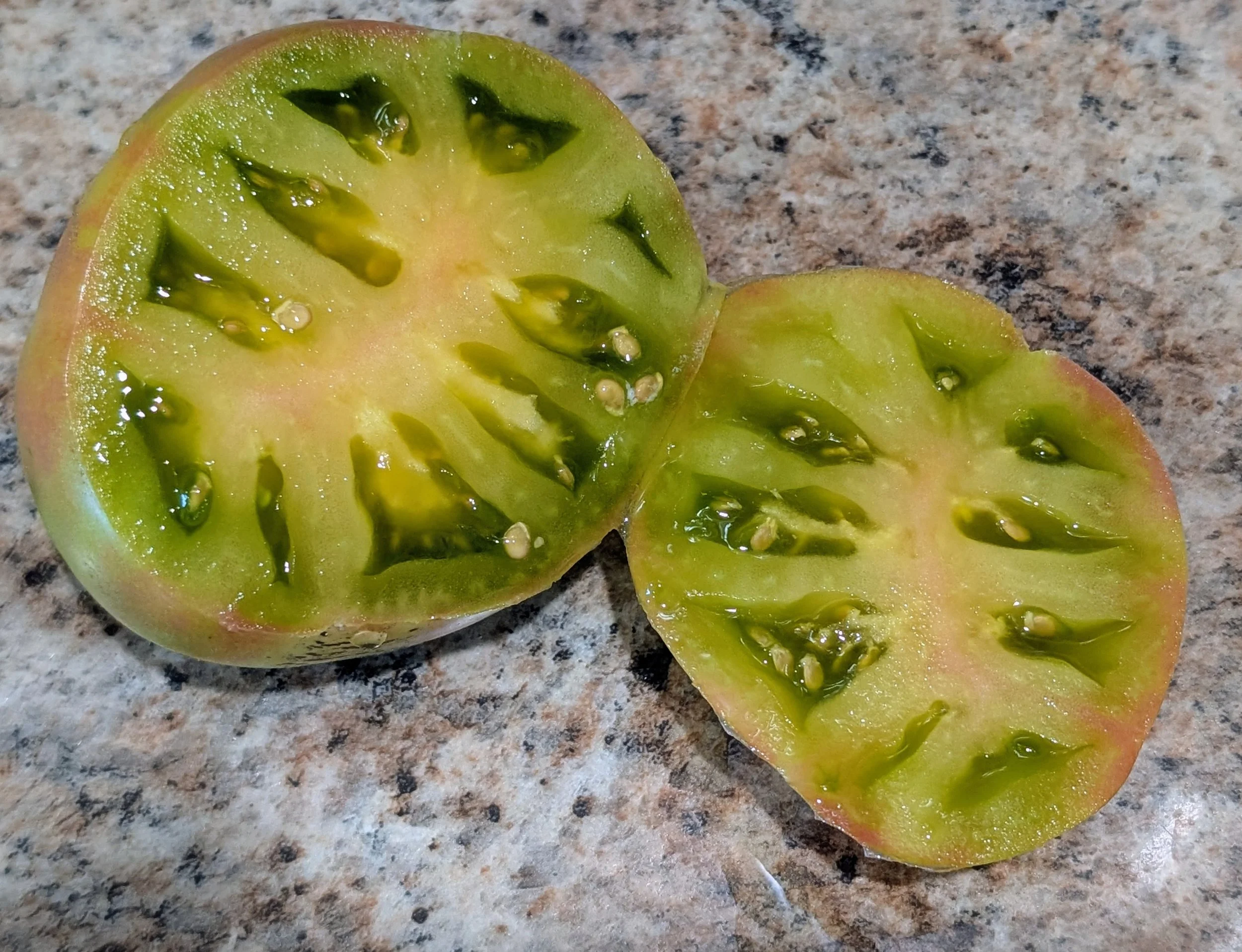
Variegated regular leaf dwarf fruit, interior

The dwarf variegated regular leaf plant provided another delightful surprise. The fruit appeared as Captain Lucky in exterior color, but had less red inside. The flavor was very pleasant. The seed was saved as T26-74. This is very promising and warrants further work.

Any other odds and ends - these don’t fit into any of the above categories

pink fruited Peppy selection chartreuse leaf dwarf - grew out T25-45. This grew as last year’s plant did - tall, chartreuse leaf dwarf with lots of medium sized, smooth, slightly oblate pink tomatoes with a delicious flavor. This is distinct from Dwarf Zoe’s Sweet in being more productive, smaller, smoother tomatoes with a slightly better flavor. This selection is probably worth naming and releasing - but this is for future work. Seed saved as T26-63.
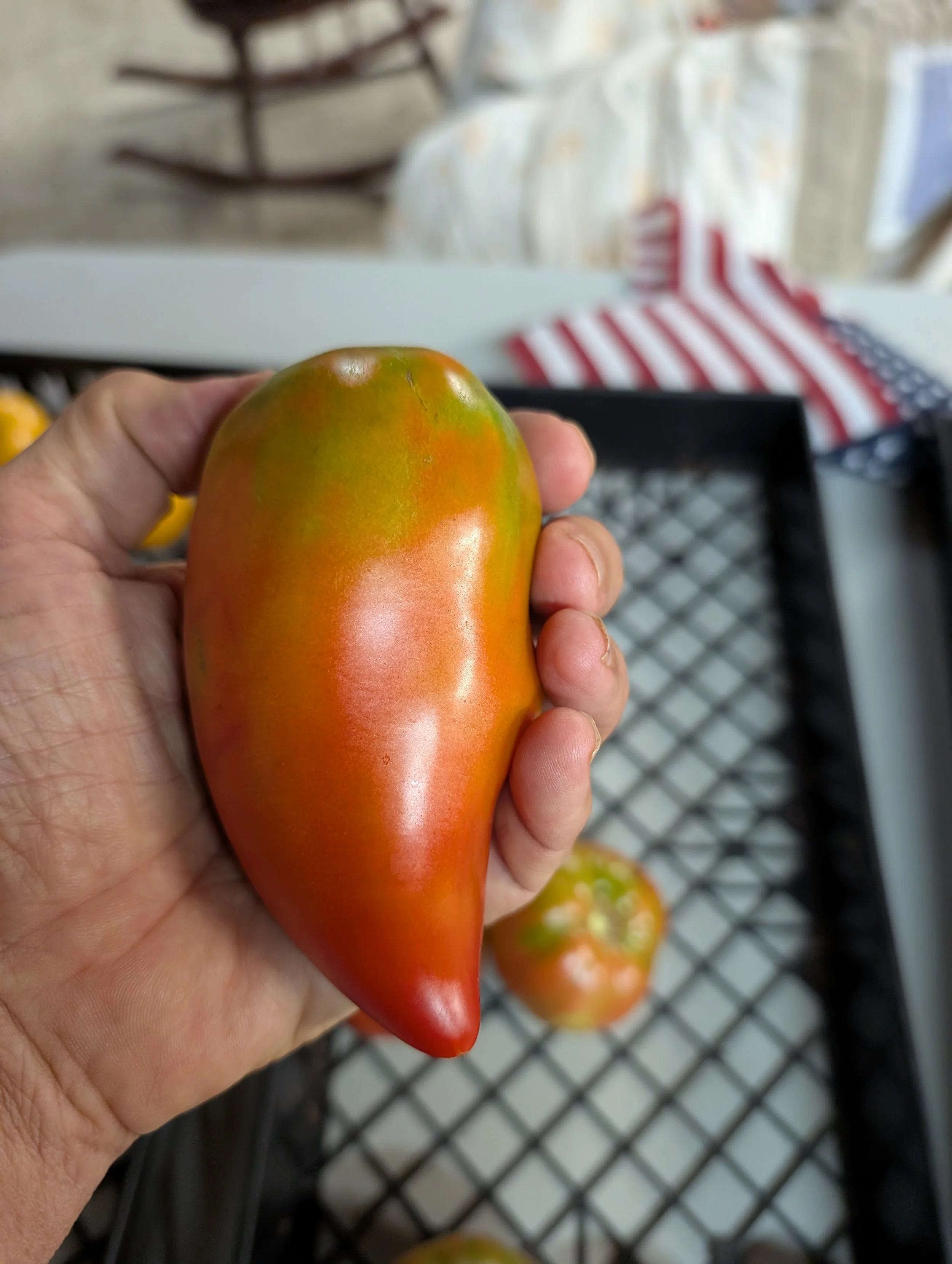
Canada Italian heirloom - similar to the Opalka or Jersey Devil types

Italian heirloom via Canada friend Steven, who sent me a few seeds to try - grown out as #8170. The tall, slender indeterminate plant had the typical weak, floppy foliage. The tomatoes were large, very long and pointed but with some variation, and were very meaty and tasty, with few seeds. This tomato is of the Opalka/Jersey Giant type. Seed was saved as T26-23. Is it unique enough to warrant a name and new release? This is a question for the coming months.
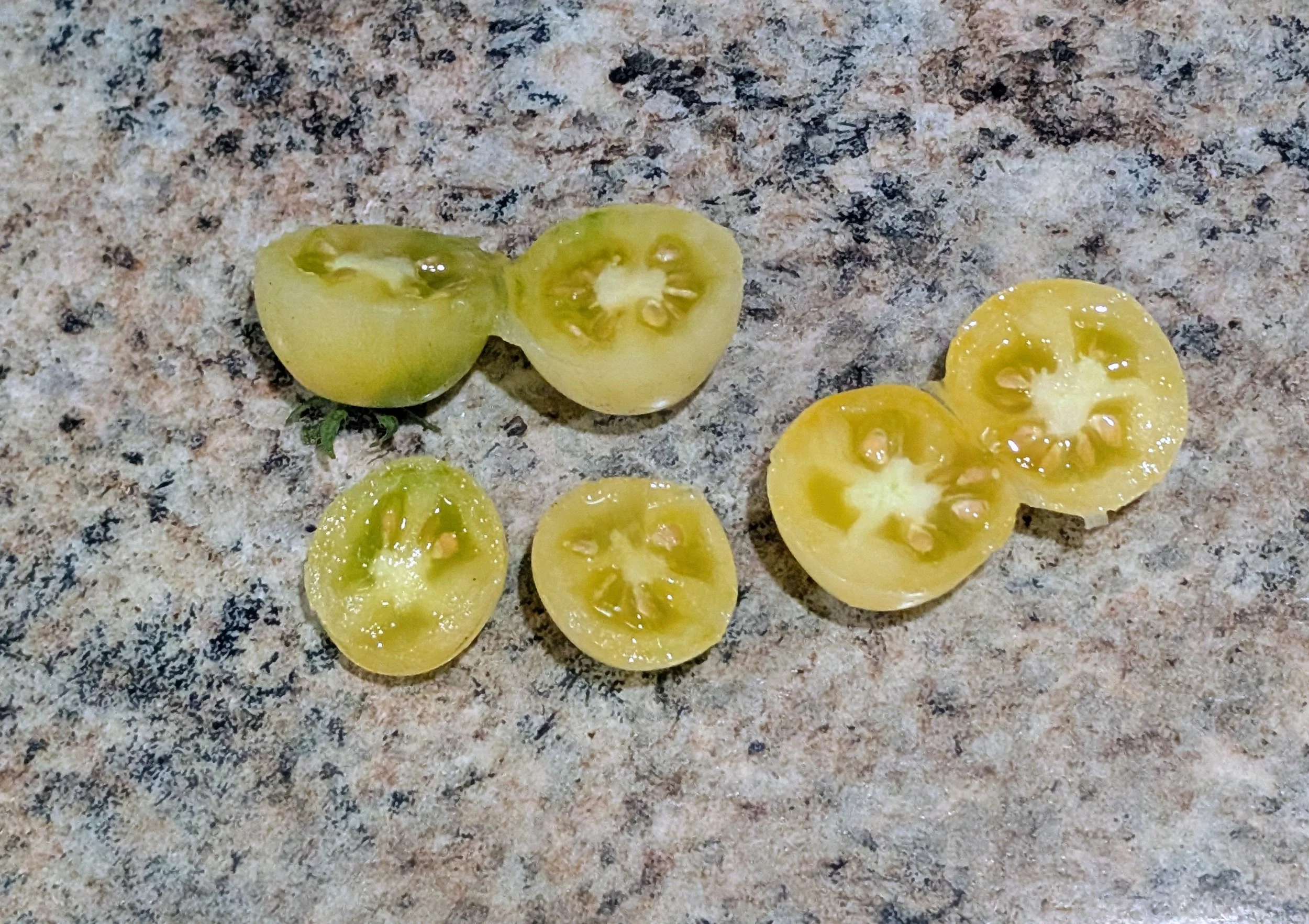
Not Irma’s Highland Ivory Cherry

Ivory fruit from Dwarf Irma’s Highland Cherry - grew out T25-57 in a raised bed. The very vigorous, prolific plant produced the same ivory colored cherry tomatoes as last year. The flavor was mild but nice. Seed saved as T26-71. The jury is out if this is worth of release; if so, it will need a name.

Cherokee Gecko - grew out T25-28. The vigorous potato leaf plant produced a good yield of medium small oblate green fleshed tomatoes that had mottled light and dark green skin. The flavor was good, but not up to last year’s result in either taste or size. More selection work is needed. Seed saved as T26-66

Dwarf Mocha’s Cherry - grew out #7574 - The plant was grown in a raised bed and provided a few trusses of cherry size and shape fruit with a black hue when exposed to the sun, and deep dusky crimson color otherwise - seeds saved as T26-75

Dwarf Green Goose Egg - grew out #7967 - The plant, which was grown in a raised bed, finally gave some medium sized green when ripe oval to plum shaped tomatoes - seeds saved as T26-78.
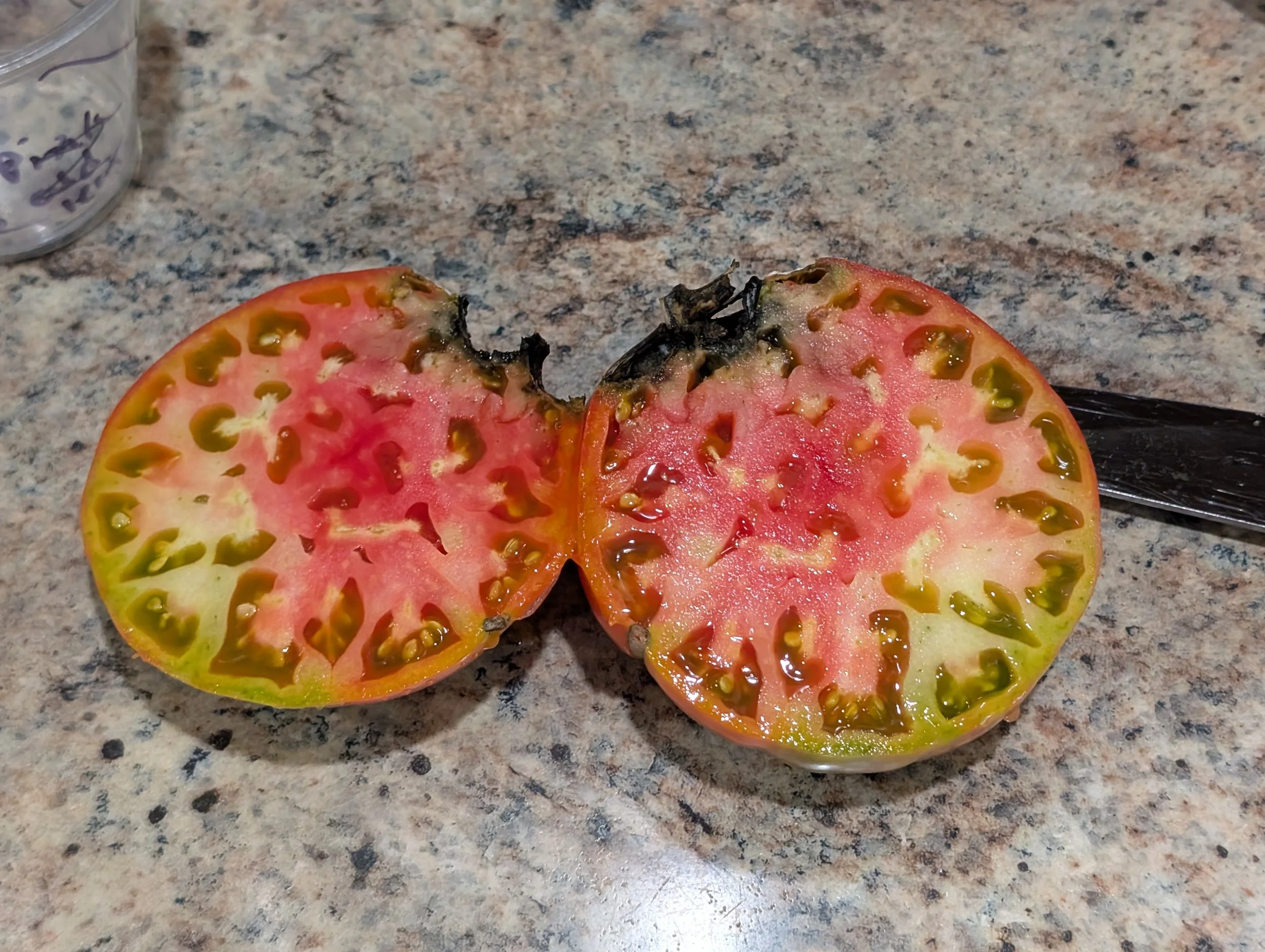
Dwarf Marlin’s Slicer - indoor mostly ripened, some insect damage. Note internal structure.

Dwarf Marlin’s Slicer - grew out #7579, a potato leaf dwarf. I put the plant into the bale that held the cucumbers. The plant grew well and yielded 3 good sized, oblate, smooth tomatoes that had some worm damage. They ripened indoors and were not tasted - just for seed saving. This is a promising addition to the Ivalde line. Saved as T26-76. Note - released Ivalde family varieties are potato leaf bicolor heart (Gloria’s Treat), potato leaf bicolor oblate (Choemato), regular leaf bicolor oblate (Awesome), potato leaf pink heart (Big Valentine), regular leaf pink oblate (Sonrojo Monster). Marlin’s Slicer fills the potato leaf oblate pink slot. Missing are regular leaf bicolor heart and regular leaf pink heart. I had the name Betts’ Beauty and the name Swirly Heart for the missing two, but they’ve not been easy to stabilize.

volunteer tomatoes around the yard - red cherry, size midway between Mexico Midget and Sun Gold (saved as T26-78), ivory - looks like Coyote (saved as T26-79), Mexico Midget (saved as T26-82)


The 2026 Garden is fully planted. Here’s Part 2 of the Variety List. There are so many mysteries!

Marlin patrolling the completed garden

Lots of bags of potting mix and filling and positioning and planting grow bags later, we have a completed garden. On May 8, I mapped out the locations of the various varieties. The following were planted on May 5 and May 8 (all captured in my log so that days to maturity can be calculated).

Here is the list of indeterminate varieties in 5 gallon grow bags. In most cases, the bags are only half full of planting mix - I am going for a few clusters of ripe fruit, not maximizing yield.

The following are from the Captain family that I created by crossing Captain Lucky with Sun Gold hybrid.

Captain F3 - 17 plants. Many of the plants are from seeds sent to me by gardeners who are playing along in the Captain project. What raised the plant number was the presence of both potato leaf and regular leaf in many of the samples (not unexpected). Planted are #8155 (from Jen Fox, she had a regular leaf large flat orange cherry, I got regular leaf only), 8148 (from Heide Dolan, she got a regular leaf orange cherry, I got only regular leaf), 8149 (from Heide Dolan, she got a red cherry on a potato leaf plant, I got one of each leaf shape), 8144 (from Eva-Lena, she had a potato leaf purple cherry, I got one of each leaf shape), 8113 (from Karen Pedelliviano who got a green cherry tomato, I got one of each leaf shape), 25-13 I got a potato leaf oval yellow/orange/pink swirl cherry, but this year I got one of each leaf shape from saved seeds), 25-36 (I got a regular leaf green and purplish round cherry, but from saved seeds this year I got one of each leaf shape), 8092 (from John Cook, he had large orange cherries, I got just regular leaf), 8095 (from Janet Felber who sent seeds from a regular leaf orange - I got one of each leaf shape), 8154 (from Jen Fox who has a potato leaf bicolor mini beefsteak - also got just potato leaf), and 8096 (from Janet Felber who has a red cherry, I had just potato leaf). What will be fascinating is to see if the colors follow through or are different - as well as size. The flavor of each will be of utmost importance to see which get taken forward.

An example of the Captain F3s - in this case, regular leaf from T25-36

Captain F2 - 1 plant of #8196 (The F1 plant I sent Alex Moring gave red fruit, from which he sent seed - I got only regular leaf).

Next - suspected crosses that I made (these hopefully are all F1 generation hybrids). Two plants of seed from Fuzzy Pink crossed with pollen from Dwarf Eli’s Surprise (very different foliage shape, but neither fuzzy - hence seem to be successful hybrids), Sweet Sue crossed with pollen from Fuzzy Pink (regular leaf seedling, hence likely successful cross), two plants of regular leaf seedlings from OTV Brandywine crossed with Honor Bright, a non fuzzy seedling from Fuzzy purple which was crossed with Dwarf Eli’s Surprise, Potato Leaf Yellow crossed with Lucky Bling., and Dwarf Eli’s Surprise crossed with either Fuzzy Purple, Cherokee Green or Cherokee Chocolate. All of these will be complex. Seeing what the fruit shape and color result will help confirm the success of the cross.

Two of the grow bags hold plants of Pale Perfect Purple from Solana seeds and the SSE. Two future grow bags will hold plants from seeds from the creator of the variety, Tad Smith, as well as Denise Salmon. The goal here is reestablishing authentic Pale Perfect Purple seeds.

Other indeterminates planted are the green fleshed Not Lillian’s Yellow and Cherokee Gecko latest selection (from Cherokee Green X Caitlin’s Lucky Stripe), a regular leaf variegated indeterminate Triply F2.

Here are the dwarf tomatoes in 5 gallon grow bags.

I am growing the six new named varieties selected and named by Marsh Eisenberg - Pleaser, Resistance, Avenue K, Faye Carrie, Marsha’s Favorite and Gilda’s Hat. I am also growing two sources of a variety I hope to get released - Dwarf Liz’s Teardrop. Both samples are from 2020. Finally, I am growing the delicious medium sized pink fruited Peppy Chartreuse leaf selection.

Finishing off the 5 gallon grow bags are peppers Snackabelle, Mini Belle, two selections of Fire Opal, Chocolate Bell, Orange Bell, a ground cherry from my friend Adam, and eggplants Midnight Lightning, Twilight Lightning, Mardi Gras and Skinny Twilight

Finally, an update on all that was planted prior to the grow bags. The straw bale indeterminate tomatoes and sweet peppers are growing very well, and I will have to ponder guide stakes within the next few weeks.

Both varieties of corn germinated very well; I filled in only a few blanks. Both summer squash are up. Cucumbers have proven to be stubborn, probably because of the cool nights, but I finally see life. Lastly, the three types of snap beans have varying germination success. Marbel is excellent and I planted only a few fill ins. I planted many more fill ins for Goldilocks and Jade.

Sue blowing bubbles for Eli

The first plants and seeds are in the strawbales. Here is part 1 of my 2026 variety list

Finally! Some much needed rain - view of the garden on May 6, 2026

April 27 saw the first planting of seeds into the strawbales. April 30 followed with tomato, and a few pepper, seedlings, I did my first batch of grow bag plants on May 5, but I will cover those varieties in the next blog.

Potato Leaf yellow, planted in the strawbale on April 30.

Here are the varieties that were direct seeded on April 27:

Cucumber Deli Star hybrid (thanks to Sam Austin of the UK for the seeds) - 2 hills in one bale, 2 seeds in each hill. Yet to appear on May 6,

Summer Squash Green Machine hybrid, and Zephyr hybrid, one bale for each - 2 seeds planted but I plan on thinning to only 1 plant per hill - 1 hill in each bale. Germination for both varieties is a success.

Sweet Corn - 2 bales with a double row of Jackpot hybrid, 2 bales with a double row of Sweetness hybrid. This is a different arrangement than last year’s block of 4 bales, which created too much crowing of the inner rows. Germination noted for both types today.

Snap Beans - 4 bales pushed together, 3 rows of beans. Varieties are Marbel, Jade and Goldilocks. Germination is just starting.

Here are the 2 summer squash bales with the hills marked by a 2-3 inch deep topping of potting mix.

Finally, here are the seedlings that were planted into strawbales on April 30.

Indeterminate Tomatoes - heirloom varieties - Cherokee Purple, Captain Lucky, Lillian’s Yellow Heirloom, Cherokee Chocolate, Lucky Cross, Ferris Wheel, Cancelmo Family Heirloom, Potato leaf Yellow, Earl, Green Giant, Giant Syrian, World War 2, Italian heirloom sent to me by a Canada garden friend, and Lucky Bling.

Indeterminate Tomatoes - Research varieties - 4 plants of the F2 generation of Potato Leaf Yellow crossed with Cherokee Purple (carried out by my friend Alex) - 2 regular leaf and 2 potato leaf. One indeterminate potato leaf variegated F2 selection from the Triply three way cross (Cherokee Purple x (Dwarf Choemato X Dwarf Walter’s Fancy)). Eight different selections grown to find the desired traits for Lillian Rose, which is a selection out of Cherokee Purple X Lillian’s Yellow Heirloom I found and named in 2022.

Dwarf Tomato - Dwarf Eli’s Surprise, my name for a variegated, chartreuse potato leaf selection from the Peppy family (Dwarf Zoe’s Sweet X Dwarf Walter’s Fancy).

Sweet Peppers - one bale was planted with single seedlings of Shishito and Corno di Toro red.

Side view of the bales with added grow bags with plants, taken on May 5

In addition to the above we are now eating lettuce and awaiting garlic, collard, kale and chard. Despite having less time to garden, I seem to be right where I hoped to be date and progress-wise.

In the next blog I will provide information on the many grow bag tomatoes, peppers and eggplants that were planted yesterday, and will be finished on Friday May 8. After that, it will be regular care and providing support - and updates!

Spring Flowers are Blooming - and Seeds have Germinated.

Our backyard saucer magnolia in full bloom on March 10

This is THE time of year for us - it isn’t just having a love of gardening, but the whole process of observing nature wake up. The weather has been wild - and that shows no sign of letting up. A week of 70s and 80s brought a whole array of blossoms - forsythia, magnolia (shown above), spirea (shown below), quince and daffodils. Then we had a night in the mid 20s, which the magnolia clearly hated - many of the blossoms turned brown. Next week we are in the low 20s for a few nights. Fortunately, some of the spring blossoms don’t seem to mind - next up will be our redbud, dogwood, Lady Banks rose and lilacs. I hope that they don’t get bitten.

Seed planting and germination is going very well, but is not without unfortunate (as in dumb) incident. I was moving flats of tomato seeds carelessly and I dumped my second full tray, with lots of experiments. Fortunately I had enough seeds of each to do a full replant, and they’ve popped up and joined their companions outdoors (see below). Of course, these are all headed in later today, as the strong windy rain, followed by the low 20s, is not at all compatible with happy tomato seedlings!

Seedling flats all off the heat mats and spending most of the time outdoors

Of all of the seeds planted - 176 cells in the 50 cells flats - the following are the only no-shows: Lettuce Green Ice, Aunt Ruby’s German Green from 2012 (that makes me sad), Ferris Wheel from 2013 and 2014, Cancelmo Family from 2017, Giant Syrian from 2014, two different Fire Opal sweet peppers and one eggplant (Skinny Twilight). The jury is still out on seeds in 11 cells. But that means, that only 20 of 176 cells are currently no shows - a really great result.

I was pleased to see germination from 7 different 2016 saved Cherokee Purple or Cherokee Chocolate. The oldest seeds I got to germinate were Green Giant saved in 2014 - 12 year old seed. There will be lots of decisions to be made, and lots of findings await, particularly in leaf shapes of the various Captain F2 and F3 seeds I started. All of the Lillian Rose samples are up and growing. It is going to be a fascinating garden.

The only news items - I am back doing weekly Instagram Live sessions, on Fridays at 4 PM eastern (follow me at @nctomatoman and you will be notified when they begin) - I will be in Shelby speaking at the Cleveland County Master Gardeners event this coming Saturday - and I am looking to schedule my right knee replacement for mid May!

Eli looking wise at 14 months old

About that new knee - and about the first planted seeds...

Spring is anxious to arrive! Volunteer crocus in our front beds

On February 3 at 10 AM I was wheeled into surgery to get my new left knee. A few hours later I woke up in the recovery room, had a nice chat with the nurse (little of which I remember), then it was off to my room to be greeted by Sue. They got me out of bed to use the bathroom at 2 PM, meaning the leap of faith to put some weight on that knee using a walker and strong arm of a nurse/PT person. What an odd experience - but - success. Sue sat with me until after dinner, I spent the night (being checked regularly by nurses - vitals and all) - and the next day at 11 PM had my trip to the PT room, got dressed and headed home.

The unveiling - 24 hours after surgery

What followed was figuring out how to get in and out of bed, using the walker to get around the house, starting with home PT - then after a week moving on to a cane - then a week after that tossing the cane too. Today (one day short of 3 weeks post surgery), I drove myself to my first off site PT. I did a bit of grocery shopping, stopped at a coffee shop - and look forward to a few months more rehab and daily exercises.

I am pretty amazed at a few things. The whole process has been pretty much pain free. I used just Tylenol a few times daily after my first day home. Strength in the knee has built up quickly - I am a 0 degree angle when extended, and 112 degrees when bent. Full speed ahead - and I now eagerly anticipate getting the right knee done in October. All of this went so well because of the skilled doctor and support team at the hospital, and great home care at home by Sue and Caitlin. I also have to thank hiking and gardening - it is clear that having strong leg muscles really helped the whole process.

The knee today - much improved, much healed

That out of the way, let’s talk gardening.

Initial seed starting took place on February 20. One partial flat was seeded with various greens - 3 cells of chard, 1 of collards, 1 of kale, 1 of spinach, and 7 types of lettuce. First growth was noted this morning - February 23 - one of the chard cells showed life, 3 days from planting. The flats are on constant temp, inexpensive heat mats in Eli’s bedroom (my office) on the top shelf of the bookcase, loosely covered with Saran wrap.

Also on February 20 was planted various types of tomato, pepper and eggplant seeds that I deemed would be stubborn or erratic due to seed age, or questionable status of the fruit when the seed was harvested. Among these seeds are Aunt Ruby’s German Green saved in 2012, Ferris Wheel saved in 2013, Giant Syrian, Green Giant and Ferris Wheel saved in 2014, Green Giant saved in 2015, three lots of Cherokee Purple and four lots of Cherokee Chocolate and one of Cancelmo Family Heirloom saved in 2016, two lots of Cherokee Purple and two lots of Cherokee Chocolate and one of Cancelmo from 2017, stubborn World War 2 from 2023, and Chocolate Bell, Fire Opal peppers and Skinny Twilight eggplant saved in 2025 from fruit that may not have been sufficiently ripe. I don’t expect to see much happening in this flat for several days or longer.

On March 1 I will plant 2 flats of tomatoes from recently saved seeds for back ups, main plants, projects, and local plant sales. I will probably plant 1 final flat with some flowers, herbs and tomatoes that had germination issues.

My next speaking engagement is March 21 in Shelby for the Cleveland County Master Gardener event. I’ve also tentatively started regular weekly Instagram Live shows, most likely Friday afternoons. My latest one (from last week) can be found on the reels page at my Instagram account, @nctomatoman ,.

2025 Garden Review - Part 4 (Final Part) - Everything Else

The garden in early September.

The last three blogs summarized all of my tomato growing efforts for 2025. But there is more to life than tomatoes for a gardener. This blog will report on everything else that I grew in 2025, in a bit less detail than for the tomato sections.

Beans! Goldilocks is obvious. Fowler are the fatter green beans, Maxibel the slender ones

Bush Snap Beans

  • Goldilocks - We love this bright yellow slender yellow snap bean. It has replaced Roc d’Or as my favorite wax type. We get a heavy initial crop then pull the plants.

  • Maxibell - I rotate my green bush beans, and it has been some time since I grew this variety. It was superb - long slender beans that are simply delicious. This is also a single cropper, and we pulled the plants once that first flush was finished. I alternate this with Jade and Marbel for our green slender beans.

  • Fowler - This is more of a traditional green bean, rather than the slender filet types. Fowler is special to me in that it is the first variety I requested as a new Seed Savers Exchange member in 1986. The variety is not as lanky as the other two beans I grew this year, but yield very heavily. Once the first flush is picked, the plants tend to reflower heavily, providing a nice second crop. Insects such as bean beetles tend to ignore it as well. It is actually the perfect bush green snap bean!

Deli Star hybrid - is indeed a star!

Cucumbers

  • Deli Star hybrid - We only grew this because it is absolutely wonderful. The medium length, somewhat slender cukes are pale green, with tender skin that needs no peeling. The texture is crisp but tender, and the best flavored cucumber I’ve tasted. It is mainly female flowered and yields very heavily, and seems to resist disease well. The main downside is that it is available only from UK seed companies. I have to thank my friend Sam for generously providing me with seeds.

Zephyr and Kefren

Summer Squash

  • Zephyr - Hands down my favorite summer squash, this variety is just perfect. The yield is incredible. The flavor is unmatched, as is the texture, firmer than other summer squash. The only slight downside is that the plant runs a bit, and takes up quite a lot of real estate.

  • Kefren - I still seek the idea zucchini - Kefren is very good, but not the “it” variety I seek. Though the dark green squash are well formed and delicious, the yield is not quite as generous as I would like. I enjoy the variety Dunja much more. I may go back to an old favorite - Spineless - next year.

Natural Sweet variety - first corn I’ve grown successfully since the late 1980s in West Chester, PA

Corn

  • Natural Sweet - I did a full analysis of my straw bale - corn project. It was very successful and one of the best elements of my 2025 garden. All of the details can be found here.

Sweet Peppers

Red Corno di Toro left, ripe Orange Bell right

  • Orange Bell - This was the best sweet pepper of our 2025 garden. The medium to pale green blocky bells ripen orange and are very sweet.

Unripe Chocolate Bell. I am waiting patiently!

  • Chocolate Bell - I am still waiting to get a ripe fruit from my plant. I have one nice big blocky green fruit coming along.

  • Shishito - This is a pepper machine. They are still going strong.

Carolina Amethyst, on the way to red

  • Carolina Amethyst - Early fruit rotted before ripening, but later fruit are looking great. This pepper is a bell that goes cream to lavender to red.

Royal Purple on the way to deep red

Royal Purple - The light chartreuse bells go to black purple, then to deep red. Though it seemed to have collar rot early on, it held well and is now ripening lots of nice bells.

Fire Opal - The plant in the straw bale was grown from crossed seed - the peppers are like large Jalapenos and go from deep green to brownish purple to red. I have one growing in a raised bed that looks correct - it should be a cream colored bell that goes to lavender, then to golden yellow.

Super prolific White Gold - color is correct, but the peppers are quite small.

  • White Gold - This is an interesting one. The color is correct - bells that go from cream to yellow - but they seem very small.

  • Red Corno di Toro - Someone sent me seed for this a few years ago and I got exactly one to germinate. I have plenty of saved seeds now - the large dark green frying peppers go to red - and are very sweet.

Hot Peppers

Jalapeno - Nothing surprising here, a very tall plant, typical dark green peppers with corking go to red. They are milder than I expected.

Pinata is great this season

  • Pinata - Wow - are these pepper machines! chartreuse to yellow to orange to red quite hot Jalapeno types. I have two plants - both are thriving.

Assortment of ornamental hot peppers in my elevated bed

  • Mix of ornamentals - I grew out quite a few lots of peppers in the Gemstone/Bouquet selection project and have some good leads to move forward with. They are edible, and are a Thai type but very colorful. When red they dry well - we grind them for hot pepper flakes.

Skinny Twilight ready to harvest

Eggplants

  • Mardi Gras - This is my own selection from a bee cross. The tear drop shaped light green fruit are lightly striped with lavender. It did well this year. The flesh is light green.

Green Ghost, producing heavily

  • Green Ghost - A sister eggplant to Mardi Gras, it did great - pale green tear drop shaped fruit with light green flesh.

  • Midnight Lightning - The dark green foliaged plant has a heavy purple cast. Slender dark purple eggplant have green flesh - very prolific - and the most like its parent, Orient Express hybrid, from which I selected this.

  • Skinny Twilight - This is also from Orient Express hybrid. The foliage doesn’t have the purple cast quite as much, and the fruit are not as dark a black purple. This is also pale green fleshed.

  • Twilight Lightning - I messed up my labeling, and didn’t grow this variety. It is also from the Orient Express selection project, has very slender white/light lavender fruit with white flesh. There’s always next year!

Native black eyed Susan in our perennial garden

The rest

I grew two basil varieties - Emerald Towers (a Greek Columnar, non flowering type), and Genovese. This was the best basil season experienced in Hendersonville so far, with very little downy mildew attacks.

As far as flowers from seeds, I grew two salvia coccinea - a scarlet, and a salmon pink (Coral Nymph), nice verbena and zinnia color mixes, and Petunia Red Save for a hanging basket. The perennial garden is always the star, so we use annuals as accent flowers in containers or the borders.

Basil (back row) and ornamental hot peppers (middle and front rows) from late June

2025 Garden Review - Part 3. Last tomatoes - new family heirlooms and attempted crosses

Valdichiana, normal (purplish) stem, stem end

Here we go, folks - the third - and last - part of the 2025 garden tomato update. This one will focus on everything not yet covered, including the various family heirlooms sent to me by other gardeners over the last few years. It was time to try them out and get some fresh seeds saved.

Test planting of seeds from fruit from purplish stems - all were purplish

Valdichiana - This tomato was collected in Italy and showcased on Joe Lamp’l’s Growing Epic Tomatoes discussion board by Candace Godwin. It proved to be quite an interesting little mini tomato project itself. When planting seeds, I noted that most had purplish, normal tinted stems. A very few had stems with no purple pigment. I grew a plant with purplish stems here, and one with pigment free stems at Caitlin’s house. The fruit from the purplish stems were as Candace showed at the Lamp’l group discussion - large, flat, chocolate colored, highly ribbed - quite unique! The flavor was very good, the flesh firm. The fruit from a plant with pigment free stems was very odd - very, very firm, less side, much darker green brown color, not at all as palatable. The purplish stem selection is much better. I will be chatting with Candace to see where we should go with this. The tomato is unique enough to warrant release.

Test planting of seeds from fruit from pigmentless seedlings - no pigment!

Valdichiana, normal stem, blossom end

Valdichiana, normal stem, sliced

Valdichiana, whitish stem, stem end

Valdichiana, whitish stem, sliced

German Heirloom, showing the yellow green shoulders

German Heirloom - Seeds of this variety were sent to me by Penny Roscoe of Missouri in 2023 and it is #7913 in my collection. I grew it in Caitlin’s garden. Wow - these green shouldered pink hearts were huge! It was nearly all flesh, with very few seeds. The flavor was mild and lightly sweet. I need to get back to Penny for more on this tomato’s history. It is impressive in size and beauty, if not flavor, but would make a superb sauce tomato with its meatiness.

German Heirloom, sliced

Curtis Cheek on the left, Bee F2 potato leaf from Caitlin’s garden on the right

Curtis Cheek - This variety was sent to me by Nadia Ako-Adjci of Maryland in 2023 - it is tomato #7921 in my collection. The plant was crowded and got diseased in my daughter’s garden, but ripe fruit was obtained from the regular leaf plant. It is reportedly heart shaped, but the fruit I harvested was compressed against the stem and shape wasn’t possible to ascertain. It was certainly a nice looking pink variety, but I didn’t get to taste it. Seeds were saved and it is worth another try.

Red and Yellow - I received seeds from Steve Kulik of New York in 2023, who noted it as a family heirloom. The regular leaf plant produced large typical red/yellow swirl bicolor tomatoes. It suffered from a challenging season, with lots of rain, which caused disease. I didn’t taste or photograph, but did save seeds.

Vine, stem end

Vine - This variety, sent to me by Kaye Cloninger of NC early this year, wasn’t grown under the best conditions (crowded into my daughter’s garden), but the potato leaf plants yielded nice medium sized, tasty pink tomatoes. I need to find out about its history. Seeds are saved - this is a very tasty tomato.

Vine sliced

Green/gold Purple, showing the ribbed shoulders

Green/Gold Purple - Here’s an oddity, sent to me by Ed Gray of NC. Ed claims he started growing in 2021 and doesn’t remember its source. It looks very much like a tomato that my friend Ralph grew, with large chocolate tomatoes and green stripes - that is the coloring of this one. Ralph’s tomato came as an off type of Vintage Wine (which is pink with gold stripes and potato leaf). It grows heart shapes for Ed, but mine were oblate - nearly blocky square shape, with ridged shoulders and very firm flavorful dark crimson flesh. It certainly is interesting - and grew well in Caitlin’s garden.

Green/gold Purple, sliced, showing its solidity

German Splash - This variety, sent to me by Ryan Swinney of Ohio this winter, is the only variety I grew that didn’t yield a tomato. It was in a very crowded part of Caitlin’s garden. It supposedly is one of the large yellow/red swirled bicolors. I will give it another try next year.

Limbaugh Potato Leaf - This was sent to me by Lorraine Sciulli in 2023. There is a lot of info about it on line - apparently it is the SSE variety Potato Top that was popularized by Fred Limbaugh. The potato leaf plant gives typical oblate pink beefsteaks. The plant grown in Caitlin’s garden provided one tomato that I didn’t taste, but was used for seed saving.

Heirloom from Lucas

Lucas Heirloom - This heirloom was sent to me by Lucas Carusi, and hails from Abruzzo, Italy. It is probably the variety Pera d’Abruzzo. The plant was grown in Caitlin’s garden and is typical of some Italian paste types, being quite hollow. It would make a great stuffing tomato!

Lucas heirloom sliced, showing the hollowness

Harts - This tomato was sent to me by Bonnie Swenson of Wisconsin this winter. It is a variety that supposedly was created by Carmen Alberti, and he passed seeds onto Bonnie. For me, it was regular leaf and produced medium sized oblate scarlet tomatoes. I didn’t get a photo, and the plant struggled with crowding in Caitlin’s garden, but seeds were saved. I tasted a bit and it was nice.

Big Barney - This was given to me by Steven Kulik of PA. It is a regular leaf plant that produced pink oblate tomatoes - the plant struggled with conditions, so I don’t have a clear opinion of the variety. I do have fresh seeds saved.

Boho - This variety was shared with me by Eric Dahle of Wisconsin in 2024. It is quite unique, in my experience - very firm scarlet hearts, with almost solid meat and very few seeds. Scarlet heart shaped tomatoes are quite rare. It would make a great sauce and paste tomato, due to its extreme meatiness.

Giant Crimson - This was sent to me by Mike Seitz of Virginia in 2024. I suspect it was supposed to be large and pink, but when grown in Caitlin’s garden, it was small/medium sized, round and scarlet. The taste was very good. I think it is a variety that became crossed somewhere along the line.

WV 23 - This is a famous tomato also called Mannon’s Majesty, an updated version of West Virginia ‘63. It was sent to me by Charles Hughes, Garner NC. The flavor was fine - it was a medium small, round scarlet tomato. It did not thrive in Caitlin’s garden.

Abraham Lincoln (not), stem end

Abraham Lincoln - What a stubborn variety this is! Sent to me by Bill Moffett of Asheboro, NC in 2024, we both hoped this was the authentic Abraham Lincoln. Alas, the regular leaf indeterminate plant with no bronze tinge produced huge oblate pink tomatoes - the flavor was fair at best, and it reminded me of German Johnson. Abraham Lincoln as released in 1923 was a more round tomato, large, and scarlet red. Back to the drawing board - I fear the real A. L. has gone extinct.

Abraham Lincoln, sliced

Finally, here is a report on attempted crosses carried out in 2025.

In all cases I list the pollen acceptor first, followed by the pollen donor.

Not successful

  • Captain Lucky X Rufus Rainbow

  • Captain Lucky X Captain F1

  • Potato Leaf Yellow X Rufus Rainbow

  • Brandywine X Rufus Rainbow

  • Polish Bling X Cherokee Green

  • Polish Bling X Fuzzy Pink

  • Cherokee Sunburst X Dwarf Mocha’s Plum

  • Lucky Cross X Carrot Like

  • Carrot Like X Dwarf Eli’s Surprise

The following may have worked - I am still evaluating the results from test plantings.

  • Lucky Bling X Cherokee Purple - regular leaf seedling showed up, will try to carry to next spring

  • Fuzzy Pink X Dwarf Eli’s Surprise - non Fuzzy seedlings resulted, will try to carry to next spring

  • Lillian’s Yellow Heirloom X Fuzzy Purple - regular leaf seedling showed up - will try to carry to next spring

  • Lillian’s Yellow Heirloom X Dwarf Eli’s Surprise - ditto

  • Dwarf Sweet Sue X Fuzzy Pink - regular leaf, slightly fuzzy seedling showed, will try to carry to next spring

  • OTV Brandywine X Honor Bright - regular leaf seedling showed up, will try to carry to next spring

  • Dwarf Eli’s Surprise X Cherokee Green or Cherokee Chocolate - regular leaf non-dwarf seedling showed up, will try to carry through to next spring

  • Fuzzy Purple X Dwarf Eli’s Surprise - awaiting true leaves to assess

Suspected cross between Lucky Bling and Cherokee Purple

2025 Garden Review - Part 2. Tomatoes - Old Favorites and New Favorites

Cherokee Purple, Cherokee Green and Cherokee Chocolate - favorites for decades

Moving on through the 2025 tomato efforts, it’s time to cover the tried and true - for many years, or for a few. These are the workhorse varieties, the ones we avidly look forward to slicing and eating. It was a great year for tomato flavors - we miss them already!

Cherokee Purple (top left), Cherokee Green (right), Cherokee Chocolate (bottom) showing the interiors

Let’s start with old favorites, heirlooms, stable newer OPs - but not results of my breeding projects.

Cherokee Purple - After last year’s blossom end rot disaster, things returned to normal this season and Cherokee Purple was totally up to par. It did have septoria disease issues and didn’t provide as high a yield as we would have liked. The pictures above show exactly what Cherokee Purple should do. I used seed vial T24-20, which was saved from plants grown at the Veterans Healing Farm last year. T24-20 came from T22-3, which was from T16-104, which was from T02-3, which was from T91-27, which was from the JD Green seeds #287. The fruit grown this year was 6 grow outs removed from receiving the seeds. Oh yes - the flavor was superb.

Cherokee Chocolate - Last year it grew red (which led to the Bee project); this year it was exactly as it was supposed to be. I used seed T24-21, saved from plants at the Veterans Healing Farm. T24-21 came from T22-2, which was from T16-119, which was from T11-13, which was from T96-3, which was from T95-47 - the plant that showed the mutation of skin color from Cherokee Purple. The fruit grown this year was 6 grow outs from discovering the variety. This is just one super delicious tomato.

Cherokee Green - I love this variety. I grew the highly productive plant from T23-22, which connects back through several seasons to seed from Johnny’s Selected Seeds in 2015. This tomato is gorgeous, and yummy, along with a tomato machine.

Captain Lucky blossom end

Captain Lucky - This tomato zoomed to the top of my list for flavor very recently. Grown from seed saved in 2024, it didn’t disappoint. Yield was fine, flavor was spectacular.

Captain Lucky sliced

Brandywine stem end

Brandywine - It was a very good, not great year for Brandywine yield-wise (grown from seed saved in 2024), but was certainly among the best flavored tomatoes in my garden. This is simply a very special tomato.

Brandywine sliced

Lillian’s Yellow Heirloom blossom end

Lillian’s Yellow Heirloom - It was late, but it was great! This may have been the best year yield-wise for this tomato since we moved to Hendersonville. Flavor was superb. I grew it from seed saved in 2019, our last garden in Raleigh.

Lillian’s Yellow Heirloom sliced

Lucky Cross - 2025 was a struggle for Lucky Cross, sadly. Bedeviled by an unruly plant, blossom end rot, and low fruit set, the few tomatoes I got from the plant were great. Alas, there was just not enough of them. I grew the plant from seed saved in 2024. The fruit were large, oblate, yellow with red swirls, as expected. I didn’t get a good picture of it.

Sun Gold - 2025 was certainly better than 2024 for my favorite cherry tomato. You can see pictures of it in the prior blog (next to tomatoes from the Captain project). It did battle septoria leaf spot, but produced well enough before it went down. It shared a straw bale with Rosella Cherry.

Rosella Cherry - My friend Justin implored me to try this productive, purple cherry tomato and sent me seeds. He was correct - this is a fine cherry tomato, perhaps my second favorite after Sun Gold. You can find pictures in the previous blog next to Captain project tomatoes.

OTV Brandywine blossom end

OTV Brandywine - I finally returned to this tomato that I really enjoy, but don’t grow often enough. It is really my favorite red heirloom, after Nepal, with superior flavor to Andrew Rahart and Aker’s WV. I grew it from seed saved in 2018. It is a potato leaf variety with large smooth scarlet tomatoes, named by Carolyn Male for our defunct newsletter. It went down earlier than I would have liked to what looked like pith necrosis.

OTV Brandywine sliced

Potato Leaf Yellow unsliced

Potato Leaf Yellow - This wonderful tomato is now available from Victory Seeds. It is a pale orange, not yellow, but prolific and delicious. The plant for the 2025 garden was from seeds saved in 2024.

Potato Leaf Yellow sliced

Dester stem end

Dester - Though not a great year for this favorite variety, it was the best since my Raleigh driveway gardens. I grew it from seed saved in 2023. The large oblate pink fruit have everything one would want in tomato flavor. I received seed from the Seed Savers Exchange in 2013, after attending the tomato tasting in which this was clearly the best tomato there.

Dester, sliced

Tomato volunteers in my driveway - Mexico Midget, Egg Yolk and Coyote

Mexico Midget - There is no surprise here - the tiny scarlet fruit were plentiful and delicious. It is actually still growing in my garden, in a 5 gallon container, doing successful battle with septoria all year long.

Surprise - This was my biggest challenge to grow, as seed lot T16-113 germinated very poorly. I grew it to get fresh seed, as well as to simply observe its weirdness. I didn’t get a picture, unfortunately. The plant has the same yellow leaf characteristic as Honor Bright, and the tomatoes go through the same type of color transformation- pale green to snow white to orange to red. It is a good sized tomato - approaching 8 ounces - and has good flavor. I would love some of you to give it a try.

Brandywine left, Mullens Mortgage Lifter right

Mullens Mortgage Lifter - My T22-58 seed was of poor quality, but one seedling did eventually emerge. I also got a few seeds from my friend Adam. I grew one plant here, and one in my daughter’s garden. The very large oblate, ribbed pink fruit were characteristic as can be seen in the pics. The flavor was very good, with more sweetness than I enjoy, but was very typical for Mortgage Lifter. I believe this to be the Estler strain and was shared with me by Charlotte Mullens of WV back in 1990.

Brandywine left, Mullens Mortgage Lifter, right, sliced

Nepal - Grown from seed lot T24-18, this was grown in my daughter’s garden. The round, 8 ounce, smooth scarlet tomatoes were delicious.

Halladay’s Mortgage Lifter - Grown from seed T22-57 in Caitlin’s garden, it performed as expected - large pink tomatoes that are similar to the Mullens strain. This is likely the M. C Byles (Radiator Charlie) version.

Earl - grown in Caitlin’s garden from seed T24-12, Earl was typically productive and delicious. The potato leaf plant produced medium to large pink tomatoes.

Dwarf Sweet Sue, blossom end

Dwarf Sweet Sue - This has shown some variability with respect to seed source. The plant in my garden is from seed T23-72, from the Veterans Healing Farm greenhouse, which looked just right. The medium sized bright yellow tomatoes were delicious. The pink blossom end blush didn’t show as much, as I took the tomatoes from the plant prior to full ripeness.

Dwarf Sweet Sue, sliced

Rosella Purple, blossom end

Rosella Purple - It’s been some years since I grew this favorite dwarf. It didn’t disappoint. The tomatoes were not as large as I’ve experienced in past gardens, but the yield and flavor were just fine. I planted seed lot T23-107, which was grown in the greenhouse at the Veterans Healing Farm.

Rosella Purple, sliced

Moving on, we now get to newly created/named varieties that will be or should soon be released - consider them tomorrow’s heirlooms

Lucky Bling, blossom end

Lucky Bling - I love this tomato! The starting point was my cross between Blue’s Bling (essentially a variegated leaf version of Cherokee Purple) with Little Lucky, made in 2021. I grew out 2 plants in 2002 and hit the jackpot with both. Lucky Bling was selected for potato leaf variegated leaves. The tomatoes that resulted were yellow with red swirls and even some lingering green - a tricolor - with superb flavor and great production. That is exactly what I got this year from the plant from seed T24-31. This has quickly become one of my favorite tomatoes. I will confirm that Victory has seeds so that they can release it soon.

Lucky Bling, sliced

Polish Bling, stem end

Polish Bling - I hit the jackpot again with my 2021 cross between Blue’s Bling and Polish. My single plant grown in the F2, selected for potato leaf variegated foliage, was a winner with its large tasty purple fruit. This year my plant was from seed T22-17. Behind Triply F1, Polish Bling was the most productive plant in the garden, with medium large, smooth, nearly round purple tomatoes with outstanding flavor. This is also a priority for Victory Seeds for a release by them soon.

Polish Bling, sliced

Mary’s Favorite, sliced

Mary’s Favorite - This lovely large bright yellow variety was discovered as a regular leaf selection from seeds saved from my cross between Cherokee Purple and Lillian’s Yellow Heirloom, by Mary Revelle. She suggested the name, as it was a new favorite for her. The variety struggled a bit with blossom end rot, but the tomatoes were as hoped - good sized, lovely color, and wonderful flavor. This is another destined for Victory Seeds.

Rufus Rainbow, blossom end

Rufus Rainbow - This variety gives Lucky Bling a run for its money. The year it was selected it was very good, but this year it was truly outstanding. Along with Polish Bling, it was just behind Triply F1 for yield champion for my 2025 garden. This is a sister tomato to Lucky Bling; it originated from the same cross (Blue’s Bling X Little Lucky); in this case, the variegated foliage is regular leaf and there is a bit less red coloring in the flesh. The flavor was outstanding. The plant I grew this year was from seed 8068, shared with me by tomato friend Reece Kim. This is yet another destined for Victory Seeds in hopes of a release within the next few years.

Rufus Rainbow, sliced

Don’s Delightful Heart, blossom end

Don’s Delightful Heart - I’ve really experienced a lot of luck in the varieties I’ve chosen to cross, and the selections I’ve made when growing out seeds. This variety originated when I crossed Don’s Double Delight with Cancelmo Family Heirloom in 2021. The hybrid itself was not great in terms of texture or flavor. I had a feeling something good was hiding in the genetic material, and this potato leaf selection turned out to be a star. The plentiful tomatoes are medium sized, heart shaped, and pink with gold stripes. The flavor is delicious - in line with the excellence of the two parents. Yet again, this will be sent to Victory for near term release. My 2025 plant was from seed T23-28.

Don’s Delightful Heart, sliced

Sullivan Rose, stem end

Sullivan Rose - My cross between Cherokee Purple and Lillian’s Yellow Heirloom made in 2021 gave one of the best flavored tomatoes of my experience. F2 generation selections from saved seed have proven to be a real treasure chest. Much work needs to be done on one of my favorite selections, Lillian Rose, which has proven to be stubborn to stabilize. Tomato friend Mike Stigler selected this gem, a lovely potato leaf pink (reminiscent of the hybrid in quality), and named it Sullivan Rose. You guessed it - this will go to Victory so that it can get in line for a future release.

Sullivan Rose, sliced

Rufus Red Stripe, stem end

Rufus Red Stripe - This tomato appeared in a grow-out of Dwarf Hannah’s Prize in 2023. Rather than medium sized scarlet tomatoes, the plant I grew produced scarlet tomatoes with gold stripes - attractive and delicious. Seed T23-93 produced plants grown in my garden, as well as Caitlin’s. The stripes showed up and a new tomato, which I named Rufus Red Stripe, joins the Dwarf Tomato Project list of successes. It is on its way to Victory in hopes for future release.

Rufus Red Stripe, sliced

Finally, are the odds and ends growing my garden - unstabilized or new crosses, varieties grown to do breeding work - things that don’t fit into any specific category.

Cherokee Purple X Potato Leaf Yellow F1, ugly multilobe fruit

Cherokee Purple X Potato Leaf Yellow F1 - my friend Alex decided to make this cross so that we could search for indeterminate tomatoes of the color of Uluru Ochre. It was a tomato machine in my garden, with medium to huge and ugly pink tomatoes with a delicious, full flavor. I saved lots of seeds - next year the fun will begin.

Cherokee Sunburst, stem end

Cherokee Sunburst - Alex crossed Cherokee Green with Earl (two wonderfully flavored varieties) a few years ago. One of his selections was a potato leaf, large yellow/red bicolor tomato with delicious flavor that he named Cherokee Sunburst. He shared seeds with me. What I got was potato leaf, prolific, but bright yellow with very little red swirling. The flavor had an unusual tart, nearly piney note that caught my attention. It clearly needs a bit more selection work, which will be up to Alex.

Cherokee Sunburst, sliced

Honor Bright - Some varieties in my 2025 garden were grown for use as pollen for new crosses. Honor Bright is a very odd historic variety from the Livingston Seed Company in the late 1800s. The flowers are nearly white, the foliage goes from green to yellow, and the medium to medium small tomatoes go from pale green to white, then to orange and finally red. I saved seeds, and ended up using the pollen in a few cross attempts. I didn’t get a good photo of the plant or fruit and didn’t taste it either.

Blazey selection - Similar to Honor Bright, which is a parent of the Blazey family (crossed with Dwarf Blazing Beauty), I grew this dwarf potato leaf selection for its green changing to yellow foliage. I ended up not using it in crosses. The tomatoes were medium sized and went through the pale green to white to orange to red color changes. I didn’t take pics or taste.

Cherokee Green X Caitlin’s Lucky Stripe, from potato leaf plant at home

Cherokee Green X Caitlin Lucky Stripe F4, two selections - I made 8 crosses in 2021. This one didn’t get the attention that some of the others did. (Ferris Wheel X Striped Sweetheart is the cross with the least attention so far). A few years ago I got a really good result with the ChG X CLS F2 selection. The potato leaf plant produced delicious green fleshed tomatoes that were green skinned with light striping. I planted seed T23-26 and grew two plants - one in each garden. The plant at Caitlin’s house gave round, medium sized green fleshed tomatoes that ripened with a yellow skin. The one at my house was the real winner - 4 ounce oblate distinctly patterned striped light and dark green tomatoes with a nice, balanced flavor. It is worth refining and pursuing with a possible future release. I should start to ponder a name for it.

Cherokee Green X Caitlin’s Lucky Stripe, potato leaf, from plant at Caitlin’s House

Carrot Like - I grew this odd ball variety for its pollen for crosses only. The determinate plant has fine, nearly carrot like leaves. Productivity is high - small to medium scarlet tomatoes of no great flavor. It also got diseased quite early in the season - something not at all new for this variety in my experience.

Agatha, stem end

Agatha - This was probably the most fun mini project in my garden. In late winter, I was reading a Hendersonville library acquired Agatha Christie book called “Peril at End House” to Sue. On 2 pages of the book were dried tomato seeds. I scraped them off the page and kept them until spring, when I would see if they would germinate. Both seeds did germinate, much to my delight. I grew one plant in my garden. My friend Elijah took the other, but it was a rough season for him, so the plant in my garden is the only specimen. I expected it to be a cherry tomato. Imagine my surprise when the lovely smooth medium large globes started to ripen. The plant was productive, and lots of seeds were saved. The flavor was very good. I named the tomato Agatha’s Mystery and hope to share seeds for others to test. If I were to guess which variety this is, possibilities are Rutgers, Marglobe, Break O’Day, or offspring of Big Boy or Better Boy. Gardening is even more fun when one gets to have adventures like this - pure serendipity!

Agatha, sliced

Fuzzy Pink Fruit - This begins three varieties grown just for pollen donating or receiving. Grown from T21-96, this proved to be a productive determinate, very fuzzy plant with small to medium pink tomatoes. I didn’t take a pic of the fruit.

Fuzzy Purple Fruit - Grown from T21-95, this very fuzzy plant produced medium purple tomatoes. No pics were taken.

Dwarf Mocha’s Plum - Grown from #7572 (from Bill Minkey), this dwarf produced lots of 3 ounce long paste shape purple tomatoes with a dark blue black shoulder (an antho variety). I didn’t take pictures.

Lillian’s Yellow Heirloom regular leaf, cross, blossom end

Lillian’s Yellow Heirloom regular leaf selection - I will end with a real head scratcher. The plant that produced this unexpected, but excellent green when ripe tomato is 8054 - which came from T23-10 - a regular leaf seedling from saved Lillian’s Yellow Heirloom. I grew one plant of the regular leaf from T23-10 last year, and it produced a very unusual oblate, medium sized yellow tomato with some solid patches of red on the skin. I can’t really confirm what is happening here. It is going to take growing out of seeds saved from this green tomato to see if this is stable. If it is, it is worth pursuing - the clear skinned green fleshed fruit are delicious, and the plant was very productive (grown in Caitlin’s garden).

Lillian’s Yellow Heirloom, regular leaf off type, sliced

Pale Perfect Purple - I grew this years ago, from a plant mailed to me by Carolyn Male - it is a variety created by Tad Smith. My own saved seeds were too old to germinate. A tomato friend named Christy got seeds from Dale Thurber and shared a few with me. Germination was very slow - I grew a plant in Caitlin’s garden, and my friend Adam grew one as well. The variety did not come true to type - the small to medium round tomatoes were pink instead of purple.

Here ends my 2025 Tomato Update Part 2. Part 3 will soon follow, and focus on family heirlooms recently sent to me but yet to be grown out, as well as other odds and ends, and my 2025 attempted crosses.

2025 Garden Review - Part 1. Tomato Breeding Projects

Captain Family results - second from left Sun Gold hybrid, then Captain F1, and two F2 selections - potato leaf, and regular leaf

It is time to begin my review of my 2025 season. I will start with tomatoes, divided into a number of parts. This first part will be quite complex, as it will detail work done on a number of breeding projects - some new, some ongoing. I hope you enjoy reading these blogs. I will include as many pictures as possible.

Tomatoes in the first pic above sliced - Rosella Cherry is on the left (not part of my 2025 garden projects, but grown on recommendation of a friend)

The Captain project - In 2024, I crossed pollen from Sun Gold F1 hybrid onto a flower of Captain Lucky - this created what I call the Captain project. I did a test planting in 2024 to confirm that the cross took (regular leaf seedlings). Though I grew out one plant late in 2024, the large cherry tomatoes were ripened indoors. This at least gave me some seeds to send out for growing by project volunteers this year.

This year I grew Captain (Sun Gold F1 X Captain Lucky) F1 again so that I could get an accurate evaluation, as well as save lots of seeds. The center pictures above shows the comparison between the male parent, Sun Gold F1, and the hybrid. The large pale orange cherry tomatoes were quite tasty, best when very ripe. The rosy center flesh was very attractive. The quality of the hybrid really isn’t important, as it is what happens when the save seeds were grown that leads to new, promising, interesting varieties. As to the size, I was not surprised; the small size of Sun Gold F1 is quite dominant, even when crossed with a 1 lb beefsteak (Captain Lucky). The orange color was interesting, as I was half expecting a red tomato (if Sun Gold F1 is a cross between orange and red parents).

Now the fun began -planting some of the F2 seeds collected last year to see what I would end up with. Germination wasn’t great (as I found out from feedback from some gardeners I sent seed to), but I managed to get a few regular and a few potato leaf seedings, as expected. I grew one potato leaf F2, and one regular leaf F2.

Captain PL F2 on the left, RL on the right

The potato leaf selection was a monster of a plant, very productive, resulting in slightly oval medium sized cherry tomatoes (larger than Sun Gold, as you can see in the pictures - the potato leaf selection is fruit #4, going left to right). The fruit color is a nice combo of yellow orange with a pink swirl, more prominent as the fruit ripens. The internal color is pale orange with a greenish tint. The flavor was delicious. However, this is only the F2 generation. What happens next with saved seeds will likely offer variability and surprises.

Cut pictures of PL F2 on the left, RL on the right

The regular leaf selection fooled me. The initial blossoms looked quite large, but the fruit produced were cherry sized; a bit larger than Sun Gold F1, but smaller than the potato leaf F2. The color was a nice surprise. It is a green fleshed when ripe variety with very few seeds. Very ripe fruit took on a reddish tinge in and out, and the color was much like the Captain Lucky parent. Flavor was, again, delicious. Again, being only the F2, high variability is guaranteed, including some regular leaf seedlings.

In summary, there is fun to be had exploring the tomatoes that arise in this project. I saved lots of seed from the hybrid and the potato leaf selection, and enough of the regular leaf to provide lots of folks who want to play in this project seeds to grow.

Three gorgeous Triply hybrids

The Triply project - This lower profile project actually shows great potential. Last year I crossed pollen from Cherokee Purple onto a grow-out of the hybrid between Dwarf Choemato and Dwarf Walter’s Fancy (the Matey family). I late planted on seedling last year and did achieve a few tomatoes from which I saved F2 seeds. This year I wanted to start fresh, so grew one plant of the hybrid. Saved seed from the hybrid last year led to a few dwarf seedlings I also grew this year - one potato leaf, one regular leaf.

Triply hybrid sliced. This is one delicious, prolific tomato

Triply hybrid itself was pretty spectacular. It was the healthiest, highest yielding tomato in the garden, producing uniform, smooth nearly round pink tomatoes in the 8-12 range, and was absolutely delicious.

Triply F2 dwarf regular leaf.

The Triply F2 with regular leaf foliage was really pretty - 4-5 ounce tomatoes that were yellow and pink outside, mostly pink inside, with balanced, mild flavor.

Triply F2 regular leaf dwarf, cut to show it is mostly pink flesh, but yellow gel around the seeds.

Triply F2 potato leaf dwarf, which needed just another day or so.

The Triply 2 potato leaf dwarf was quite different. Much later than the regular leaf, the color was ivory with a greenish tint. The flavor was fine. Because it came so late, I really didn’t fully ponder the implications of this color.

The very pale color of Triply F2 potato leaf dwarf

My current thoughts on the Triply Family are as follows. Being a three way cross, incorporating indeterminate, dwarf, potato leaf, regular leaf, variegated leaves, and fruit colors of white, yellow/red bicolor and purple. There is a lot here to find. My planting in the spring didn’t result in any variegated seedlings. I have lots of seeds saved from the hybrid and both F2s - and hope to find some interested volunteers to help me work on this to see what we can find.

Bee F2 regular leaf scarlet red

The Bee project - In 2024, Cherokee Chocolate grown from 2022 saved seed produced large red, rather than chocolate, tomatoes. The red tomato was an F1 hybrid between Cherokee Chocolate and one of the potato leaf varieties growing in my 2022 garden nearby. I did a test planting using seeds from the red fruit and noted a mix of regular and potato leaf seedlings. The bees are responsible for this cross, which I call the Bee project.

I decided to grow 2 of each leaf type, with a set here and a set in my daughter’s garden. My regular leaf plant, grown in a 5 gallon grow bag, produced medium size, smooth, oblate chocolate colored tomatoes. My regular leaf plant was heavily shaded and did not produce any tomatoes. My daughter’s potato leaf plant produced 8 ounce chocolate colored tomatoes. Her regular leaf plant produced 8-16 ounce flavorful red tomatoes.

Bee F2 PL chocolate

Given these results, my guess is that the potato leaf parent is Polish. I don’t feel that there is enough interest or uniqueness in this project to pursue anything further, but I have seeds saved of the red hybrid as well as the three F2s. All of the tomatoes are excellent, and purple and pink tomatoes are possible, if indeed the parent is Polish.

Vary F2 variegated fruit

The Vary project - In 2023 I crossed Dwarf Blazing Beauty and Dwarf Walter’s Fancy, which I named the Vary family. Dwarf Blazing Beauty is a medium sized potato leaf dwarf with orange fruit, and Dwarf Walter’s Fancy is a medium sized potato leaf dwarf with ivory colored fruit - the foliage is variegated. The hybrid, grown last year, was a potato leaf dwarf, no variegation, with medium or larger pink tomatoes with great flavor. The color was definitely a surprise. I saved lots of seeds.

Vary F2 sliced

Many gardening friends have seeds saved from the hybrid to experiment with this year. I germinated quite a few seeds, seeking variegated seedlings. I planted one of them, and later on, a few others, but my labeling became messed up so I can only confirm one variegated plant from the Vary F2 seeds. It produced a good yield of medium sized yellow/pink swirled tomatoes with very good flavor. I am not sure that it is worth taking further, and am awaiting results from other volunteers.

Matey F2 variegated selection fruit

The Matey project - In 2023 I crossed Dwarf Choemato and Dwarf Walter’s Fancy, which I named the Matey family. The story here is very similar to the one above, except Dwarf Choemato, a medium to large yellow/red bicolor, was used instead of Dwarf Blazing Beauty. The hybrid, which I grew last year, produced loads of red/yellow bicolor fruits with delicious flavor on a potato leaf dwarf with no variegation, as was expected. I saved loads of seeds.

Matey variegated F2 sliced

I planted one variegated seedling in my garden. It produced a good quantity of bright yellow medium sized tomatoes with very good flavor. Again, I am not sure if this one is worth pursuing, and prefer to wait to see what other gardeners who received seeds found.

Peppy selection - chartreuse, variegated, ivory tomatoes - meet Dwarf Eli’s Surprise

The Peppy project - In 2023, I crossed Dwarf Zoe’s Sweet with Dwarf Walter’s Fancy, which I named the Peppy family. Dwarf Zoe’s Sweet is a unique dwarf from our project in that it has chartreuse foliage and medium to large pink tomatoes. The intent is to find variegated chartreuse dwarfs, which would be something completely new. The hybrid of the above cross produced a potato leaf, normal leaf color dwarf with lots of pink tomatoes from which a lot of seed was saved.

Last year I did a test planting and managed to find a single chartreuse variegated plant. It was too late to grow it for tomatoes, so I kept it alive in the garage. When planted out this year, it thrived, and ended up producing medium to large ivory colored delicious tomatoes. I named it Dwarf Eli’s Surprise in honor of our grandson, who was born on December 27.

I also kept a chartreuse selection growing indoors all winter, and it was a really find variety, producing a heavy crop of medium sized, delicious pink tomatoes, quite different from Dwarf Zoe’s Sweet (which was larger, more ribbed shoulders, flatter). It may be worth working on and releasing.

Finally, from my planting of so many Matey, Vary and Peppy seeds additional variegated seedlings were found, but my poor labeling mean I don’t know which is which. I planted 8 of these in one of my raised beds midseason, and at least 3 of them will produce ripe tomatoes. We shall see what they produce!

That does it for my 2025 Garden Update - Tomatoes, part 1. You will see part 2 soon, focusing on some other ongoing tomato projects.

Sweet corn grown in strawbales? Sure thing! Here's how I did it...

June 30 - 2 weeks from harvest. Mission accomplished!

We love great sweet corn, but it has been a long time since we’ve grown it ourselves. It was in our very first garden, in West Lebanon NH in 1981. We grew it in Villanova PA in 1984, and in West Chester PA from 1989-1991. Deer and lack of sufficient sun meant no corn in our Raleigh gardens.

Since strawbales are working so well in our Hendersonville gardens, I decided it was time to take the plunge and give corn a try. Sue and I are so glad that I did, as it has proven to work wonderfully. We’ve been harvesting 4 ears each day for a week, and there is lots more to come.

Corn seedlings emerging within a week of direct seeding

Here is what I did - step by step.

I purchased wheat straw bales in early April, deciding on four in which to grow the corn. I pushed them together to form a big square, positioning them strings down.

They underwent the typical treatment - alternating days of 1/2 cup high nitrogen granular (I use a 29-0-5 lawn starter) and deep watering, followed by 1 cup of 10-10-10 granular.

Throughout the 2 week prep, there is heavy daily watering. The bale treatment was done by mid April, but I decided to wait until early May to direct seed the corn into the bales. This also helped to get through the heavy mushrooming of the bales just after prep completion.

I decided on the corn variety Natural Sweet hybrid and ordered a packet from Pine Tree seeds. There are countless corn varieties, but this one sounded worth trying. We like the yellow/white bicolored corn, and 75 days to maturity sounded about right.

On May 5, the day I chose for planting, I spread a 2-3 inch layer of soil less planting mix over the entire 4 bale block. Whether it was wise or not, I recall seeing how thickly corn is planted in fields, so decided to just go for it. I planted four rows - two in each set of bales. The seeds were spaced 3 inches apart, with rows about 6 inches apart - the corn rows were about 6 inches from the edge. The seeds were pushed into the top layer of soil less mix to the depth of an inch.

After planting, I watered the planted strawbale block thoroughly. In about a week, seedlings emerged, and germination approached 100%.

Corn plants about 2 weeks after planting the seeds.

Realizing that corn gets tall and we get gusty thunderstorms, I felt that driving 6 foot takes into each corner of the block, and twine spanning the stakes at the heights of 1, 3 and 5 feet above the strawbale surface would provide the necessary support.

Since corn is a heavy feeder as well as a thirsty plant, I watered daily and fed weekly with applications of 10-10-10 granular. This is the extent of the care throughout the growing season - feeding and watering. The corner stakes and twine held things up perfectly.

Corn on June 11, about 5 weeks after planting. It has grown beyond the 3 foot twine.

It was so thrilling to see the plants tassel, and not long after that, silks began to show up where the ears were forming. The corn reached about a foot taller than the top twine support, making it a perfect fit.

My main concern was that the close planting would make for poor pollination, which would result in ears with kernel gaps. Once the tassels started to release pollen, I helped things by gently shaking the plants. each silk needs to have a pollen grain touch the end. We get frequent breezes here, and that is the natural pollination method.

Corn clearly tasseling at the end of June

As the calendar turned to early July the tips of the silks started turning a bit brown and ears started to feel like they were filling out nicely.

Corn stalks with silks showing.

The first ears seemed about ripe for the picking on July 11. A few were a bit less mature than ideal, but I was delighted to find that the ears were perfectly filled out. Pollination was complete even with the dense planting.

First 4 ears, harvested July 11

We are now at 17 ears harvested and they only get better and better - probably the best corn we’ve ever eaten. For the cost of 4 straw bales and a packet of seeds - about 30 dollars - I expect a minimum of 40 ears of corn.

I will wait for the final yield to decide on any needed tweaks to the process. If the inner two rows had issues maturing ears, I will aim for more plant separation next year. I will also try out some old favorite heirloom types, such as Hooker’s Indian or Country Gentleman.

Wrapping up this blog, for our 2025 garden, we are loving our string beans, summer squash, cucumbers, eggplants and peppers, and tomatoes are just beginning. But this will always be for me the garden in which corn finally made its triumphant reappearance!

ADDED ON JULY 21

Our current yield is 47 delicious ears of sweet corn - above my self set threshold for success. There may be a few more ears to come that are in the second rows, or from later emerging seeds. However, I have a pretty good idea now about the potential of this method - and a few tweaks I would make next year to make it even more successful.

Planting so much of one variety leads to a concentrated, somewhat overwhelming harvest. More gradual would be better. A reduction in size of the last dozen or so ears also indicates my spacing was too tight.

I am mulling a few changes. Selecting two different varieties of corn with distinctly different days to maturity would spread out the harvest, as well as afford a chance to try 2 additional varieties next year. A different orientation of the bales - using two rows of two bales each, rather than a block of 4 - would reduce the inner plants. Spacing the seeds to 6 inches apart would help ensure each plant got the water and nutrients needed. Here I am, not even 2 weeks into harvesting and eating the corn, and I am already excited about fiddling with the procedure next year with an eye for even more success.

Our first ears